From time to time, nearly everyone looks back on their life and regrets a few things that they didn’t experience. Mine is 4-H.
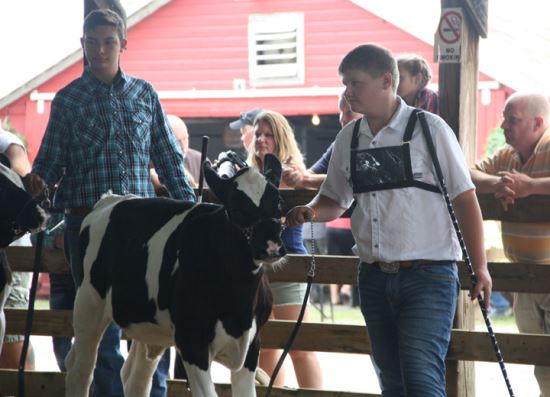
I never really knew what it was all about until watching Wyatt grow through it. Last week marks the seventh year that he has shown a starter calf at the Calhoun County Fair in Marshall, Michigan. Through the years, I have not only watched his progress during competition, but also seen that there is much more to 4-H than this aspect.
4-H is an American thing. It is a club for youth with a primary goal of developing citizenship, leadership, responsibility, and life skills of youths through experimental learning programs and positive youth development approaches. Although it is for all, it is more closely tied to rural youth, with the original purpose of instructing rural youth in improved farming and farm-homemaking practices.
The 4-H concept was “born” in 1902 as a focal point for youth to have hands-on experience in practical matters. The desire was to also make the public schools and educators more connected to rural life.
During this time, the United States Department of Agriculture noted that adults were hesitant to accept new agricultural discoveries and practices, but educators found that youth were more open to experimenting with new ideas and sharing their experiences with adults. Thus, 4-H became a means to introduce new technology to adults.
The official 4-H emblem is a green four-leaf clover with a white “H” on each leaf. Oscar Herman Benson of Wrights County, Iowa is credited with originating this design. He was noted for awarding 3-leaf and 4-leaf clover pennants and pins for students’ agricultural and domestic science exhibits at school fairs. The four H’s represent four personal development areas of focus: head, hands, heart, and health.
These four areas were developed into the official 4-H pledge by Otis E. Hall in 1918 in Kansas. The pledge further exemplifies these four areas:
“I pledge my head to clearer thinking,
My heart to greater loyalty,
My hands to larger service,
And my health to better living,
For my club, my community, my country, and my world.”
Wow — these are words we all would be wise to adopt in our lives.
No matter what a person does in life, each task usually has a particular end goal. It is no different in 4-H. Whether a youth chooses to do projects or livestock, all are judged and awards are presented accordingly.
Judges are the link between the 4-H project, the 4-H member, and the
standard of performance. Although judges have standard rules to use as
guidelines, it is still basically their personal opinion on which is the
best.
Livestock is judged in two different classes: showmanship and market. Showmanship is the ability to show an animal to its best ability. This class does not take into account whether you have a prize-winning animal or not; it is solely about how you present yourself and your animal. This is why preparation for showmanship starts at home weeks prior to the fair. It is pretty evident each year which kids have worked with their animals and which have not when you see how “in tune” kids and their animals are, and which animals walk and behave according to their owner’s commands.
Judges look for three things in showmanship. First, the participant should be clean and wear suitable attire, which includes a button-up or polo shirt, good jeans, boots, and belt. They should also keep their eyes on the judge at all times. Secondly, the animal should be clipped, trimmed, washed, and clean. Thirdly, the animal is judged on how well it responds to the owner and shows itself.
The second part of the judging is market class, where the animal is judged according to the animal breed and industry standards. Again, this starts weeks before the fair, with many variables affecting the animal’s final appearance. Much of this has to do with its weight, how well it is filled out, and its form (straight back, height, etc.)
Of course, this goes back to bloodlines. All livestock is based on ancestry, and most times a “good” animal is the result of good genes. In 4-H, this can be a good or a bad thing. Some parents will literally spend 10,000 dollars or more on one animal so that their child will have the best to show. Of course, the grand champion and reserve grand champion represent the best animals in each class. I would much prefer to see an average specimen chosen for one of these titles, simply because the youth has chosen the right feed and nurturing practices instead of the winner being chosen because of predisposed characteristics.
Although the competition and the ultimate sale of the 4-H animal on sale day are the highlight of fair week, it is about so much more. I wish there were a way to reward the kids for how much character they build through 4-H.
I can see personally how 4-H has helped form Wyatt and his fellow members from children into caring, reliable young men and women. Even though they work together as a club all year, when it comes showtime they are basically competitors, not only with strangers from other clubs, but also with each other. Even so, I have seen Wyatt and the others be the first ones there to help another member in need. That makes them all winners in itself.
Like I said earlier, all of a member’s hard work is culminated in one judge’s opinion. Just being human, some judges are better and fairer than others. This year was a case in point with the judging of the dairy starter calves.
It was evident during showmanship that the judge was partial to girls over boys. Naturally, the boys were disappointed when they had performed just as well as the girls and were not rewarded accordingly, Wyatt included. Even though he surmised that market class would go the same way, he went in the ring prepared to win, not lose. He did not win in the ring, but he did win by learning the important lesson that life is not always fair. You don’t give up, you keep trying. That’s what makes a real winner. Thank you 4-H.
The camaraderie that these kids have is amazing. A group that spends 7 days a week, 24 hours a day together is bound to be close. Because of this, they will do well in any group in life. Wyatt was involved in pee-wee competition this year, helping little tykes to get used to the show ring. He does equally well with tots or 90-year olds. Thank you again, 4-H.
There are 6.5 million 4-H members in the United States, aged 5 to 21, in approximately 90,000 clubs. Their motto is “To make the better best” and their slogan is “Learn to do by doing.” Now, if that isn’t a recipe for life, I don’t know what is.