Identify the presence of lice and how to get rid of lice on chickens to avoid an infestation in your chicken flock.
Lice
Lice come in two varieties: blood-sucking and biting. Blood-sucking lice attack only mammals. Biting lice attack both mammals and birds. Several species infest chickens — more, in fact, than affect any other bird — and a chicken may host more than one species at a time. How badly chickens become louse infested depends in part on their strain; some strains are more resistant than others. Debeaked birds, because they can’t groom properly, are more likely to become seriously infested than chickens with their beaks intact.
An infested bird can be so irritated from being chewed on that it won’t eat or sleep well. Egg production may drop by as much as 15 percent, and fertility may also drop. Chickens become restless, scratching and pecking their own bodies. In the process, feathers are damaged — not a good thing when birds are raised for show. In a serious infestation, especially in chicks, birds die.

Louse infection — technically called pediculosis — often accompanies poor management and is associated with such problems as malnourishment, internal parasites, and a variety of other infections. Whether louse infestation causes these problems, or these other problems make chickens more susceptible to lice, is arguable but entirely academic: poor nutrition, infection, worms, and lice are all undesirable.
Louse Species
Louse species vary in shape and size, ranging in length from 1/25 to 1/4 inch (1 to 6 mm). Most lice are yellow or straw colored, making them difficult to see on white chickens but easier to spot on dark-feathered varieties. Interestingly, northern fowl mites are not compatible with lice, because lice will either eat the mites or starve them by outcompeting them. A chicken with lice is therefore not likely to have mites, which is a good thing because lice are easier to get rid of than mites. All species of lice are wingless and spend their entire lives on the chicken, quickly dying otherwise.
Young lice look like mature lice, only smaller and lighter in color. All species attach their eggs to feathers. Each female louse lays 50 or more eggs, and the life cycle from egg to egg-laying louse is about a month, so you can see how quickly a chicken can become overrun with lice. Each louse species has a preference for feeding on certain parts of a chicken’s body, resulting in descriptive common names such as wing louse, head louse, and fluff louse. Most lice eat feathers, dried skin, and other organic matter on the skin.
The head louse (Cuclotogaster heterographus) is the most serious louse pest of young birds, particularly in such heavily feathered breeds as Polish and Cochin. Mature lice are oblong, gray, and rather large. Females lay one egg at a time, gluing it to down or a feather on the top or back of the head, under the beak, and sometimes on the neck. Head lice spread from a hen to her chicks, causing the little guys to become droopy and weak. Seriously infested chicks may die.
The body louse (Menacanthus stramineus), sometimes called the chicken body louse or yellow body louse, is the most common louse that bothers mature chickens. It is flat, straw colored, and one of the largest of lice. It lives on the skin of less densely feathered areas of the body, such as below the vent and under the wings. In a heavy infestation some lice may move onto the breast, head, or other parts of the chicken’s body. Signs include numerous scabs on the bird’s skin and pearl-colored egg masses at the base of small feathers. In mature chickens egg clusters are typically attached to feathers around the vent; in chicks they might be found on the throat or head. Body lice move fast — when you part a bird’s feathers, take a quick look before the lice scurry into hiding.
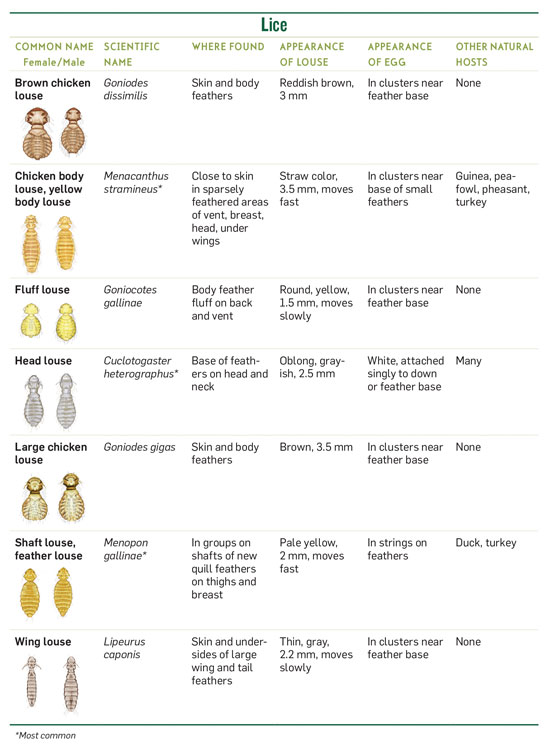
The shaft louse (Menapon gallinae), also called the feather louse, looks like the body louse, only about half the size and paler in color, and spends its time on feather shafts rather than on skin. It does not bother chicks until they are fully feathered. It punctures soft quill feathers near the base to feed on blood, and leaves strings of light-colored eggs on feathers. It likes to rest on feather shafts but scurries toward the bird’s skin when the feathers are parted.
The fluff louse (Goniocotes gallinae) stays mainly on fluff at the bases of feathers on the chicken’s back and vent. It has a pale yellow, nearly circular body and is among the smallest louse that affects chickens. It usually does not occur in large enough numbers to cause a serious problem, although a massive infestation results in feather damage, anemia, restlessness, and reduced laying.
The brown chicken louse (Goniodes dissimilis) is a large, reddish-brown louse that favors a temperate climate. A similar species, the large chicken louse (Goniodes gigas), occurs in more tropical climates. These lice live on both skin and body feathers and can irritate chickens to the point that they injure themselves with incessant scratching and feather pulling. Young chickens in particular may get too restless to eat, causing them to become thin and weak and eventually die.
The wing louse (Lipeurus caponis) favors the undersides of the large feathers on a chicken’s wings and tail. It is a slender (longer than it is wide), gray louse that moves rather slowly when disturbed. Aside from prompting the usual restlessness caused by all lice, the wing louse is not a serious threat to chickens that are otherwise in good health.
Life Cycle
A louse lives for several months, going through its entire life cycle on a bird’s body. It can survive less than a week off the body. The female louse lays her eggs, called nits, on a chicken’s feathers and makes sure they stay there by sticking them down with glue.
Nits hatch in 4 to 7 days. Young lice, called nymphs, are unlike other insects in that they look like adults, only they’re smaller and nearly transparent. They go through several molts and develop color as they grow.
When a louse matures, it mates on the bird and starts laying nits. One female may lay as many as 300 nits in her lifetime. Since lice go through one generation in about 3 weeks, in just a few months one pair explodes into thousands.
Lice usually travel to chickens by way of wild birds or used equipment. They spread by crawling from bird to bird or through contact with infested feathers, especially during a molt.
Taking Action
Lousiness is usually worse in fall and winter. Suspect lice if your chickens are restless and constantly scratch and pick themselves. Look for moving lice on feathers and skin, and for white or grayish egg clusters at the base of feathers. If you see lice on one bird, chances are good the whole flock has them, or soon will. Inspect your birds at least once a month, especially during fall and winter when the concentration of lice is greatest. As soon as you spot lice, treat the entire flock as described under Parasite Control, below. For head lice, insecticidal powder may be combined with Vaseline and rubbed onto each bird’s head and neck.
Repeat any treatment twice at 7-day intervals. Avoiding lice largely involves preventing their introduction. Discourage wild birds from nesting in the coop. Treat newly purchased infested chickens before putting them in with an existing flock. When acquiring used feeders, carriers, or other equipment, thoroughly disinfect them to make sure they are not harboring lice.
Excerpted from The Chicken Health Handbook, 2nd Ed. (c) Gail Damerow. Photograph by (c) Elizabeth Cecil. Illustrations by (c) Bethany Caskey. Used with permission of Storey Publishing.