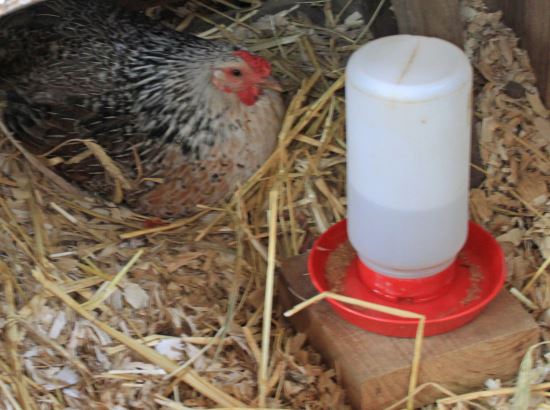
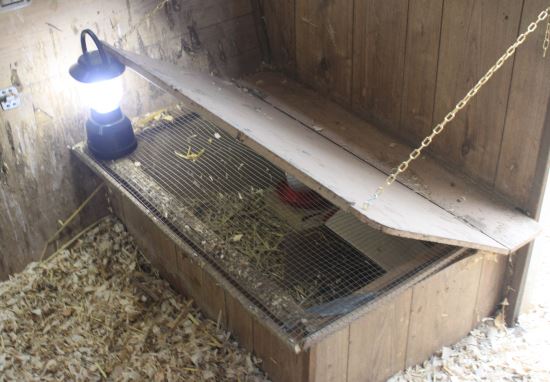
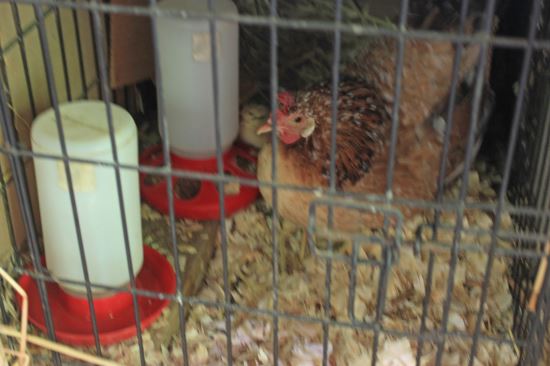
I had written back in April about my frustrations awaiting a truly broody hen to hatch the dozen eggs I had on order. Finally by April 23 I had my broody hen — one who had never shown any indication of broodiness before, and settled right in the first day. Within a week I had my shipment of eggs and by then a second hen had gone broody! So I set six under each hen — one in a nest box I had placed in a cage and one in a pen I had fashioned from a storage space under what had been a bench in my converted camper:
On the third morning, however, Broody #2 was off the nest, letting me know in no uncertain terms that she wanted out of the coop. So I placed her eggs under Broody #1, while Broody #2 enjoyed a normal day outside.
Unfortunately, I overlooked one detail in my reading material on broody hens. It’s considered advisable to switch them to an all-grain feed ration, so that if the hen should poop in the nest it’s less likely to be messy and soil the eggs. Hens eat and drink very little — or sometimes not at all — while they’re broody. They do, however, produce very large and smelly poops every now and then, especially in the early days.
Shortly after setting the eggs I noticed one of these in Broody #1’s pen (not in the nest), and cleaned it out thoroughly, I thought. Still, I kept noticing the odor. On the third evening, when I went to candle the eggs I discovered the reason: there was actually quite a mess in the nest box itself, which had gotten over most of the eggs!
I wasn’t sure at that point if it was okay to clean the eggs, so I went in the house and consulted a book on homestead chickens. I was really looking for information on using an incubator, since I had bought one as a backup and figured the hens were pretty much a lost cause by now. But I found some advice on what to do about dirty eggs. It said you could try cleaning them with a dry abrasive cloth, or if this fails you could wipe them briefly with a damp cloth. But very dirty eggs should not be set, not only because of the bacteria but because if the pores in the shell are clogged the egg can’t “breathe.”
Well, I tried both methods, neither of which worked, so here I was stuck with dirty eggs. Meanwhile, Broody #2 had returned to the nest, so I took all the eggs and set them under her. I still had some questions about the incubator, so I thought it best to stick with a hen.
Next evening I candled the eggs, which hadn’t been done yet. I had never candled before, so I wasn’t sure exactly what to look for. Still, the picture wasn’t encouraging. I found only three that I was pretty sure were viable. One of those had a small break in the shell, and I believed it would be too risky to leave that one in, so I got rid of it. Unfortunately I had also forgotten reading that if you dribble some hot wax on a small crack you can usually repair it. So I probably tossed out a perfectly good egg!
To make a long story short, on hatch day I found two broken eggshells under Broody #2 (who, by the way, had brooded diligently the whole time since I set the eggs!) and two little balls of fluff peeking out from under her. It was hard to get a picture, so you can barely make out one of them in this photo:
When no eggs pipped the second day I finally pitched all the remainder, which turned out to be just as I expected — mostly dead and decomposing, with just a couple that seemed to contain only an egg yolk. My supplier was very supportive when I contacted him for advice throughout the process, and generously offered to replace the eggs at no cost except the shipping. So I now have at least ten apparently viable eggs under a new broody.
As for Broody #1, I kept her on the nest as a backup in case Broody #2 should take off again. After the initial foul-up, which was partly my fault, she turned out to be a very good broody, setting the whole time without complaint. In fact, she was furious when I took away her fake eggs after the hatch!
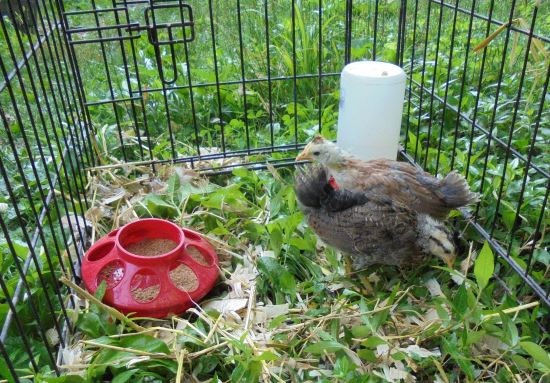
Meanwhile, my first two hatchlings are growing nicely (more on them later). Here they are at about three-and-a-half weeks: