Cold weather can fuel lice outbreaks in livestock, but nontoxic livestock lice treatments can safely keep infestations at bay.
For many of us, our first run-in with lice was as schoolchildren, when an infestation quickly spread among our community and could be stubborn to eliminate. The discovery of a louse or nit on a child’s scalp sent families into a frenzy of fine-tooth-comb-fueled searches and scalp scrubbing with medicated shampoo or olive oil. Those frustrations and concerted efforts to control a lice outbreak in school are similar to what you can face when confronting the tiny insects on your livestock.
The good news for those of us who keep both children and animals is that, although all lice come from the same insect order (Phthiraptera), the families of lice that infest people and animals are different. In other words, if your cows or sheep carry lice, your (human) kids are safe. But with children safely out of the equation, livestock infestations can still be serious, affecting both your animals’ health and your farm’s profit margins. In all types of livestock, lice can cause discomfort, leading to reduced feeding and generally declined conditions, and they can spread disease. In sheep, lice can damage wool, compromising its marketability. Heavy infestations in cows (millions of lice can live on a single animal) can reduce milk production and weight gain, tellingly known as “ill-thrift.” The hog louse, which targets pigs, is a particularly large, bloodsucking creature that can cause profound irritation.
Unlike ticks and flies, which are prevalent in warm weather, lice threaten herds and flocks in cold weather – sunshine and warm temperatures drastically lower their numbers each spring. But during the dark months of the year, an infestation that goes unnoticed or untreated can even inflict death. Understanding how to prevent and treat lice outbreaks – preferably without toxic parasiticides – is essential farm knowledge.
Signs of Lice On Livestock
In livestock, two main families of lice can infest your animals: biting lice and sucking lice. The biting variety feed on skin, while the suckers feed on blood. Biting lice (sometimes referred to as “chewing lice”) have wider, rounded heads that are brown. Sucking lice are generally larger and darker than biting varieties, with black or bluish-black, pointy heads designed to poke into skin.
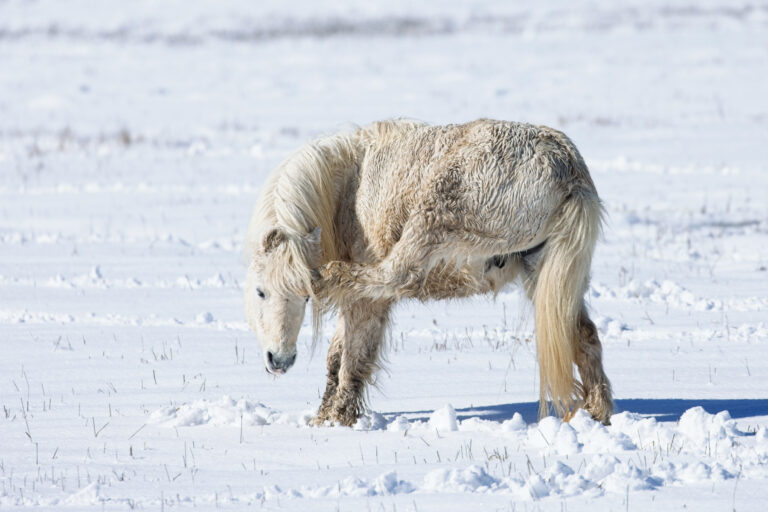
To spot signs of a potential lice infestation, look for livestock that are excessively scratching or rubbing, or that have a reduced appetite, patches of bare fur or wool, or self-inflicted abrasions. If you suspect an infestation, try a trick for identifying lice that employs Scotch tape: Press the tape against the suspected area to catch any eggs and nymphs. You’ll be better able to see them – given they range in size from only 0.7 to 1.5 millimeters long – and identify the species. Using a magnifying glass can help, and when in doubt about the species, take the specimen to your veterinarian.
Both biting and sucking lice are species-specific. The louse on your horse isn’t the same one that’s on your swine, cattle, or poultry. (Goats and sheep can share some species.) In pigs, nymphal lice are normally found on the inside or backs of the pigs’ ears or even in the ear canal, on the legs, or in the skin folds of the neck. Cattle, goats, and horses tend to attract lice to their topline and base of their tails, while sheep can be impacted all over their bodies.

Lice Prevention
Prevention is the best “cure” for lice. Clean housing, well-spaced animals, low humidity, and quality feed that includes essential minerals all help animals avoid infestations or reduce their severity. Grooming or shearing can help remove eggs and lower louse populations. Lice jump from animal to animal, so cramming livestock into tight quarters aggravates infestations. Keeping animals outdoors as much as possible can reduce the likelihood that lice will thrive. When you bring new additions into your herd or flock, consider quarantining the animal for at least two weeks.
If lice numbers are kept low, treatment is often not required – especially during late winter – because lice will disappear in springtime. But when conditions converge to help the little buggers explode in numbers, opt for assertive treatment. Treating lice in animals can be a stressful, time-consuming, and expensive undertaking.
Lice Life Cycle
The life cycle of a louse dictates treatment schedule. After the female lays her nits (eggs) on an animal, the nymphs hatch 7 to 12 days later. Nymphs look like their adult forms and can feed all the same, but they can’t yet produce eggs. They’ll grow into adults in another week or two. Because topical treatments don’t kill the eggs, you’ll need to time treatments, generally two weeks apart, to interrupt the cycle effectively.
Tricky, Toxic Livestock Lice Treatments
You can find numerous dusts, pour-ons, and sprays for killing lice. In addition to their expense, these products can pose health risks to farmers, disqualify animals from organic certification, and require waiting periods before animals can be slaughtered or their milk can be sold. The chief forms of chemical interventions include pyrethroids, avermectins, and organophosphates.
Dewormers, such as ivermectin, also eradicate lice but are disfavored as a treatment because applying them in midwinter when worm counts are low can have the unintended effect of building immunity to the drug, creating a bigger springtime problem. Dewormers are also expensive and can result in the loss of organic certification for the treated animals.
You don’t need to be an organic farmer to avoid chemical applications. A common organophosphate for treating lice is malathion, which some studies suggest causes cancer in humans. The U.S. Environmental Protection Agency’s determination that “suggestive evidence of carcinogenicity [is] not sufficient to assess human carcinogenic potential by all routes of exposure” for malathion isn’t enough to comfort me. When I’m wrestling with a sheep or cow, I can’t avoid exposing my skin to and inhaling these chemicals. Children can be even more vulnerable, and many of these chemicals impact the environment. Malathion, for example, is highly toxic to bees and some fish, and it’s considered moderately toxic to birds.

Lower-Risk Livestock Lice Treatments
Remedies for treating lice infestations exist that not only have lower toxicity but also can be lower-cost and highly effective. For organic producers, nonchemical methods will preserve organic certification. (The U.S. Department of Agriculture provides guidance to organic farmers in U.S. Code § 205.603, “Synthetic substances allowed for use in organic livestock production.”) One of the most common organic treatments is sprinkling food-grade diatomaceous earth – a powdery substance derived from fossilized algae that damages insect exoskeletons – onto the backs of sheep, goats, or cattle and then working it in with a brief rub. Some farmers will add sulfur or a lime-sulfur mix to their powder.
Essential oils provide another option. Peppermint oil is a natural repellent that can serve as a preventive. Tea tree oil is a known antimicrobial. Dilute either with water or a carrier oil and apply them directly to the animal’s back or infected area. In 2025, researchers at the University of Vermont Extension tested the effectiveness of treating lice using mineral oil steeped with lavender, clove, and thyme. They loaded scratching brushes, which cattle routinely rub against, with the oils. On-farm trials proved 97 percent effective for eliminating lice using two treatments spaced two weeks apart.
Keep Calm and Carry On
Over the course of years raising animals, lice can seem unavoidable, but their populations don’t need to grow into a serious problem for your farm. Housing, feed, and stress levels can either contribute to, or prevent, a lice outbreak. Their presence shouldn’t immediately cause panic.
I recommend farmers evaluate whether the threshold of a given infestation has reached one that justifies the costs and labor of treating your animals. Consult a veterinarian who can help you make this determination, identify the specific louse species, and implement an intervention, whether conventional or organic. Brushing out eggs or dusting with diatomaceous earth may be enough to slow an outbreak until the spring grass grows and nature takes its course.
Attorney-turned-farmer John Klar left a career in tax advising and litigation in 1999 to raise dairy animals with his wife on 160 acres in Vermont. He is the author of the book Small Farm Republic.
Originally published in the November/December 2026 issue of Grit magazine and regularly vetted for accuracy.