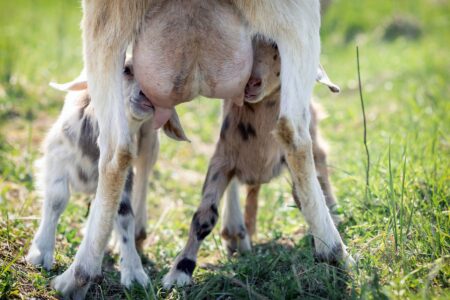
Do you know what to look for when your dairy goat udder is developing? Learn what to look for to know she will have a nice udder for milking.
For those of us that want to have our own milk supply, the thought of milking a goat is a wonderful thing. It’s a nice quiet time for both the goat, as she eats her special grain that helps with the milk supply, and for the one who is milking her. My mind likes to wander as my head rests on the doe’s side and the gurgling of her stomach makes me giggle. But, do we really know what to look for when the doe’s udder is developing as her body is getting ready to deliver her first kid? Will she have a good over all attachment, will she have good teats for hand milking and will they be defined; does the udder look like two large teats? Or will her udder just be some small poochy thing that will fit in one hand. Well, I hope this helps you to learn what to look for.
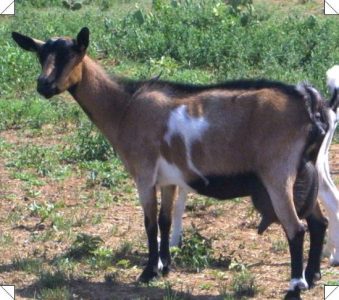
This is La Brie, a 1st generation Mini-Alpine. The apperance of her udder is what I want in my herd. Don’t let this udder fool you though. Her teats are great for hand milking. This photo was taken a day after she arrived so her body is gaunt from the trip. I bought her for her front attachment and the size of her teats for hand milking. Sometimes this gamble pays off as every one of her doe kids and granddaughters has nice hind attachments. She is also a doe that gives a gallon per day. I took a chance with her and it was a good thing. She is now at a farm where her new owner needs the amount she gives to make cheese.
Of course, a doe can’t give milk unless she is pregnant and has a kid first. That is the reason she develops the udder in the first place, to feed her kid. There are those that are called precocious doe’s. This doe will start to produce milk without being bred. I’ve never had one but I’ve heard about them. This is not the doe I am talking about.
Before a doe is bred her teats will be like two little fingers attached to her belly right before her hind legs. Before she is bred, check and see if there are only two of them. Sometimes there is a third that is close to the larger one, this is called a spur. They can be removed at birth very easily. There is also a double teat that has two openings. You don’t what that either. I hope you check this before buying any doe. This is a breeding fault and you don’t want to breed this trait into her offspring. It is hard to milk this teat also.
The best way to tell how an udder will develop is to look at your doe’s mom and her sire’s mom. If you don’t own them, the breeder of your doe most likely has photos or will let you see their udders. This is best when they are “in milk”, meaning they are producing milk. You’ll want to look at both the front and hind attachments. From the back, you want to be able to see how far down the leg the udder is attached, the further down, the better. Some doe’s don’t have any attachment at all. This one, stay away from if you are new to breeding dairy goats. I have had one in my herd but with good reason as I’ll explain when we get to her photo. The front of her udder you want to be a few inches behind her belly, where the umbilical was attached. It’s common for doe’s that are first fresheners to have a sort of cup at the front of their udders. This usually goes away with each delivery but I have seen a few doe’s that never loose it. It has nothing to do with the amount of milk this doe will produce. There was one doe in my herd that was 9 years old and still had this cup and produced just over a gallon per day. This is a wonderful amount for a goat to produce.

This is Hawaii & she has NO udder. This was taken in November of 2012. You can see one teat on the right. This will be her first time to kid.
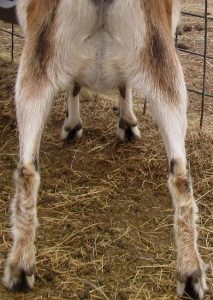
Here is Hawaii getting closer to her due date of Feb. 10, 2013. There is a big difference but with her winter coat you can’t see the real attachment. When I felt it she has a very nice attachment and will most likely be in the milkstand when her kid is weaned. She is from my best bloodlines also. I’m hoping for a buckling from her to keep for breeding. Notice her wide stance, this was a natural photo while she was eating, I did not set her hind hooves apart for this photo. This tells me she will have a nice udder, enough to fill this space in. Her mom, Honolulu, had this stance as well and filled it with her udder.
You’ve waited 5 months for your doe to have her kids. If she is a first time freshener her udder will start about 5 weeks ahead of her due date. I’ve had some start at 8 weeks out so it’s not written in stone. When your doe is 4 weeks from her due date, it’s a good idea to start to feel her udder, or lack of it. This will help when she has to go in the milk stand and you will have your hands on her udder every day. PLEASE, remember that doe’s do not like cold hands and I can’t say I blame them.
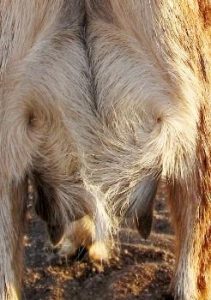
This is an udder just after it was milked. The doe is Aruba, my favorite and the granddam to Hawaii above. This is with her winter coat but where the hair swirls on either side is where her attachment is. A GREAT hind attachment.
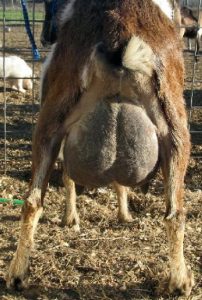
Here is Aruba with her udder and hind legs shaved. You can really see the attachment where the skin folds on either side. This doe has passsed this on to her kids and grandkids as well.
NOTE: shave a full udder, it’s much easier when it is full.
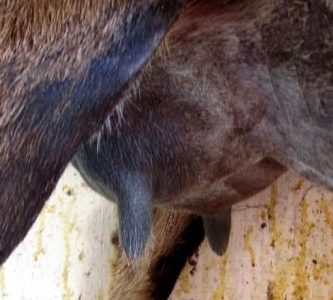 Here we see the udder from the front/side. The only thing I wish Aruba had is longer teats. Selective breeding has put this into her offspring.
As the weeks get closer to delivery of the kid, you should see the udder get a little bigger but not much. In the winter months it is harder to see with all that winter hair on the hind legs. See if that little pouch is attached to the hind legs and how far down the leg it goes.
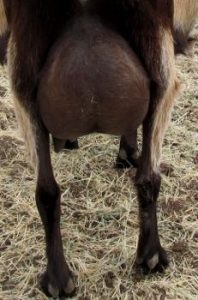
This is BootsRMade4Walkin and she is one that is not hairy in the winter. This photo is of her 2nd freshening this past Dec. 2012, the day before she had twin girls. I don’t like to see the teats below the hock(elbow) as the doe can step on it when she stands up and it will cause problems. If you have a first freshener (a doe that is going to have kids for the first time) please remember that with every freshening her udder will get a little bigger. By the time she has had kids for 5 years, it will be what it will be, again this is not written in stone. I don’t like to see the teats below the hock(elbow) as the doe can step on it when she stands up and it will cause problems. Enjoy the pictures.
Suzy Minck owns Milk Maid Ranch in Texas.