Every businessperson wants to make a profit, but profit margins are often small for livestock raisers. Nevertheless, raising grass-fed beef offers opportunities for livestock producers to succeed.
Because regenerative grazing is based on working with – not against – natural systems, you can start raising grass-fed beef with minimal capital. A farmer or rancher can keep production costs low by fostering biological activity to improve the soil’s health. Profit can come from the health and productivity of the fields and the cattle. Producers will know they’re on track for profitability when the organic matter in their soil increases, their paddocks support more cattle, and those cattle are healthy.
If you can afford to purchase land, build a barn, and buy a tractor and haying equipment – and you want to own these things – then go ahead and buy them. But you don’t need to own any of them to raise grass-fed beef.

Lay of the Land
You’ll need pasture for grazing, but you don’t have to buy it. Pastureland might be available in your community to rent with a low-cost or free lease.
Conservation land. A great deal of acreage is owned by conservation groups, states, and other public entities. Sometimes, these land stewards find that after grassland has been saved from development, the effort to keep it from becoming overgrown is a maintenance headache. Getting a long-term lease to graze conservation land requires discussions with decision-makers about their expectations for how the property will look. They need to understand that healthy, diverse grassland might include a diversity of “weeds.” And tall grass that’s perfect for grazing might look like hay gone to waste. Be proactive: Provide the community with information about the importance of letting the grass grow high and the roots grow deep so soil life can perform its functions.
Leasing from homeowners. Some homeowners might also have unrealistic expectations of how a pasture looks before and after grazing. When you make an agreement, let the landowners know the pasture will be managed to ensure its long-term health and good nutrition for the cattle – and what that management will look like.
Dairy land. Because the price of milk remains low while the costs of production have risen, many dairy farmers are looking for other ways to earn income from their land. Some are willing to rent pastures for grazing.

Animals and Infrastructure
With grass-fed beef, the need for permanent fencing is minimal. You’ll need a sturdy perimeter fence to keep your animals off the road and off the neighbor’s farm, but interior fencing can be temporary; for example, a single electrified wire. With regenerative grazing, the fence is more to designate a new area for grazing than to confine animals. If cattle always have grass in front of them or are comfortably full, they won’t put pressure on the fence. Cattle will flourish when given good grass and plenty of water.
Barns tend to accumulate manure and urine, concentrating the nutrients on an impervious floor, which leads to runoff and groundwater pollution. Beef cattle have no need of a barn and are healthier outside where the sun shines. You do need to provide a sheltered spot where they can get out of the wind.
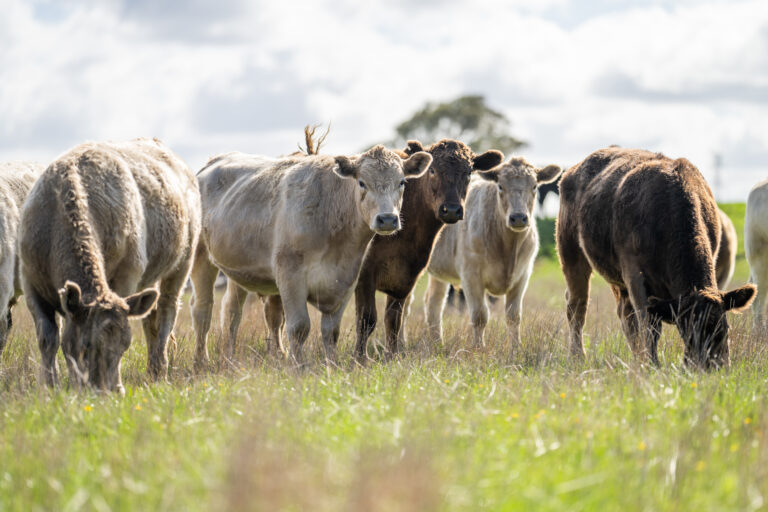
Commercial success with grass-fed beef depends in large part on cattle that are genetically suited to be raised and fattened on pasture without grain, notably one of the following breeds: Angus, Red Angus, Hereford, Devon, British White, Shorthorn, Belted Galloway, White Park, and Murray Grey. Cattle from one of these breeds with the appropriate body conformation can finish (that is, be fat enough for slaughter) at 18 to 20 months of age.

Within your chosen breed, look for animals of moderate height (about 48 inches) with wide, deep bodies; their legs will appear short. We aim for a ratio of about 60% depth of body to total height. The deep body allows space for a big rumen, and grass-fed cattle get all their energy by processing a great volume of grass and other pasture plants in their rumens. Another plus for a deep body is you’ll get a lot of high-value meat.
Most conventional dairy cattle lack the capacity to maintain their body condition while they produce milk, unless they’re in some kind of shelter. But our rugged grass-fed cows, with their heat-generating rumens, insulating blankets of fat, and warm hair coats that retain body heat, are perfectly content to lie down in a snowy field on a 10-degree-Fahrenheit night. They get up in the morning, shake off the snow, and carry on with their day.
Check out this breed profile on Celtic White Park cattle!

Equipment and Materials
Enumerate the specific tasks throughout the year that call for a tractor and consider whether those jobs justify the considerable expense of buying, maintaining, and running one. It may be more economical for you to rent a neighbor’s machine or to hire the neighbor to spread bales around the farm before winter weather sets in. Likewise, do the math on your hay costs. Where we live, our costs are about $50 a bale to buy hay and $40 a bale to make hay when you factor in fuel, equipment, depreciation, and labor.
Consider the results of a study of 10 livestock operations in four southeastern states comparing adaptive multi-paddock grazing with conventional grazing. The regenerative approach increased the biomass generated per acre threefold, and the regeneratively managed acres were able to carry more livestock. Even with the higher stocking rate, these operations had better water infiltration, more plant diversity, and higher soil carbon levels than conventional neighboring operations with continuous grazing. More livestock means more income.
What if you sold your haymaking equipment, grazed cattle regeneratively on land that was previously hayed, reaped the benefits of increased forage in your pastures – including raising more animals on the same land base – and focused on extending the grazing season? You wouldn’t need to buy much hay.
Making Pasture More Profitable
Two proven techniques for getting more from your pastures are planting cover crops for extending the grazing season at both ends, and planning ahead for winter grazing.
Cover crops are a valuable and inexpensive way to feed grass-fed beef cattle. Cover crops can augment your grazing by emerging before the perennial sward, thereby starting the grazing season earlier; by enhancing the usual summer slump of perennials suffering from heat and lack of rain; and by extending high-energy grazing into the typical non-growing season. (“High-energy” refers to the energy at the tops of the plants, not the energy of the cattle!)

A “cocktail cover crop” is a mix of eight or more plant species that can work well on a finishing farm, especially to convert idle or misused land back into vibrant perennial grassland.
Over time, the use of cover crops can reduce or eliminate the need for fertilizers and herbicides, along with their expense. Of course, costs are associated with planting a cover crop. A cost-benefit analysis is necessary to determine which annuals to plant and the timing of the planting to synchronize with the perennials already in your pastures. Chicory and some other species are particularly high in energy. Some choices, such as rye, start growing early in spring (if fall-planted) and create a highly nutritious early bite to jump-start grazing while waiting for perennials.
Another consideration is the improved daily weight gain from the cover crop. A high rate of gain is key to finishing cattle in the early months of the non-growing season before their second winter, because cattle gaining less weight will take two years or more to be finished, which means a second winter of using stored feed. Therefore, the addition of a cover crop to extend high-energy grazing into December and January can significantly decrease production costs.
Winter Grazing, aka Stockpiling
One strategy for extending the grazing season for cows and calves is to stockpile grass for winter by letting an area remain uncut and rooted in the ground. It’ll be dry and brown and perhaps covered with snow, but cow-calf pairs will love it.
We undertook a trial of this method by selecting 20 acres of pasture that we stopped grazing in July. Because we’d received a Sustainable Agriculture Research and Education (SARE) grant to do this study, we followed a protocol to test the nutritive value of stockpile. To create a baseline, we took forage samples in July and sent them to a lab for evaluation of the typical measures of feedstuff quality, such as the total digestible nutrients and relative feed value.
We brought the cattle back into the stockpiled area to begin grazing in December, and we used a single-wire electric fence to portion off just enough for them to eat each day through December, January, and February. We also took photos and forage samples for each of those months at six designated locations, sent the samples to the lab, and plotted the nutrition values on a graph. The value we measured declined slightly through winter, as expected, but when we compared the sample values with the values of control hay and baleage, we learned the nutritive values of grass in our stockpile were higher. The cost savings for every day you can feed stockpile are considerable and could be the difference between breaking even or making a profit.
The Devon Is in the Details
Profitability with grass-fed beef depends on the details: how you care for your animals, how you manage their breeding, and how you address their nutrition needs throughout their lives. The following management issues affect the bottom line but are often ignored.
We recommend moderately sized British breeds for grass-fed beef production, because of their early maturity and ability to fatten on grass and forage. These breeds will bring you more pounds, which means more income.

Let’s say you have 75 acres of pasture, and on average you produce 3 tons of forage per acre. The same is true for your neighbor. Cows need approximately 3% of their body weight per day to maintain their condition and raise a calf. So, whereas your neighbor’s 1,600-pound Simmental cow will need 48 pounds of dry matter per day, your 1,200-pound Devon cow will only need about 36 pounds. Since your tonnage is 3 tons (6,000 pounds) per acre times 75 acres (450,000 pounds), you can support 34 of your moderate-sized cows on your spread, whereas your neighbor can only support 25 large cows. Each of those cows will produce a calf every year. Your cows will produce 34 calves, while your neighbor’s will produce only 25. Because you have a moderate-sized breed, your herd will yield more salable pounds than your neighbor’s larger cattle on the same-sized land base.
Allowing your cattle to mature will also improve profitability. Bulls need a fair amount of energy from forage to maintain their body condition and to breed cows. To ensure longevity of the breeding stock, we recommend allowing bulls to grow to close to their mature size and weight (2 years and 3 months) before putting them to work breeding.
Farmers expect heifers to produce a calf every year. When cows fail to conceive the year after having their first calf, they’re usually culled from the herd – an investment loss. We believe the reason 15% of heifers fail to breed back is because they’re bred when they’re too young to begin their reproductive lives. A heifer should be 3 years old before she has her first calf, which means breeding her at 2 years, 3 months. If you have the right breed and let your females fully develop before carrying a calf, your cows may have nine calves each in their lifetimes, paying back your investment handsomely.
Conventional producers often wean spring calves at 5 or 6 months, because some mothers can’t support their own condition plus feed a calf in winter. Not only is weaning this early stressful for both mother and calf, but there’s also a physiological issue: The calves experience a drop in growth as their gut flora switch from grass and mother’s milk to hay or baleage. You can eliminate these problems by leaving the calf with the mother. A rugged breed of cow with the conformation that correlates to success on a grass and forage program will have no problem nursing her calf for 10 or 11 months. By doing this, you can also expect 15% more growth in the calf over winter. The calf will have fattened by the end of the year – a financial boon.
Rewards of Separate Finishing
Conventional producers often ignore the rewards of separating cow-calf production and finishing into two operations. Cows need only enough energy for maintenance and nursing a calf, whereas finishing cattle (feeders) need a lot more. So, if the herd is grazed as one unit, the feeders are held back by the cow-calf pairs and don’t get the nutrition they need to fatten. But on the finishing farm with multiple moves per day, the rate of gain increases dramatically, leading to a shorter and more profitable finishing period.
Let’s look at the numbers. A 750-pound yearling needs another 500 pounds to reach market weight of 1,250 pounds. He gains 2.5 pounds per day on energy-rich grass, so he’ll need an additional 200 days, or 6.5 months, to add those 500 pounds. Because he was 12 months when he started, the additional 6.5 months will get him finished at 18 to 19 months. At a slightly slower rate of gain, he’d finish in 19 to 20 months. This scenario is achievable with a cocktail cover crop delivering a 3-pound-per-day gain.
Calves born in May can be sent to slaughter before the second winter, provided they’ve had a good rate of gain and are sufficiently fat for the marketplace. Harvest at 18 months would be in November. If the calf is to be harvested at 20 months (in January), the animal will need stored feed at the end of its life, unless there’s a cover crop in the rotation for the late fall months. Positive economics of finishing are partly about the size of the herd being finished. The more cattle in the finishing herd, the lower the cost of labor to move them.
If you have good cattle for grass-fed beef and are grazing regeneratively and following a protocol for the care of your animals and your soil, you can build on that strong foundation. Each year, document what you’ve done differently and the difference it made. The financial future of your farm could look brighter soon.
Ridge Shinn and Lynne Pledger operate Big Picture Beef, a company partnering with farmers to increase access to wholesale markets while promoting holistic grazing. This is an adapted excerpt from their book Grass-Fed Beef for a Post-Pandemic World (Chelsea Green Publishing), available on Page 57.