An egg-bound hen could die if she isn’t able to lay within 48 hours. Learn about egg-bound chicken treatment so that you can take swift action if needed.
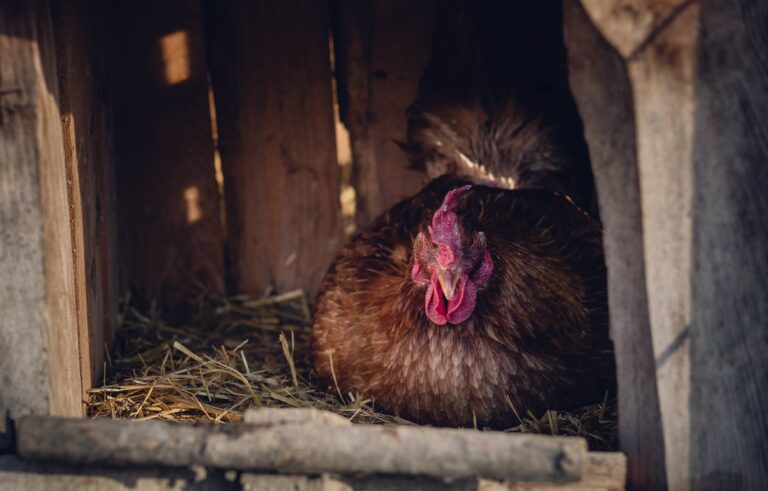
Imagine one of your hens is acting funny. She is fluffed up, her eyes are closed and she is lethargic. You notice her sitting on the ground and maybe dragging her wings. Her tail is down and most likely she is straining or pumping her backside. Upon closer examination you notice that liquid is dripping from her vent and you may feel an egg-shaped lump. All signs of an egg bound hen.
Considering the process that a chicken goes through nearly every day to lay a perfect egg, it’s no wonder that things go wrong sometimes. Fortunately, being egg bound is not all that common, and there’s a good chance you may never have a hen suffer from it, but it’s still good to know the signs and how to treat it.
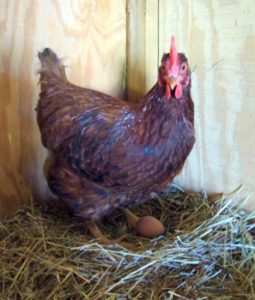
An egg bound hen literally has an egg stuck in her oviduct. It is most common in young chickens. It could be due to a large or double yolked egg that is too large to pass through, genetics or a calcium deficiency. Calcium is needed for proper muscle contraction. Too much protein in a hen’s diet can also cause egg binding. Other potential causes are internal worms, low quality feed, dehydration or weakness from a recent illness.
You want to handle your egg bound chicken carefully to avoid breaking the egg inside her, which can lead to infection and possible death. Peritonitis is caused by egg material stuck inside the hen and must be treated immediately with an antibiotic, such as Baytril, and probiotic powder to build up her good bacteria.
Even if the egg is not broken, the condition must be treated quickly. An egg bound hen will die if she is not able to pass the egg within 48 hours, so once you have made your diagnosis, treatment should start immediately.
Egg Bound Chicken Treatment
The easiest thing to do is to carefully bring the hen into the house and soak her in a plastic tub in your bathtub.
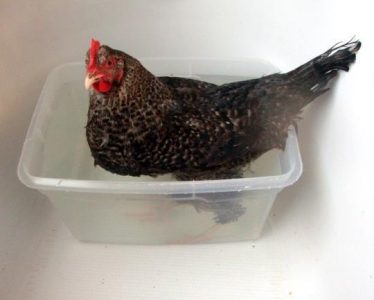
Submerge her lower body and vent in warm water with some Epsom salts for about 20 minutes, then gently towel dry her.
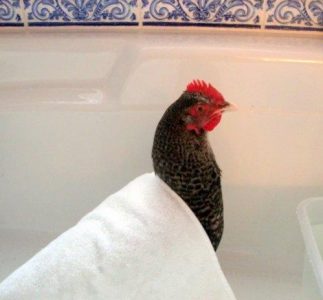
If it’s winter or there’s any draft, dry her off with a hair dryer set on low heat.
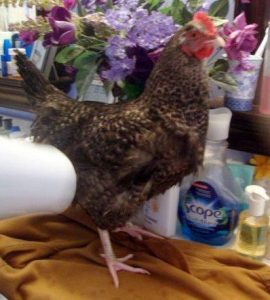
Then rub some vegetable oil around her vent and very gently massage her abdomen. Put her in quiet, dark location in a large crate or cage. A dog crate or bird cage with a towel or blanket draped over it, a towel that has been warmed in the dryer on the bottom, and set over a pan of hot water (or with a heating pad under the towel) with a heat lamp is perfect. You want to create moist heat.
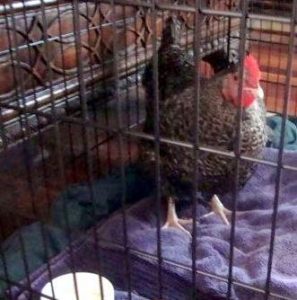
Give her some Nutri-Drench and 1cc of liquid calcium. Then give her some time to herself. Repeat the soak in the tub every hour or so until she lays her egg.
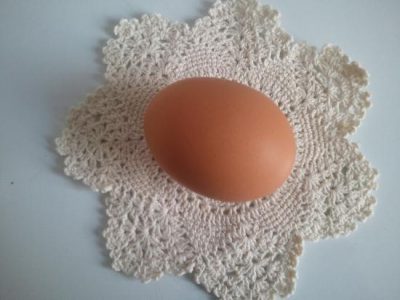
As a last resort, a visit to a vet is recommended or, if you can see the egg, you can carefully extract the contents of the egg using a syringe and then gently crush the shell, keeping the fragments attached to the membrane and remove it using vegetable oil squirted in and around the vent. Antiobiotics is recommended in that case to be on the safe side.
Hopefully this is not a condition you will ever encounter, but if you do, at least you will be prepared.