


Early spring is a great time to feed our bees. We had a warm day last Sunday and we took advantage of the weather to check our hive and make sure the bees made it through the winter. We were out and about that day boiling down our maple sap into syrup and saw one or two bees foraging around the yard. We knew if they were active enough to fly away from the hive that it would be safe to open the hive without lowering the temperature too much.
Bees keep the hive a constant temperature throughout the winter by clustering around the queen and using combined body heat to keep things warm.
Early spring is a good time to feed our bees because their honey stores are at an all time low. And while the bees are active, flowers are in short supply this time of year. Supplementing their food is a good way to ensure that they will make it until the first blooms appear.
There are many ways to feed bees. When we first started our hive we fed the bees a simple syrup of sugar and water fed through an inverted mason jar feeder that attaches through the front of the hive opening. We did this through their first spring and well into summer until we noticed that the jar was no longer being drained. This meant that our new colony was making enough honey to support themselves without our help.
This type of feeding is only useful if the temperatures are above freezing.
Some people feed their bees all winter by adding an empty box to the top of the hive and supplying simple syrup in a chick waterer.
We chose not to do this because we would have to fill the container periodically and in our climate, this would lower the temperature of the hive each time we had to open it. Not only that, but the bees would have to work extra hard to keep the temperature of the empty box warm as well.
Instead, we chose not to collect the honey from the harvesting super last fall because we wanted to ensure that the bees would make it through the winter. So we sacrificed our harvest to ensure the bees would have a great first year.
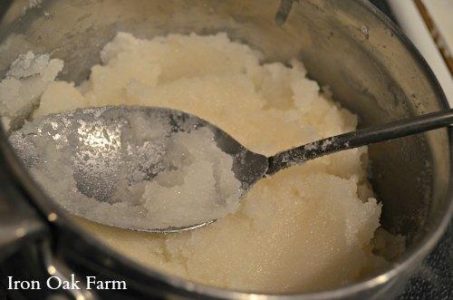
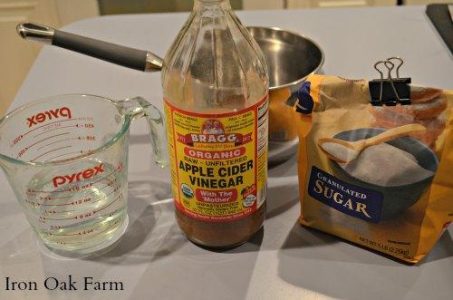
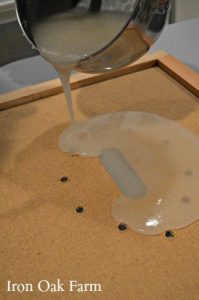
To feed our bees we made a candy of sorts made from granulated sugar, water and apple cider vinegar.
The vinegar helps support immune system.
- 4 cups granulated sugar
- 1 cup water
- 1 Tbsp apple cider vinegar
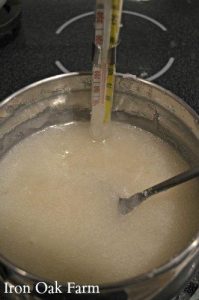
We boiled it on the stove until the sugar dissolved and continued boiling until soft ball stage or 240 degrees on a candy thermometer.
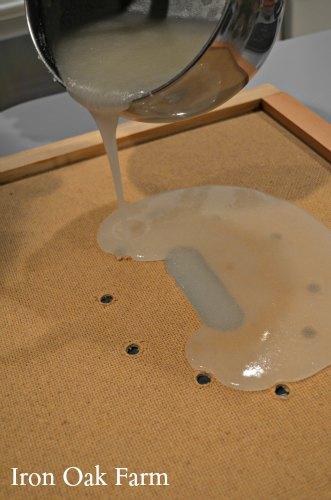
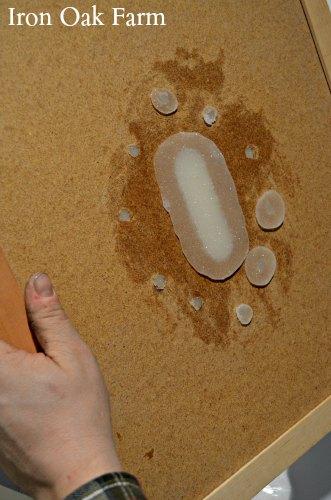
We had an extra masonite inner cover for our hive so we drilled holes in it.
We placed a sheet of wax paper underneath so the sugar wouldn’t run everywhere.
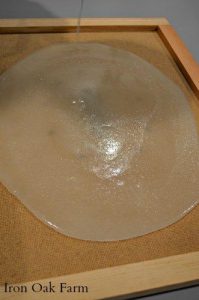
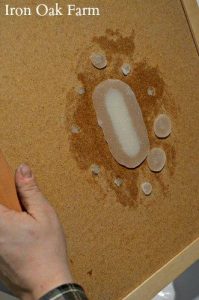
Then poured the hot candy over the board so some would run through the holes. The bees will eat their way through these holes to the large puddle of hardened sugar.
Once cooled, the candy hardens and stays in place.
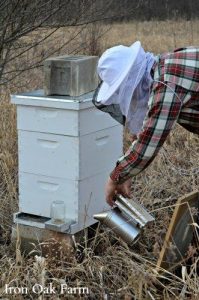
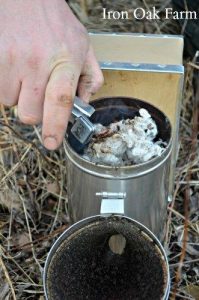
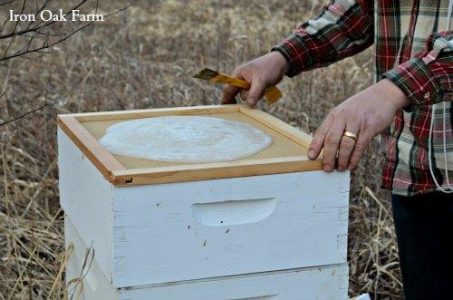
To add this to our hive we suited up, lit our smoker and removed the top. We could see the bees coming and going and hear them buzzing strongly inside.
We added this board to the top of the hive. It was easy and quick with minimal stress to the bees.
To learn more about our bees and other animals on our farm visit Iron Oak Farm.