Imagine a fruit as tropical and exotic as the banana that’s hardy in northern zones and as naturally pest resistant as it is delicious and nutritious. You may think awhile and conclude that this fruit simply doesn’t exist, but at my family’s Magicland Farm we grow many types and varieties of fruits and vegetables, and our homegrown banana-like pawpaws are among the most popular. We don’t grow the pawpaws in greenhouses or solariums. Rather, they are grown outside, and while their DNA is composed of genes that evolved in the tropics, pawpaw trees survive with ease in temperatures that drop below zero.
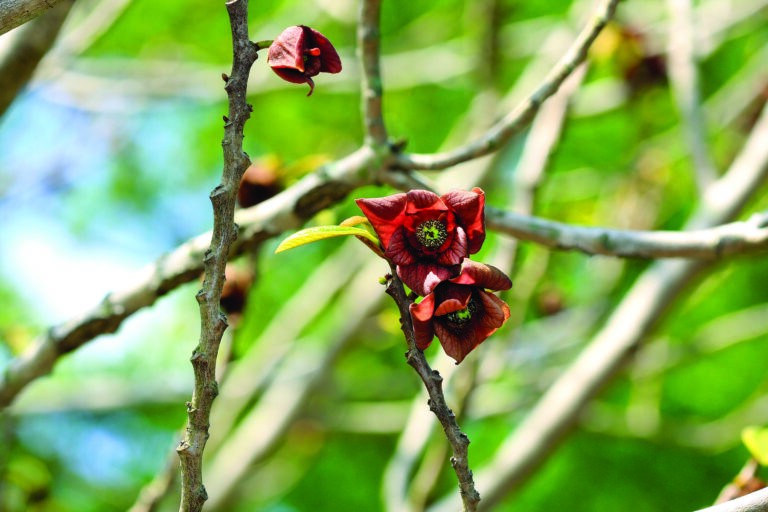
The pawpaw (Asimina triloba) belongs to the tropical custard apple family, which includes delights such as sweetsop, soursop, cherimoya and, of course, the custard apple, which is the botanical family’s namesake. Pawpaws are also locally known as Michigan Bananas, Hoosier Bananas, and Insert-state-where-they-are-native Bananas because their flavor, and in some ways their texture, is reminiscent of the grocery store variety banana.

Germinating an interest
Many years ago, I read Euell Gibbons’ book, Stalking the Wild Asparagus, and when I got to the chapter on papaws (Gibbons’ spelling), I felt tingles travel from my toes to my neck. What I read indicated that the pawpaw tree was unusual, it bore delicious fruit that wasn’t bothered by bugs or disease, and – perhaps most intriguing of all – it was really a tropical tree that somehow wound up with enough toughness to grow wild in northern states.
After learning that the pawpaw was native to Michigan (and the range from northern Florida to southern Ontario, and as far west as eastern Nebraska to east Texas), I kept an eye out for it every time I took a walk or drove through a forested area. I looked for years without success. Then one warm mid-October day, when my dad and I were hiking along the banks of Michigan’s Muskegon River looking for a good place to fish, I unknowingly walked right into the middle of a thicket of pawpaw trees. That was truly an exciting day.
The next day, thoughts of fishing faded from my mind, but I still headed back to the river. This time with a camera and (yes, I confess) a shovel. I used a roll of film on the pawpaw trees, and then calmly dug up an 18-inch-high root sucker from the big pawpaw patch. My only excuse is that I was young and naïve.
After moving that bootlegged pawpaw around a bit (and no, it wasn’t to avoid the law), I finally gave it a permanent home at our Magicland Farms. That now-33-foot-tall tree has plenty of company, including some grafted named varieties, and in my opinion it produces fruit of the highest quality. I’ve since named the variety “Newaygo” because the parent tree was located within the city limits of Newaygo, Michigan.
Pawpaw farming
When I started planting pawpaws on my farm, I thought that someday I might sell pawpaws at a farm market. At the time, few had heard of pawpaws, so I felt it would be a good challenge to my sales talents. I was wrong. It turned out to be more of a challenge to my patience. The demand for my pawpaws quickly exceeded supply, and I’ve been trying to catch up ever since.

People like pawpaws
Pawpaws are highly nourishing, and many folks find the fruit to be delicious. The yellowish flesh of a perfectly ripened pawpaw is reminiscent of a sweet homemade pudding with natural banana flavor, a bit of pineapple juice, and a pinch of vanilla extract thrown into the mix. Some claim they also detect a hint of mango. In fact, one variety of pawpaw was given the name “Mango.” While most pawpaws have a yellowish flesh, sometimes you will come across a variety with white flesh. In my opinion, the yellowish flesh varieties are sweeter and more flavorful than the white-fleshed types.
An unripe pawpaw is usually dark green, turning lighter green or yellowish-green as it ripens, and then turning brown or even black as it softens. I’ve read books, articles and internet blogs that mention waiting for pawpaw fruit to turn an unappetizing black, with its flesh a pudding-like consistency, before eating. I like pawpaws best when about 5 percent to 15 percent of their skin has turned from a light greenish-yellow to a light brown and their flesh retains a bit of firmness. I also use my sense of smell to determine ripeness. If a warm pawpaw doesn’t have a distinctive odor when held close to the nose, it probably isn’t ripe. And like most fruit, pawpaws are best picked when ripe. In Michigan, pawpaws ripen from mid-September through mid-October. If they are picked in August, they aren’t at all tasty, no matter how long they sit in a fruit bowl.

Prediction of a pawpaw-filled future
I believe the pawpaw will become one of the most popular native fruits to be commercially grown in the United States, and that it will someday approach the popularity of the blueberry – another native fruit that at the beginning of the 20th century was only harvested from the wild. Also, I truly believe that currently the pawpaw is the best native fruit tree to plant in home gardens throughout much of this country because it has great taste, is especially rich in many minerals (magnesium, zinc, iron, copper, manganese), and has amino acids that are hard to find in other fruit. It is also an attractive, clean tree with large, tropical-looking leaves that turn a gorgeous pure-yellow in the fall. A really big benefit for the home garden is that pawpaws don’t require the use of pesticides to obtain nearly perfect fruit.
Personally, I have only two regrets regarding my pawpaw plantings. The first regret goes back many years to when I dug up that tiny root sprout without permission. The second regret is even greater: I should have started planting pawpaw trees sooner than I did!
For more information on pawpaws, including several recipes, visit Kentucky State University’s informative website on pawpaws at www.Pawpaw.KYSU.edu.
Tom Fox owns and operates Magicland Farms near Fremont, Michigan, with his family. When the farm closes in late fall, Tom turns his attention to writing on a variety of topics and designing useful, intriguing electronic gadgets.