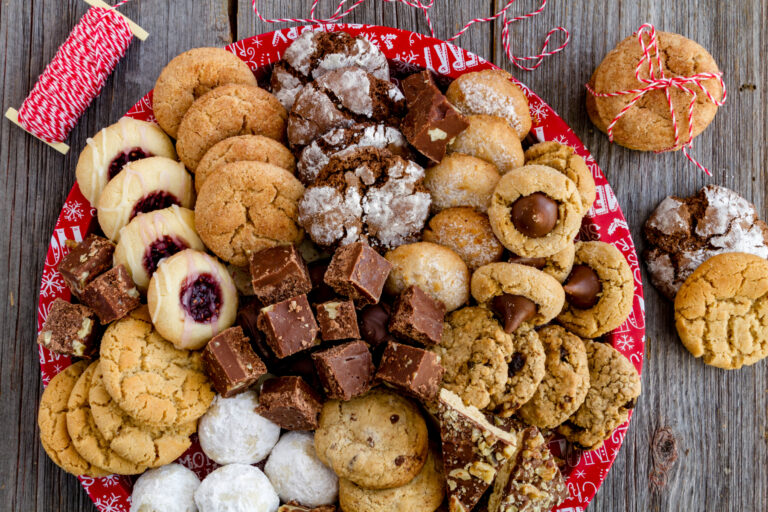
Candy making carries a mystique that many folks find intimidating, but there is simply nothing that satisfies a holiday craving like candy recipes and homemade sweets. We’ve all heard tales of fudge that wouldn’t set or brittle that just would not break, but with a bit of care and a little understanding, comforting confection is easy to achieve. Employ these few practical suggestions, and you can make holiday treats to share with family and friends this season or any day. Who knows? Your candy may become a family tradition.
My grandmother’s specialty was divinity, or sea foam candy. She made it often, choosing days carefully after consulting the weather report. If it rained, her candy making was postponed. If it was dry and clear, out came the old candy pot, spoon and sugar canister.
My mother’s specialty is fudge. Chocolate, peanut butter, white fudge studded with red cherries and, her favorite, pineapple. She has a special fudge platter from her high school days. Yellow roses rim the large, deep dish that came from redeeming Octogon Bar Soap wrappers.
I am partial to fudge, too. We are always looking for new and unique flavors. The vote is still out on the carrot and prune fudges we recently tried. Through practice and advice from others, I’ve found candy making easy when three basic tips are followed.
1. Understanding candy temperatures is key to candy success. Each level of heat is called a stage. The following basic stages describe what to look for while cooking sugar syrup.
- SoftBall: 234 to 240 degrees. If a spoonful of syrup is dropped in a cup of cold water, it will quickly form a soft ball that loses its shape as soon as removed from the water. Most fudges and fondants are cooked to this stage.
- Firm Ball: 245 to 250 degrees. This syrup will form a firm but pliable ball in cold water. It will hold its shape momentarily out of water. Most divinity and caramels are cooked to this stage.
- Hard Ball: 255 to 265 degrees. This syrup forms a hard ball, will not lose its shape and can be rolled around on a platter. Most taffy is cooked to this stage.
- Soft or Light Crack: 270 to 280 degrees. This syrup forms brittle threads in cold water that melt when taken from the water. Most butterscotch is cooked to this stage.
- HardCrack: 285 to 300 degrees. This syrup forms brittle threads in cold water that stay brittle out of water. Most brittle candies such as peanut brittle are cooked to this stage.
You can test the syrup in two ways. A candy thermometer, which costs $10 to $30, can be purchased at hardware, kitchen stores and large discount stores. It is the most reliable.
You also can use the old-fashioned cold water method. You’ll need a cup of cold water ready as you are cooking the syrup. As soon as the syrup has boiled at least 5 minutes, drop a teaspoonful of syrup into the cup of water. It should sink to the bottom. Use your finger to see if it holds shape, cracks, dissolves or spreads. If you are a novice at candy making, you should remove the pan from the heat so as not to scorch the syrup while testing it. Be careful not to get hot syrup on your skin.
2. Controlling sugar crystallization is another key to success. Only a few candies, such as fondant, take advantage of some crystallization. Most candies depend on a smooth syrup. Keeping sugar crystals from forming on the insides of the pan is accomplished as follows.
- Grease the pan, including sides, with a little butter or margarine before putting in the ingredients.
- Brush down any crystals that form with a pastry brush dipped in hot water. This can be done more than once during cooking.
- Pour the finished syrup onto the work surface (or platter) without scraping the pan to ensure that any crystals formed in the bottom of the pan do not get into the final product. This leaves the pan to be scraped and enjoyed by your helpers.
3. Having all ingredients and utensils ready is the best way to ensure a smooth candy-making day. A heavy saucepan with a flat bottom and straight tall sides is recommended to keep the syrup from boiling over or scorching. A heavy wooden spoon should be used to stir because it does not heat rapidly like metal. Shallow pans or platters that can be buttered are best for holding fudge. Wax paper is used for dipped candies. Many candy makers have a marble slab that draws out heat and offers a great work surface.
Divinity Recipe

- 3 cups granulated sugar
- 1/2 cup water
- 1/2 cup light corn syrup
- 1/8 teaspoon salt
- 3 egg whites
- 1 teaspoon vanilla
- 1 cup chopped nuts, optional
- In heavy pan, combine sugar, water, corn syrup and salt. Place over medium heat. Stir until sugar is dissolved. Boil mixture without stirring to 265 degrees on candy thermometer or just below soft crack stage.
- In large mixing bowl, using electric mixer, beat egg whites until stiff. Carefully, pour hot syrup over egg whites, beating constantly. Add vanilla. Beat until mixture loses gloss. Stir in nuts. Drop by teaspoonful onto waxed paper. Cool completely. Yields about 2 dozen candies.
Pineapple Fudge Recipe

- 3 cups granulated sugar
- 1 tablespoon light corn syrup
- 1/2 cup drained, crushed pineapple
- 1/2 cup heavy cream
- 2 tablespoons butter
- 1/2 teaspoon vanilla
- 1 cup coarsely chopped walnuts
- In well-buttered, heavy pan, combine sugar, syrup, pineapple and cream. Bring to boil over low heat, stirring constantly. Continue cooking, stirring occasionally until candy reaches 236 to 238 degrees on candy thermometer or the soft ball stage.
- Remove from heat. Add butter. Do not stir. Cool until saucepan feels lukewarm. You can either let the pan sit or place it in a sink with 1 inch cool water to speed the cooling process.
- Add vanilla. Beat until candy begins to thicken. Fold in nuts.
- Pour into buttered, 8-inch square or round pan. As candy firms up, it will have glossy look and become creamy. Cut into small squares. Store in cool, dry place. Yields about 60 small pieces.
Toasted Pecan Cream Fudge Recipe

- 2 cups pecan pieces
- 1 box (16 ounces) confectioner’s sugar
- 1/4 cup baking cocoa
- 1 package (8 ounces) cream cheese
- 1 teaspoon vanilla
- 1 cup chopped nuts, optional
- Heat oven to 350 degrees. Place nuts on rimmed cookie sheet in single layer. Bake for 5 to 8 minutes until toasted. Remove from oven and cool completely. Butter 9-inch pie plate and set aside.
- Sift together sugar and cocoa. Set aside.
- Place cheese in top of double boiler. You can make a double boiler by placing a saucepan inside a larger pan with 1 to 2 inches of water. Bring water to boil in bottom pan. Stir cheese until completely melted but not bubbly. (Do not let cheese cook.) Remove pan from heat.
- Stir sugar/cocoa gradually into cheese. Add vanilla and nuts.
- Transfer fudge to buttered pie plate. Let cool completely. Cut into bite-size pieces. Store candy tightly covered in refrigerator. Yields 2 to 3 dozen pieces.
French Fudge Recipe

Children can make this in no time.
- 1 package (12 ounces) semisweet chocolate chips
- 1 can (14 ounces) sweetened condensed milk
- 1/4 teaspoon salt
- 1 teaspoon vanilla
- 1/2 cup chopped walnuts or pecans, optional
- Line 9- or 10-inch square pan with wax paper. Set aside.
- In large, microwave-safe bowl, place chocolate chips, milk and salt. Microwave on medium for 1 minute. Stir mixture. If chips are not completely melted, cook for 1 more minute.
- Remove bowl from microwave and set on towel or hot pad. Stir in vanilla and nuts. Pour fudge into prepared pan. Use butter knife to smooth top. Chill in refrigerator until fudge is firm.
- Turn pan upside down over cookie sheet or cutting surface. Remove wax paper. Cut into squares. Yields about 2 1/2 dozen pieces, depending on size.
Chocolate-Walnut Fudge Recipe
- 1/4 pound butter
- 4-1/2 cups sugar
- 1 cup evaporated milk
- 2 cups marshmallow crème
- 3 packages (6 ounces each) chocolate chips
- 1 cup chopped walnuts
- 1 teaspoon vanilla
- Animal crackers, optional
- In large, heavy saucepan, combine butter, sugar and milk. Bring to boil. Cook for 6 minutes (time it), stirring frequently. Remove from heat.
- Add remaining ingredients except animal crackers. Mix well until chips are melted.
- Pour into buttered 9-by-13-inch pan. Smooth top.
- For children’s treat, press 1 animal cracker upright into soft fudge portions before it sets.
- Cool completely. Cut into small squares and store in tins in cool, dry place.
Heavenly Hash Recipe

Sweet melody of candy favorites.
- 1/2 cup sugar
- 1/2 cup evaporated milk
- 1 tablespoon white corn syrup (white Karo)
- 1 package (6 ounces) chocolate chips, semi-sweet or milk
- 1 cup chopped walnuts
- 1 cup miniature marshmallows
- In heavy, 2-quart saucepan, mix sugar, milk and corn syrup. Bring to boil over medium heat. Stir constantly, boil 2 minutes. Remove from heat, stir in chocolate chips until melted. Let cool 10 to 15 minutes. Add nuts and marshmallows.
- Using 2 spoons, drop candy by spoonful onto wax paper-lined cookie sheets. Chill until set. Yields about 1 to 1-1/2 dozen candies. Store in airtight container at room temperature.
Chocolate Filled Dried Fruit Recipe
Fruity, intensely sweet confections.
- 1 pound whole dates or 1/2 pound dates and 1/2 pound dried apricots
- 4 squares (1 ounce each) semisweet chocolate
- 2 tablespoons boiling water
- 1/2 cup confectioner’s sugar
- 1/2 teaspoon vanilla
- Be sure dates have no pits or pit pieces. Use sharp knife to make thin slit lengthwise on fruit and remove pit. Press date open.
- Chop chocolate and place in small saucepan or top of double boiler. Add boiling water, sugar and vanilla. Heat over low heat just until chocolate is melted. Stir until smooth.
- Remove from heat. Keep warm. (If using saucepan, place it in another pan that contains boiling water. If using double boiler, set entire pan on hot pad.)
- Fill dates with spoonfuls of chocolate mixture. Press fruit closed. Let stand to harden. If using apricots, spoon mixture onto 1 apricot half and press another half onto chocolate. Let stand to harden.
- Store loosely, covered with wax paper in between layers.
Connie Moore is a freelance writer, cookbook author/editor and weekly newspaper columnist. She and her husband and son enjoy cooking, gardening and bird watching at home near her hometown of Medway, Ohio.