You can be stubborn as one. You can be sure-footed as one. You can play Pin the Tail on one. So sit yours down and read on – then you can say for sure that you know Jack about donkeys and mules!
Remember third-grade Sunday school and snickering over the word “ass” in the Bible? Yes, indeed, there are more than 400 instances of that word in the King James Version and more than 130 references to donkeys, but the long-eared critters were around long before Biblical times: Asses were domesticated some 6,000 years ago, about the same time as the horse.
Mule vs. Donkey
There’s no real difference between a burro, a donkey and an ass, aside from the notion that one of them is not suitable for polite company. (The word “donkey,” in fact, seems to have been created as a substitute for a now-vulgar word that was perfectly acceptable a few hundred years ago.) A mule is a horse of a different color, though, being the offspring of a male donkey and a mare. A hinny comes from a stallion and a female donkey.
Alas, that’s the end of the road: Mules and hinnies are almost always sterile. For more on this topic, check out Why Are Mules Sterile?
Aside from the obvious ear unlikeness (donkey ears are enormous, compared to horse ears), there are other physical ways to tell that you’re sitting on an ass and not on a pony.
Donkeys and Mules
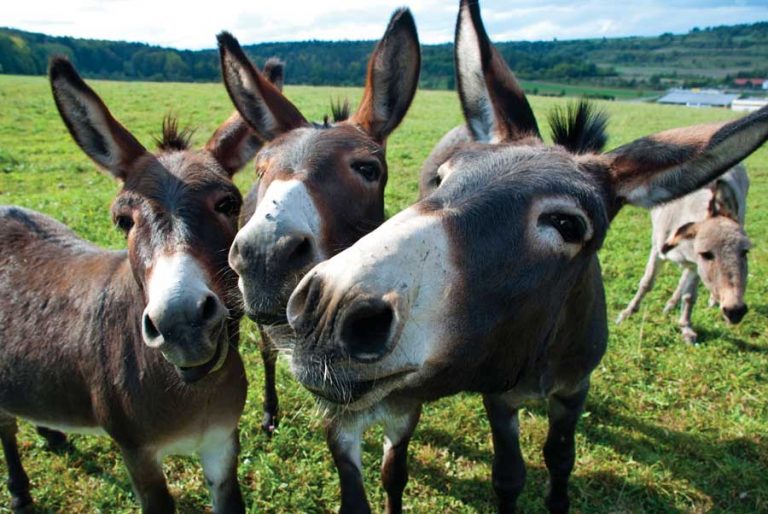
Donkeys and mules lack true withers, their spines are generally straighter, and their rumps are differently shaped than their horsey counterparts. Donkey hooves are smaller and rounder than a horse’s hooves, and their manes are bristly, as if the donkey had a good scare. Their tails are more like cow tails and less like a horse’s showy switch. There also have been instances of donkeys born tailless, which is surely helpful when faced with children and pins.
The other big difference, according to donkey and mule lovers, is in the personality and intelligence of the critters. Mules and donkeys have a strong sense of self-preservation and plenty of common sense, which means they’re often calmly observant of their surroundings. They’re durable and strong, usually gentle, and generally quite confident in themselves, which leads to the legendary sure-footedness that gold miners, explorers and tourists appreciate. It also means that being mule-headed isn’t being stubborn – it’s just a way of steadfastly avoiding trouble.
So now that you’re convinced that you want an Equus africanus asinus in your life, you need to decide on the size of your ass. Miniatures can be as small as a German shepherd, while Mammoths can tower over a human adult. You can get your brayer in several fabulous colors, including the classic gray, reddish, spotted or striped, dun, black, or whitish. Your donkey might have a smooth coat, he might have a corded look, or he might be a shaggy cutie that begs to be hugged. He may have a fancy name like Poitou (a very rare breed) or Catalan (snatched from extinction), or he may be a plain ol’ common Ethiopian donkey that, like most of his kind, sports a fur “cross” down his back and over his shoulders.
But if you want a donkey in your life, you’ll have to be patient. Momma donkeys (Jennies; Jennifers if you’re being formal) have a gestation period of around a year, and it takes a few months for baby to be weaned (though he can eat grass at a month old). Boy donkeys, by the way, are called Jacks, which means, technically speaking, that the woman who cut you off in traffic is not what you called her.
And so, there you have it. Some information on donkeys and mules. Whether you know him as an asal (Irish), a boriky (Malagasy), a nagwi (Korean), a roba (Japanese), or a plain old donkey, that just about covers your … .
Terri Schlichenmeyer, book reviewer and trivia collector, lives in Wisconsin with two dogs and 11,000 books.