Andrew and I were both raised with chickens. We each were used to the “standard” backyard operation. There was a wooden shed-like coop which housed nesting boxes, roost, feeder and waterer. This coop was located not far from the house and was surrounded by a small chicken yard made of wood posts and chicken wire. Both of our families kept on average of 1-2 dozen birds being mostly hens with a single rooster. I’ve always loved poultry of all kinds, and Andrew also likes birds but is an even bigger fan of eggs! So we always planned on having chickens. However, the first 6 of our 8 married years found us renting homes with land, but inside the city limits where poultry aren’t well thought of.
Two years ago we moved a doublewide onto a small corner portion of my parents land. This gave us time and the ability to save money to purchase our own land, which was our main goal. It also gave us a whole 1/3 of an acre with no restrictions! Well, no restrictions as long as my parents approved that is. Since we were not planning on living there long and my parents already had chickens in their barn, we did not need to build a permanent chicken enclosure. After a few months we found ourselves with an empty 10 x 12 foot chain link dog kennel. The idea struck us that this kennel could be turned into a portable coop for a few hens. So Andrew got to work modifying the dog pen into a chicken pen. By adding tarps to the top, an empty igloo dog house on “stilts” made of concrete blocks, a ladder for them to climb into it, and a few well placed boards running along the top to support the hanging feeder and waterer, we were ready to go! We headed to a neighboring counties poultry breeder and came home with 8 young hens around 6 weeks old. These hens were $5.50 each. Seven were a commercial egg-laying cross called a Cinnamon Queen, and the other was one Macey just had to have called an Americana. We were told these Cinnamon Queens would begin laying by five months of age, and would lay at least 6 eggs a week! Well, we were doubtful about that but wanted to give them a try. A few weeks after purchasing them, Andrew built a covered two nest nesting box on short legs to sit inside the coop. This was the perfect size and design for such a small number of girls in a tight space! Much to our surprise, by 4 ½ months old every one of the Cinnamon Queens were laying big beautiful brown eggs! Something that still continues 15 months later.
In December of 2010, we moved our home and family onto our own farm. Instead of that 1/3 acre lot, we now found ourselves with 24 vacant acres! We knew we wanted to switch to pasture raised poultry, and went about devising a way to do so in a manner that would compliment our other plans. This spring Andrew completed the first stage of our land improvements by fencing 2 acres in field fence and building a small barn. Inside this barn, was one large stall for sheep and another smaller stall for our chickens. This stall is assessable to our birds, but not to the sheep or guard donkey.
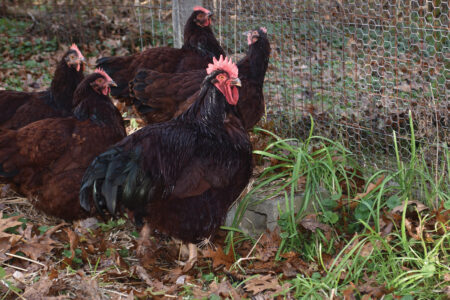
To do this, we simply installed a 4 foot gate across the entry way, and build a wooden rail across the remainder of the opening with space between the rails large enough for our birds to come in and out but not the sheep. So far, this has worked very well for us! Inside we keep a 50 gallon barrel for feed (with a secure lid of coarse!), roosts, 4 nesting boxes, and a large hanging feeder and waterer. Now we had a nice set up, but only 8 hens! So we headed back down to the poultry breeder and picked up an adult barred rock rooster and 6 barred rock young hens. Rocky, the rooster, is still my favorite bird in the field!
So now we had 14 laying hens and one rooster. By this time, several of our friends knew we had chickens and therefore, eggs. With everyone wanting eggs and needing enough to feed our own family we just didn’t have enough birds. Buying them was getting expensive though. So we went to my parents house and pulled out the incubator and egg turner I had purchased for a project in high school. This 40 egg capacity incubator was all we needed for what we had planned! We headed home and spent the next few days collecting well formed, large sized, clean eggs. 23 days later, our first run of chicks hatched! It was only April, so we kept them inside for two weeks before looking for a draft free location to move them outside. While these young ones were growing, we started another run of 28 eggs in the incubator. We eventually decided to move the young birds into our storage shed in the back yard. Since it was still very cool, we put a single heat lamp over them.
Lesson #1 learned the hard way: Don’t put chicks in a location where you can not completely control the environment if it is enclosed. For the first 5 days our 8 little chicks were fine. On day 6, we were all away from home. This day the high went into the upper 70’s instead of the 60’s we had been at. I had closed the shed doors when we left to prevent any predator from having an easy meal. When we came home three hours later, every bird was dead. The temperature inside the closed shed, under the heat lamp, in their cardboard box read 108 on the thermometer. I had unknowingly killed our entire run of chicks!
Two weeks later our second run of chicks hatched. This time we had started with many more than our first run, out of the 28 eggs we started 23 hatched! Now commercial hatcheries usually have around a 70% hatch rate. Our second attempt yielded an 82% rate!
This time, I was leaving nothing to chance! We purchased large plastic totes and new digital thermometers. These chicks stayed inside for two weeks also, starting all together in one tote and then moving into two totes as they grew larger. We gradually raised the heat lamps farther from the containers to lower the temperature. Then we removed one completely and left the other partially heating both containers. After 20 days of being inside, we headed outdoors to that trusty dog pen turned chicken pen. With some modifications, it became the perfect summertime nursery for baby birds! We put new tarps on the top, bracing on top to secure the tarp as well as to hang heat lamps and feeders from, and then put mobile home flashing around all of the lower inside portion to keep all their little heads from poking outside the pen (we were having dog issues at the time).
After a few weeks outside we only lost 1 of our 23 original hatches. The end of April and early May were unseasonably warm. However, in mid May we found ourselves facing a 38 degree day with young birds in an open pen! At this time we not only had baby chicks outside, but had also added 7 guineas, 5 turkeys, and 2 ducks to our baby nursery. That’s a total of 36 babies in need of a warm nights rest! Luckily, Andrew had some extra thick plastic laying around, and our “chick totes’ were clean and in the shed. Much to my city friends horror, and our country friends amusement, we moved all the birds into our master bathroom!
We lined the bathtub with thick plastic, then a layer of cardboard, and topped it with shavings. Doing it this way made for a mess free, very quick clean up! All of the chicks moved into the tub. The turkeys, ducks, and guineas were a little bit younger. They all went into the totes and shared a heat lamp. Two days later, they were all able to return to the great outdoors. We didn’t loose a single bird!
After several more weeks in the “nursery” pen, all our babies were ready to join the adults out at the barn. We moved all of the young stock (chicks, turkey, guinea, and ducks) into the barn right before dark. Placing them up on the roosts well before the adult hens and rooster came in for the night. Many of them immediately jumped off and ran outside to explore. The timid ones however chose to stay up on the roost!
Lesson #2 learned the hard way: chicks don’t swim! The next morning Andrew headed out to the barn to do a head count. He came up one short, and during our search for the missing bird we found her floating in the top of the sheep stock tank. Apparently, chickens don’t swim! The dilemma here is they must share this field, the sheep obviously can not drink out of a chicken waterer. And the chickens can not be kept away from the tanks. This is just one of those things you have to consider when deciding where to raise your birds. For us, the benefits of having them free range on grass out-weighed the risk of an occasional incident. So all the birds stayed where they were, the stock tanks stay full, and we have not lost another bird in this way since.
Now I have heard all sorts of things regarding keeping turkeys and chickens together. While I’m sure there are occasional problems and the threat of black head may be higher in some areas rather than others, we have not yet had any issues with keeping mixed poultry together. Our turkeys pretty much wander around together as do the chickens. The ducks mingle well with the turkeys, but pretty much avoid the chickens. Now the guineas are a little different. Some days they stay by themselves, others it seems they make it a game to chase the chickens. Since the turkeys hit the 20 lb. mark though the guineas have left them alone!
By August we had gotten pretty good at the chicken hatching/raising thing! After our second run, we started a run of turkeys and then another run of chicks. This last run of chicks yielded a 93% hatch rate! When the county fair rolled around, we decided to enter some eggs and see how ours stacked up compared to others in the county. Andrew and I disagreed over which eggs were more attractive, browns or blues. So he entered a ½ dozen blue eggs against my ½ dozen browns. Well, his blue eggs got 2nd and my brown eggs got 3rd.
We decided in August it was time to put up the incubators. Our last run of chicks was in the nursery pen, and all our others were out at the barn. In the 3rd and last hatch, we had 23 chicks. At 8 weeks old we learned another lesson.
Lesson #3 learned the hard way: Raccoons CAN climb between tarps and support poles. One morning we went out to check everyone and found 3 dead chicks in our nursery pen. Andrew had already caught a raccoon in the corn field that same week in a live trap. We were pretty sure our culprit was a coon. The second night, we lost another 5 chicks. Well, that was the end of that. Andrew moved his oldest coonhound into the adjoining dog pen (which had recently been vacated by the run of turkeys we hatched). We have not had a predator loss in the nursery pens since.
Lesson #4 learned the hard way: Turkeys look for ways to die. We lost 3 of our young turkey poults during the first raccoon raid, but not from the coon. After the first killing of 3 chicks the turkeys were still in the neighboring dog pen. Andrew placed live traps around the outside of the dog pens. Well, turkeys are not to bright. Several of the turkey poults flew out of the top of their pen during the night, walked into the coon trap triggering the closing door, and died somehow before we checked the trap the next day. We moved the other turkeys out to the barn that evening before moving the hound into the pen. Another turkey breeder told us that turkeys just look for an excuse to die, and I’m leaning towards agreeing with him!
So here we are in October with 25 laying hens, 4 roosters, 7 guineas, 4 Narragansett turkeys, 1 bourbon red turkey, 2 Crested ducks, and 13 young chickens. Over the coarse of this years poultry production we have sold 3 roosters, 8 hens, and put 11 roosters in the freezer. We lost 18 chicks and 3 turkeys that we hatched this year and gave 8 to my parents. Our oldest hatch is now 6 months old and laying. We kept a barred rock crossed rooster from this hatch. Not as pretty as his daddy, but still a nice little boy!
By hatching our own poultry this year we have literally saved hundreds of dollars. It has also produced “extra” birds which we have used both to sell and buy feed, as well as to feed our family. We have had several people ask if we would recommend they hatch their own or buy birds. Our answer would have to be, it depends on your purpose!
Assuming you are only wanting a few hens to provide eggs for your family you would be better off buying young hens from another breeder. I would not suggest young chicks, unless you are willing to spend a good bit more on the necessary equipment to raise them. However, I also don’t recommend that you buy laying hens from anyone unless you know them or they are highly recommended by a knowledgeable person. Many people will sell off their “old” stock that are at the end of their egg laying years to others. Often times these hens are $10-15 each and will only lay a few eggs a week for a while, and then they taper off. Instead, I would suggest finding a reputable farmer or a certified poultry breeder and start with young hens around 2-4 months old. While they are not as cheap as chicks, and you will have to wait a few months for them to lay you will be better off in the long run. The money you will save by not buying heating lamps, containers, chick feed, and such will more than cover the additional fee for buying older birds. And the laying life span of hens this age will more than compensate you for the few months you have to wait on them versus buying older “worn out” birds.
Another question we usually get is do you have to have a rooster? For the above person who is only interested in owning a few hens for family egg production the answer is no. A hen will lay eggs regardless of whether a rooster is present or not. However, those eggs will only be good for eating. The eggs from hens raised without a rooster will be no different in nutritional value, size, or frequency than those from hens with a rooster.
Now you may want to start a good sized flock and provide eggs for not only yourself but for friends and family as well. In this case you would be much better off investing in a few “foundation” birds (again, looking at 2-4 month old birds) and then hatching your own. How many birds you start with really depends on the breed. For us, our Cinnamon Queens lay 6-7 eggs a week. At that rate, you can quickly fill up a 40 egg incubator. Other breeds may only lay 2-3 eggs a week. So you would need more foundation hens to fill up that incubator quickly. Another alternative is to simply buy fertile eggs from another farmer. This sometimes yields mixed results, as you have no way of knowing how old the eggs are or if they have been handled properly for hatching. This is a good method though for those wanting a more diverse flock of several breeds of birds.
The internet gives many different opinions on how long eggs are viable, how to store the eggs, and whither to wash them or not. We have found that collecting fresh, clean eggs and storing them in egg cartons at room temperature for no more than 5-6 days yields the best results. Place your eggs in the carton and simply rotate ¼ turn each day until you are ready to start the incubator. We do not wash our eggs before incubating, but are careful to select only clean eggs for hatching. Turning is very important, as failure to do so will make the yolk stick to the side of the shell and result in dead or crippled chicks. Only select large well-formed eggs, not those that are excessively large or small.
So after you decide what breed is right for you, purchase your foundation stock, and raise them to laying age you need to be looking for your equipment. There really aren’t many necessary items required for hatching eggs. Of coarse you need an incubator. There are many, many different sizes, shapes, and brands on the market. Regardless of which you choose I would highly recommend spending a few dollars more on a forced air (circulating) incubator. Still air incubators do not have as high of a hatch rate. We use a simple Little Giant brand forced air incubator with egg turner. Egg turners must be purchased separately, and often cost as much as the incubator itself. But trust me, it is worth the extra expense if you plan on raising more than just an occasional run of birds! We spent a total of $90 on our incubator and egg turner. Many incubators come with a mercury thermometer. We have found these to be virtually useless. We switched to a digital thermometer and had around a 72% hatch rate. We then switched to a kitchen meat thermometer which we stuck into one of the vent holes in the top of our incubator. The thermometer cost $3, and increased our hatch rate to 93%! Humidity is very important and crucial for a successful hatch. Be sure to locate the water reservoirs in your incubator and keep them full during incubation. Avoid frequently opening the lid, as this lowers both the temperature and humidity. In fact, do not open the lid at all the last 48 hours before hatching. If you do purchase the egg turner, don’t forget to turn it off 3 days before your expected hatch date. Typically, chicken eggs will hatch 23 days after incubation. It isn’t unusual for some early hatchers to appear a day early, or late bloomers a day late. We leave our incubator running for two full days after our expected hatch date just in case.
Once your chicks hatch, you need a draft free place of consistent temperature to keep them for at least two weeks. We use large Rubbermaid containers ($11 at Wal-Mart) and keep them in a bathroom. Basements, heated and cooled garages, or utility rooms work great if you have them! You will need shavings, a chick feeder, chick waterer, and heat lamp for each container. Red bulbs are better than clear ones, even though they may be a little more expensive. They don’t seem to be as hard on the chicks eyes, and the chicks are better able to relax and sleep while it’s turned on. Chicks require special chick food, which you can purchase at any co-op, Tractor Supply, or other farm supply store. After those first two weeks, if it is warm outside you can relocate them outdoors. Just remember our storage shed experience, and our 38 degree day in May! A heat lamp or two may be required even outdoors. Large fluctuations in temperatures can result in dead or sick chicks so keep your eye on the weather and your birds. They will tell you if they are to cold or hot!
It may sound quit complicated, but hatching and raising your own birds is actually pretty easy with the right equipment and an attentive eye. It is also much more rewarding! You may find yourself, as I did, so happy with hatching chicks that you decide to try a few other birds such as turkeys or ducks. For those wishing to have large flocks, there really is no cheaper way of acquiring your birds.