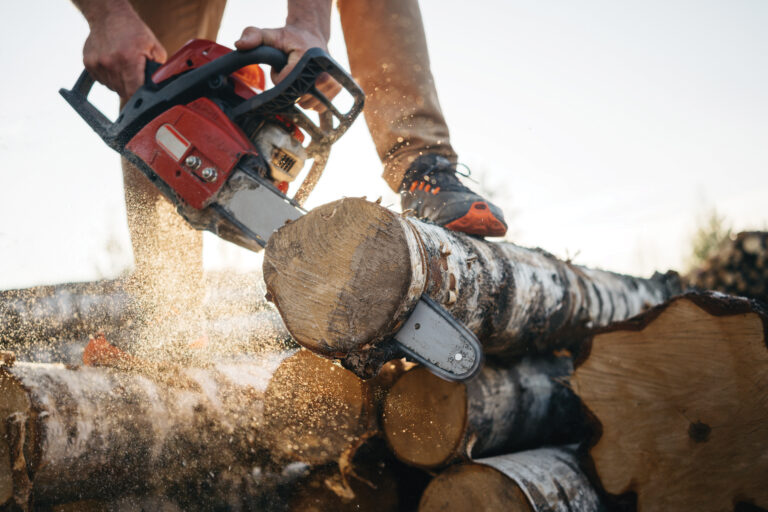
With a little know-how and some time to tinker, learn how to clean a chainsaw and keep other essential homestead tools purring along.
Generally, a small engine is defined as a gas- or diesel-powered engine of 25 horsepower or less. There are two basic types: two-stroke and four-stroke engines. Two-stroke engines are usually found on hand-held equipment, such as chainsaws and string trimmers. For this equipment, the fuel is a mixture of special two-stroke oil with fuel in a precise ratio. Four-stroke engines are typically found in larger equipment, such as lawn mowers, garden tractors, pressure washers, and generators. “Two-stroke” and “four-stroke” refer to the number of times the pistons must travel up and down the cylinders to complete a power cycle. This cycle consists of intake, compression, power, and exhaust. A two-stroke engine completes this cycle in two piston strokes, while a four-stroke engine does it in four.
One of the most common small-engine tools on farms and homesteads is a chainsaw. We live off-grid and heat our home with woodstoves eight months out of the year, cutting and splitting the wood ourselves. Since we need a large supply of wood, it’s a must to keep our chainsaws in good running condition. Before delving into specific chainsaw maintenance issues, it’s important to have a general understanding of small-engine equipment.

How to Clean a Chainsaw
Most small engines are air-cooled, relying on the movement of air around engine parts to prevent overheating. The most important maintenance task with air-cooled engines is to keep them clean. Chainsaws and mowers are especially prone to being clogged with sawdust, grass, and leaves, and this affects the engine’s ability to cool itself during operation.
Many mower and chainsaw manuals recommend checking the air filter before each use. Considering that a dirty air filter is a common cause of an engine’s failure to start, this recommendation is made for good reason. For proper combustion to take place, a certain ratio of fuel and air must enter the carburetor. A clogged air filter prevents an adequate amount of air from reaching the carburetor.
While some air filters can be cleaned and reused, others must be replaced. Your owner’s manual will tell you which kind you have, and often includes a parts diagram with part numbers as well. Washable filters should never be cleaned in solvents. Manufacturers generally recommend washing the filter with hot, soapy water — I use dishwashing liquid — and rinsing thoroughly, and then letting it dry out in the sun before reinstalling it.

Fueling Problems
A key thing to understand about small engines is that any issue with your engine starting or running poorly will involve your fuel at least 90 percent of the time. This is especially true with two-stroke engines, where the fuel and oil are mixed together. An incorrect fuel-to-oil ratio is usually the reason the engine won’t start.
Another common cause of an engine failing to start is using stale fuel. Currently, engine manufacturers recommend not using any gasoline older than 30 days. Personally, I prefer to keep small amounts of fuel on hand and make sure it gets used regularly. We keep our chainsaw fuel (gasoline mixed with oil) in a clearly marked fuel can, and shake it well before fueling. You can extend the life of fresh gasoline with fuel stabilizers. Note that fuel stabilizer doesn’t make stale fuel fresh again. It’s only effective when used with fresh gasoline to slow down oxidation.
Also, if you use metal gas cans, replace them as soon as they show any signs of rusting. Rust or paint particles in the fuel, even if you can’t see them, can clog up fuel filters and cause engine performance problems. Fuel filters can’t be expected to catch every single particle, so save yourself some grief by preventing the problem before it starts.
Read and follow all the guidelines in your owner’s manual for fuel and oil. Be sure to use only the recommended type of two-stroke oil. The type of engine oil used for four-stroke engines depends partly on climate, as well as emission standards in your state. Your manual will give directions for changing oil, and the amount of oil to refill the reservoir with. Make sure to avoid overfilling when changing your oil.

Proper Storage
Since most small-engine equipment is used seasonally, it needs to be properly stored during the offseason. Your manual will give specific guidelines, but here are the basics.
First, thoroughly clean the whole machine. The main objective of properly storing your machine is to prevent corrosion, and making sure your equipment is clean and dry is a good start. Most manuals recommend that you also lubricate specific parts during the cleaning process. This is also an opportunity to check for loose nuts and bolts, worn belts, and broken parts that may need to be replaced.
Next, ensure there’s no fuel left in the tank, especially if it contains ethanol. Ethanol is hygroscopic, meaning it tends to attract water. If an engine is left sitting with fuel in the tank, water will collect in the engine and carburetor, which may cause corrosion and gum deposits. The best way to completely use up the fuel is by operating the engine until it runs out of fuel and dies. Coating the interior of the engine with oil before storage will also help to prevent corrosion or seizing. To do this, remove the spark plug (after using up the fuel), pour 1 ounce of engine oil in the cylinder, and pull the starter handle a few times to distribute the oil.

Respect Regulations
Whether you do your own maintenance and repair work, or you hire someone else to do it, you need to be aware of the current emission standards for your equipment.
Most small-engine equipment, especially lawn mowers and chainsaws, has long been known to cause pollution. In 1997, the Environmental Protection Agency (EPA) implemented nationwide standards to be phased in over several years, with the aim of significantly reducing pollution by requiring better-quality fuel system parts and designs. These standards also make it impossible for equipment owners to make certain adjustments themselves, particularly with carburetors. Your equipment will have a sticker clearly stating which phase it complies with, along with other information for service technicians.
The manual spells out exactly which repairs and maintenance you can do yourself, and which must be done by a qualified technician. It also sets out which parts may be replaced by aftermarket versions, as long as they conform to the EPA standards for that equipment.
Above all, use the owner’s manual to keep your equipment properly maintained. Most of these maintenance tasks are simple and don’t take much time, special tools, or unique skills. Doing your own maintenance will save you money and often saves downtime too, especially if you live a long way from a qualified service technician.
If you want to go beyond regular maintenance and get more into repairs, you’ll need to obtain a service manual. Sometimes there’s a separate service manual for the engine. Many manuals can be downloaded as PDF files from the internet, either free or for a nominal fee.
I can tell you from my own experience, there’s a profound sense of satisfaction that comes from having the ability to keep your equipment running well.
Chainsaw Checkup

For most of us who live on farms or homesteads, the chainsaw is the modern equivalent of the pioneer’s broadax: a multiuse, indispensable tool.
Probably the most vital part of chainsaw maintenance is keeping the chain sharp. However, the overall performance of the chainsaw depends on proper engine operation. Here are a few simple maintenance tasks that are essential for your chainsaw’s successful operation.

- Air Filters: Keep them clean! A chainsaw can quickly get coated with sawdust and wood chips, to the point where it starts clogging up the air intake and affects engine performance. Along with other two-stroke engine equipment, chainsaws operate at a very high rpm and are therefore more vulnerable to overheating than cooler-running four-stroke engines. Check the air filter frequently. Clean it regularly, and you’ll save yourself a lot of headaches later.
- Spark Arrestors: The spark arrestor screen is located inside the muffler housing and is meant to reduce the risk of starting a fire by preventing sparks from exiting the muffler. Over time, the screen can become clogged with carbon particles, reducing its effectiveness and affecting overall engine performance. Cleaning the spark arrestor screen is usually an easy operation, consisting of removing one or two bolts from the muffler housing, locating the screen inside the housing, and carefully brushing off the carbon with a soft brass-bristle brush.
- Fuel Pickup Tube and Filter: If your chainsaw won’t start, or it starts but immediately stops, and you’re certain the fuel is fresh and the fuel-to-oil ratio is correct, the carburetor likely isn’t receiving enough fuel. Often, this can be traced to a problem in the fuel pickup line and/or the fuel filter. A typical chainsaw has a fuel pickup line that connects on one end to the fuel inlet port on the carburetor, and the other end of the line hangs down into the fuel tank. The pickup line can develop cracks over time, especially at the ends, and should be inspected regularly. The filter is attached to the end of the line in the tank, and prevents small particles from being drawn into the carburetor. Replacement pickup tubes often come with a filter attached. Make sure to get one that’s the same length as the original.
- Spark Plugs: It’s a good idea to replace the spark plugs on your chainsaws every time you tune them up. This doesn’t necessarily mean you buy new plugs; instead, keep several spares that are clean and with the gap properly set to specifications, which makes it a simple matter of swapping plugs. When you have a few extra minutes, clean and gap all of your spares, which saves time during tuneups. Also, be sure to follow the manufacturer’s recommendation on the type of spark plug you buy, with the correct heat range, which you’ll find in the owner’s manual.

Victoria Redhed Miller is an EETC-certified small-engine technician. She lives on an off-grid farm in Washington and is a regular speaker at the Mother Earth News Fairs. Her books include Craft Distilling: Making Liquor Legally at Home.