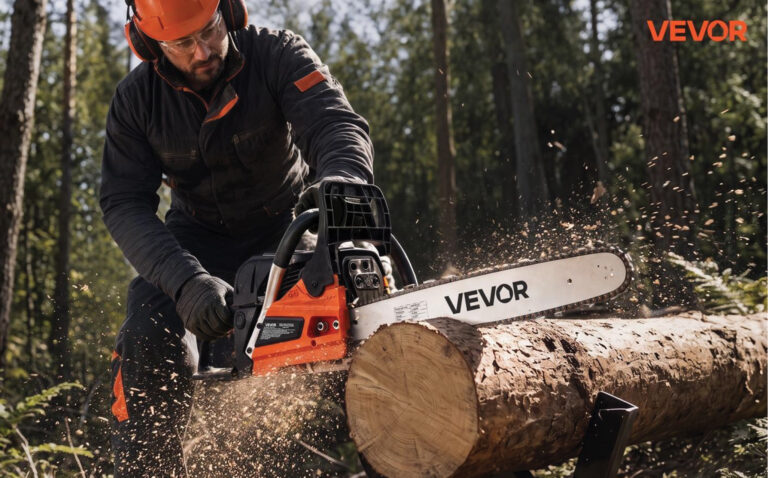
A tree has come down across the lane, and there is still firewood to cut before the weather turns. It is exactly the kind of day when a gas chainsaw should earn its place in the shed. Yet a stubborn start can leave you working the pull cord while the wood stays untouched.
For property owners, slow progress through a pile of timber is the real frustration. When every cut takes longer than it should, a morning’s work stretches into the afternoon. Hard starting compounds the problem. Repeated pulls and uncertain choke adjustments eat into the time before cutting even begins, and if the engine floods, a short job turns into an extended interruption.
VEVOR, a home improvement brand, designed its VEVOR Gas Chainsaw around what users prioritize. In a VEVOR consumer survey, the top three purchase motivations for gas chainsaw buyers were reliable durability (39.1%), quick starting (21.4%), and strong horsepower (14.2%). That feedback shaped a 62cc model with a cutting system the manufacturer rates at 40% faster performance, an easy-reset choke designed to reduce flooding, and a 360-degree reinforced starter rope built for repeated use.
The goal is straightforward: get more wood cut in less time, with a starting system that stays out of the way.
Cutting Efficiency Comes from the Engine and Chain
The central question with any gas chainsaw is how it performs once the chain meets wood. A longer guide bar provides reach, but bar length alone does not make a saw cut faster. The performance case rests on the engine and chain working together.
The 20-inch VEVOR Gas Chainsaw uses a 62cc two-stroke engine rated at 3.8 horsepower, with a maximum engine speed of 12,000 rpm. VEVOR pairs that output with a chain designed for sharper cutting and greater wear resistance. The engine supplies the power, while the chain’s cutting edges engage the wood.
VEVOR reports 40% faster cutting performance from its own testing with skilled operators under ideal working conditions. Actual cutting speed will vary with the wood, chain condition, operator technique, and working conditions. For property owners, the value of improved cutting efficiency becomes tangible at the woodpile. Preparing timber for the splitter involves repeated cuts, and slow progress on each section can stretch the work across an afternoon.
That makes cutting performance the central consideration. Quick starting helps an operator reach the task; an effective engine-and-chain combination helps move it toward completion.
Effortless Starting with an Easy-Reset Choke
With cutting capability established, the next question is how reliably the saw gets to work. VEVOR addresses that with an easy-reset choke, which is reset by holding the trigger and trigger control arm together. The design helps simplify choke management and reduce the operating errors that can lead to flooding. For anyone who has stood over a flooded engine deciding whether to pull again or wait it out, that is a practical improvement.
For rural work, starting reliability matters beyond the first job of the morning. Clearing a fence line or working through scattered storm debris often involves stopping, moving material, and restarting at another location. A choke system that reduces the risk of flooding fits that stop-and-start pattern of work.

Reinforcement Where Repeated Use Creates Wear
The pull rope is a small component with an outsized role in whether the saw gets to work. If it wears or breaks, the cutting capability of the machine becomes temporarily irrelevant.
VEVOR uses a 360-degree reinforced starter rope designed to improve durability and resistance to breakage. The reinforcement focuses on a component exposed to repeated pulling throughout the saw’s working life.
A Practical Fit for Storm Cleanup and Seasonal Work
The saw is positioned for tasks such as cutting fallen timber into manageable sections, preparing logs for splitting, and clearing material from farm lanes or wooded boundaries. The suitability of any particular job depends on the size and condition of the wood, the operator’s experience, and safe working conditions.
Autumn firewood preparation puts the emphasis on productive cutting through a succession of logs. Storm cleanup adds a different demand, with work spread across several locations and material that needs assessing before each cut. Farm and ranch maintenance can involve both patterns, making cutting power and convenient starting relevant to the same owner.
Gas power adds flexibility where charging access is limited. With suitable fuel available, the saw can support property cleanup during an electricity outage without relying on a charged battery.
For rural homeowners, farm and ranch owners, and users handling light professional property maintenance, the VEVOR Gas Chainsaw brings these considerations into one package. Its strongest proposition is the combination of cutting capability, a simpler starting system, and reinforcement at a frequently used component.
At a price in the low hundreds, the 20-inch model lets property owners get a cutting experience that rivals professional-grade saws without the professional-grade price tag. That is the substance behind VEVOR’s “Pro-Level Performance Without the Pro-Level Price” message: capable cutting, a reliable start, and reinforcement where it counts, at a price that makes sense for seasonal work.
Explore the VEVOR Gas Chainsaw and current purchase options at VEVOR, Amazon, or Walmart.