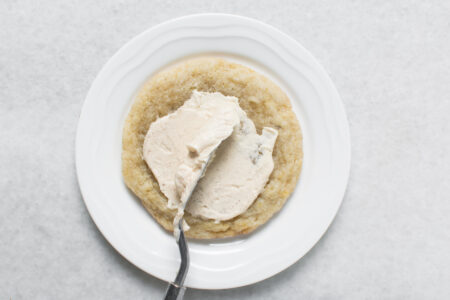
Learn to make a Sally Ann cookie recipe using a Spam can as the cookie cutter, and previously sold in grocery stores, much like today’s Oreo cookies.
It was a bit of an adventure trying to find the origin of Sally Ann Cookies. It started when I received a copy of a community cookbook with a recipe from my late great-aunt Georgia Ruth: “Sally Ann Cookies.” She was a great cookie baker, but I’d never heard her mention these.
I found out that “Sally Ann Cookies” were a commercial product in the 1950s (possibly earlier) and sold in stores.
An enduring commercial cookie is one that is delicious, but also hard to duplicate at home. Yes, commercial chocolate chip cookies are popular–because they seem to be number one in the cookie world–but that’s because fewer people make homemade cookies. Back in the day, Mom would have made chocolate chip cookies herself. Oreos are probably the ideal commercial cookie. Yes, they could be made at home but who does? And you still wouldn’t get the cookie imprint like an Oreo.
Ingredients
- 1-1/2 cups sugar
- 1 cup (2 sticks) cold butter, cubed
- 5-1/2 cups all-purpose flour
- 2 teaspoons baking soda
- 2 teaspoons ground ginger
- 1/2 teaspoon ground nutmeg
- 1/2 teaspoon salt
- 1/4 teaspoon ground cloves
- 1/2 teaspoon ground cinnamon
- 1 cup molasses (light or dark)
- 1/2 cup strong cold coffee or espresso
Frosting
- 1 cup sugar
- 1 envelope unflavored gelatin
- 1 cup cold water
- 2 cups confectioners' sugar
Directions
- In a large bowl, beat sugar and butter with mixer on low speed till blended, about 1 minute. Increase speed to high, beat until creamy, about 2 minutes. This is the "batter bowl."
- In a separate bowl, mix flour, baking soda, ginger, nutmeg, salt, cloves, and cinnamon, and stir thoroughly to mix all ingredients. Pour half of this dry mixture into the batter bowl.
- In batter bowl, add molasses. Blend with mixer on low (or by hand) until thoroughly mixed. Add other half of dry ingredients, then add cold coffee or espresso. Again, mix or beat thoroughly. The dough will be thick, but do not add water. Toward the end of this process you can even "knead" the dough with your hands to get it mixed and smooth.
- Wrap dough in plastic and refrigerate at least four hours, or preferably, overnight.
- When ready to bake, preheat oven to 350 degrees, with a rack on the bottom. The dough will be thick and cold, so leave it in the refrigerator until you are ready to work with it. Roll out dough to about 1/4-inch thickness and cut cookies with the Spam cookie cutter (for extra info about this stage, see the dough-prep tips below).
- Place cookies on greased cookie sheets. Bake on center rack in oven for 15 minutes. Let cookies cool on pan for about 1 minute, then use metal spatula to put on cooling rack. All cookies must be completely cool to frost them.
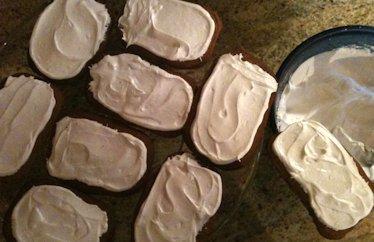
- To make frosting, place sugar and gelatin in a medium saucepan, and stir. Add water, turn on heat and stir. Heat to boiling, stirring periodically. Reduce heat to low and simmer uncovered for 10 minutes. In a medium bowl, place confectioners' sugar; pour hot sugar-gelatin mixture from saucepan in a thin stream into confectioners' sugar while mixing at low speed. When mixed, turn mixer to high and beat on high for 7-9 minutes, or until fluffy. If it starts to turn into a sort of ball and seem overly thick, stop. Cookies can be frosted immediately, but if not, place plastic wrap in the bowl directly on top of the mixture until you use it, and do not refrigerate.
- After frosting, let cookies sit at least 30 minutes for frosting to harden and dry. Makes approximately 40 cookies. To store, keep in a covered container.
Learn to make a classic Sally Ann cookie recipe just like those sold in grocery stories in the 1950s using a Spam can as the cookie cutter.
There is very little about Sally Ann Cookies on the internet, other than the recipe appearing in many variations. I also found a tiny newspaper ad, dated 1949, for salespeople for the cookie line. However, it fell out of favor long ago and stopped being company-produced. My guess is that people’s enjoyment of molasses declined as the U.S. became more urbanized. Most younger people I know say either one of two things: 1) “I’ve never eaten molasses,” or 2) “Isn’t that the same thing as syrup?”
Somewhere along the line, Sally Ann Cookies became known as a “Christmas cookie” among bloggers and recipe hounds. This is likely because it’s a rolled cookie with a cooked frosting. Many people tend to make “fancy cookies” only at Christmas. (I think once a week is much better idea.)
A Cookie Recipe That Starts With Spam?
So, where’s the Spam? Don’t worry, you don’t cut up processed meat for the recipe. But you do have to buy a can of Spam. You wash out the can very well, and use it for the cookie cutter. Store-bought Sally Ann Cookies had the oblong shape easily duplicated by using a Spam can for a cookie cutter. Word to the wise: If there’s someone in your house who’s likely to throw away your Spam cookie cutter, thinking it is trash, mark it with a permanent pen like I did.
It’s not a molasses cookie. It’s much more complex, with a texture that’s firm but not necessarily crunchy or soft, with unusual and delicious icing. This recipe makes about 40 medium-large cookies. You can easily halve it to make less. Remember that these aren’t a quick cookie: the dough needs to be refrigerated at least 4 hours, and longer is better. In my testing, I even refrigerated it for a full week and it was fine. However, freezing it did not work. These instructions might seem detailed, but trust me, I’ve done what I can to make this as easy as possible.

Tips for Making the Classic Sally Ann Cookie Recipe
- Dough-prep tips for best results (or if you’re a perfectionist like me): Not only do the baking pans need to be greased (you can use cooking spray), I recommend greasing the area where you’ll cut the cookies as well as the rolling pin. The dough is very dense and will stick easily.
- Keep the dough chilled as best as possible while rolling out, and place onto cookie sheets that are room temperature or cooler. In fact, after I cut the cookies, I put the cookie sheet in fridge for 10 minutes before I bake. This helps the cookies expand less and retain their correct shape.