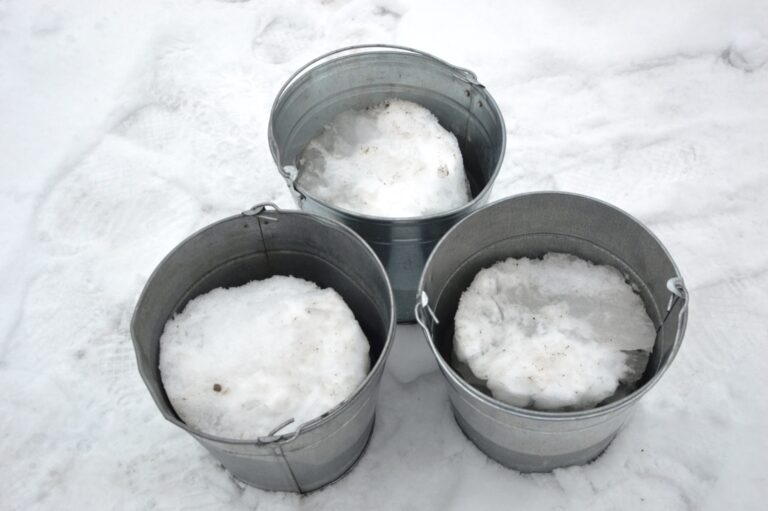

Have you ever heard the old quip, “pure as the wind driven snow?” Well, it doesn’t hold true in these parts! When the wind blows and the snow falls here, we end up with snow that’s full of pine needles, leaves, lichen and sometimes soot.
We don’t know everything about melting snow for water but since most of our water in the wintertime comes from melted snow, we’ve learned a few things to make the job easier and more efficient.

First, it takes a lot of snow to make a gallon of water. It would be nice if there was a formula involved like “four quarts of snow equals one quart of water” but it isn’t that simple. Any avid skier can tell you that there are different kinds of snow. Warm, heavy, wet snow and corn snow have a higher moisture content than cold, dry, fluffy snow. In addition, cold snow doesn’t pack as tightly as warm snow. Old snow also has more moisture by volume than new snow because it’s had time to compress and may have gone through some thaw cycles which make it denser. What this means is that if you need one quart of water the amount of snow you’ll have to melt may vary greatly depending upon the time of year, the location, the age of the snow and the temperature.
One way to estimate the moisture content of the snow you’re melting is by weight. Say you’re using a one-gallon container. One gallon (US measure) of water weighs approximately 8.3 pounds. If the snow in your one-gallon container weighs four pounds, then the water content of the snow is almost 50 percent which means it will take two gallons of snow to make one gallon of water. The water content of most snow is way, way, way below that but you get the idea of how to get a quick estimate of the amount of snow you’re going to have to melt to meet your needs.
Second, whether melting snow at home or while camping in the woods use the largest container you have! I love my canteen cups but in winter, even when backpacking, try to include a large, lightweight pot for melting snow. It makes the job go much faster.
Third, whatever container or utensil you’re going to use for scooping up the snow should be cold and dry. If it’s not, then the snow will stick to the sides and bottom when you dump it into your melting pot. It’s not a big deal but it’s more hassle. Along the same line of thought, if your water is boiling and putting out steam when you dump in new snow, the steam will coat your “dumping utensil” and the next batch of snow will stick to it. Again, it isn’t a big deal, just annoying.

Fourth, keep some water in the melting pot. For your initial use you may have to begin with just snow. If so, use low heat until you have at least an inch of water in the bottom of the pan. I’ve heard that you can scorch snow, but I’ve never seen it happen. You can, however, seriously burn your pan if the heat’s too high. The actual moisture content of snow is low so the base layer contacting the heated pan bottom may melt and turn immediately to steam. The steam is quickly absorbed by the snow above it and you have a “cave” of sorts in the bottom of the pan. This is dead air space and air is not as efficient at conducting heat as water. The result is a pan bottom that may become red hot in places while there is still unmelted snow only an inch or so above. When we empty the water from the kettle, we leave at least a couple of inches of water for the next load.
Another benefit is that you’ll be able to get more snow in the pan each time you “reload” it. The new snow is melted by the hot water until it cools the water off. Even then the cold water will saturate and melt the new snow so you can get a larger volume of snow in the pan. Eventually the snow you add will no longer melt until you add more heat. The thing to remember is that water is a better conductor of heat than air. Snow has a lot of air space which makes it a good insulator which means it’s slow to absorb the heat. The less air space, the faster it will heat up.
Fifth, purify and strain the water. Remember what I said about pine needles, leaves, lichen and soot at the beginning? When the wind blows here the snow is full of debris. Depending upon what kind of debris we’re talking about, it may not hurt to have a little in the snow. You can make a healthy tea with some kinds of pine needles and lichen! Decaying leaves and soot are another story! As the snow melts, strain any undesirable elements out with a dipper. Do it before the temperature increases or you’ll be drinking tea instead of water. It’s not so much a matter of purity as it is taste. If you bring your water to a rolling boil as we do, anything in it will be “purified.” But it will also have imparted some of itself in the form of taste and discoloration. After our water has boiled, we pour it into a barrel using a coffee filter to strain out the undesirable elements. You can use any other filter of your choice for this. We use coffee filters because we have a bunch of them. The filters will become clogged so replace them when the water no longer flows through.

Remember, filtering does not purify the water. It only strains out the debris. You must either heat the water or use a
chemical means to purify it.
At this point we’ll use it for drinking or washing as the need arises. If we’re drinking it we may filter it further. If we’re melting
water for livestock we won’t filter it or bring it to a boil.
A caution on drinking melted snow. There’s a lot of discussion about the purity of snow. It’s possible that it may have picked up impurities from the air as it falls to the ground or pollutants such as jet fuel may be mixed in with it. You’ll have to decide for yourself if this is a problem. In my opinion (which is only valid for me!) rain and surface water have the same risks. Even wells can be contaminated by underground pollutants. If it’s not an emergency and you have reason to believe the snow is polluted, then my advice is to not drink it. But that decision is one you’ll have to make!