Many years ago, after my wife and I had established our first homestead, a friend came out to visit. As we walked around the property, Ben would occasionally bend down, collecting what seemed to me to be nothing but weeds or bark or other scraps of plants and vegetation. He’d also point at a mass of tangled green plants, mentioning a number of names that made no sense to me at the time, and rattling off different ways they could be used as food or medicine. Ben was a forager; he was intimately familiar with the benefits of the abundant plant life all around us, something that most of us — including our family at the time — completely missed.
Recognizing Elder
The elder plant is a perennial with large pinnately compound leaves, which are leaves formed in pairs on opposite sides of each stem. A medium shrub or small tree, elder produces flowers that turn into drupes in late summer through early fall.
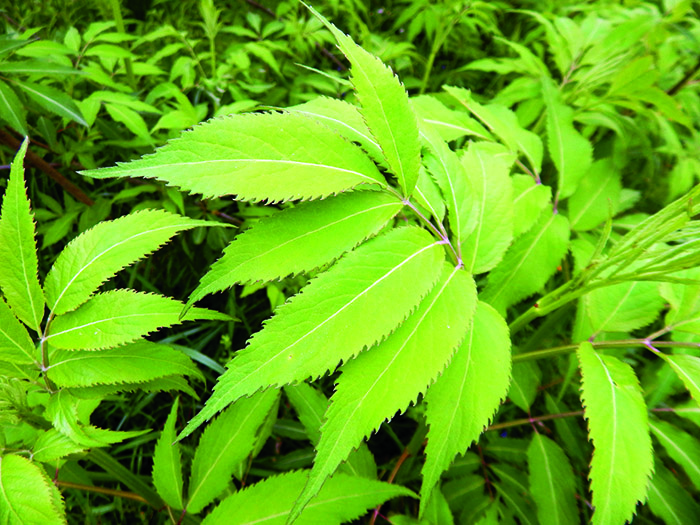
Samuel Thayer, an expert on edible wild plants, offers an excellent description of elder. The leaf typically consists of seven leaflets, which are sharply serrated; 2 to 5 inches long; elliptic with sharply pointed tips; and sessile, or have growth on very short petioles. The leaves and stems of elderberry give off a strong, unpleasant odor when cut or bruised. The small, white, five-petal flowers, about 1/4 inch across, are produced in rounded, somewhat flat-topped clusters, called cymes, at the ends of the branches. These cymes are typically 4 to 9 inches across, and each can contain hundreds of flowers. The fragrant blossoms open in late June and July.
American (Sambucus canadensis) and European (S. nigra) elderberries grow anywhere from 5 to 20 feet in height. In the wild, they reproduce by rhizomes and root suckers, as well as by seed, and tend to grow in dense thickets, similar to blackberries and raspberries.
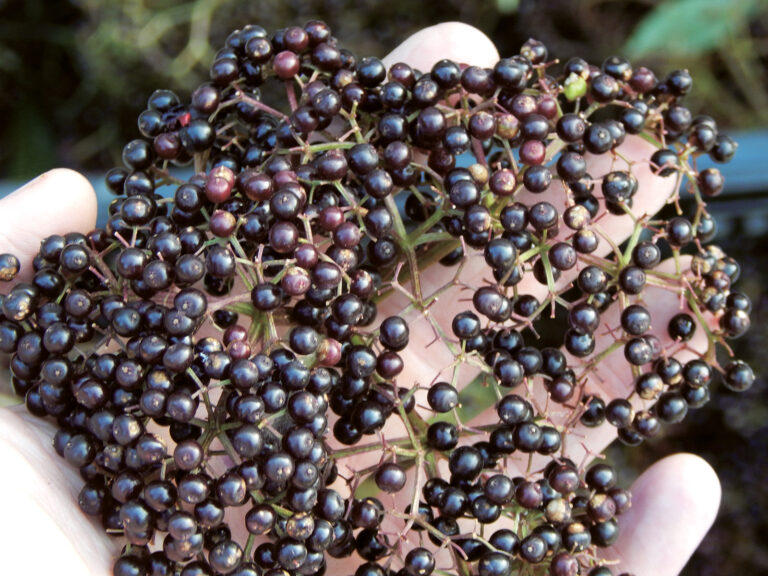
The plant’s fruit, while often called a berry, is technically a drupe. When young, the fruits are green, and as they mature and ripen, they become their familiar purplish color. What elderberries lack in size, they make up for with tremendous production; each cyme may produce hundreds of berries in one growing season. This growing habit makes harvesting elderberries easy: Just snip off the entire cyme to collect dozens of berries.
The branches of elderberry are semi-hollow and filled with pith. They’re also quite pliable, bending from the increasing weight of the fruit clusters as harvest approaches. The older branches are covered in small, scablike lenticels, which are specialized tissues that allow the plant to breathe. These lenticels are a key feature to recognize to help you more easily identify elder when foraging.

All in the Family
Though American and European elderberries are the most widely known, two others — the blue (S. nigra ssp. cerculea) and red (S. racemosa) elder plants — are also worth mentioning. The blue elder is similar to the American and European, but every facet of it is larger than its cousins. It sometimes grows as a tree, reaching heights of 30 feet or more. It mainly grows in British Columbia and through the western United States, especially the northwestern states and northern California. The berries are generally blue in color with a white bloom.
The red elder’s geographical range overlaps with and stretches beyond the blue elder’s range, growing across the majority of the northern half of the United States and as far north as Alaska. It differs from its cousins in many ways. For instance, red elders ripen much earlier and grow grape-like fruit clusters. Their berries range from red to yellow-orange. They’re generally regarded as the least desirable to grow or forage because they can be toxic if not prepared properly. The flavor is also quite poor for such a vibrant and colorful fruit.
Warning: Danger Ahead
When foraging, the best defense against making a bad mistake is to know the plant you’re seeking very well. If you know the elder well, you’ll be better able distinguish it from its closest look-alikes.
Before foraging, know which plants in your area or region are similar to elderberry, and which you may mistake for the elder. The following list isn’t exhaustive, which is why it’s crucial to skillfully learn the elder. Below, I’ll cover the three plants that are most commonly mistaken for elder.
Poke

While poke (Phytolacca americana) isn’t an exact look-alike to elder plants, people often confuse the two. Unlike elders, poke produces fruit across a much larger window of the growing season, and has a much different leaf, stalk, and flower structure. The berries are much larger, as well. Most often, those new to foraging or plant identification mistake pokeberries for elderberries.
Water Hemlock
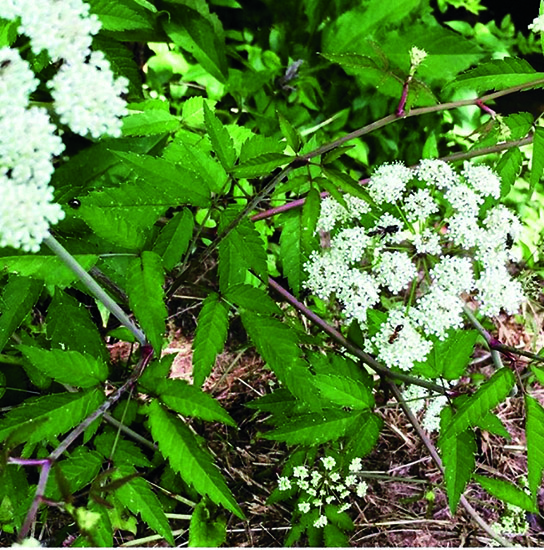
Water hemlock (Cicuta douglasii) more closely resembles elderberry. The twin plant is dangerous enough to be given the distinction of being the most poisonous plant in North America.
There are a number of clues to help distinguish water hemlock from elders, including:
- Location: Water hemlock, as the name implies, enjoys wet growing environments. While its habitat overlaps with the elder’s, it’s generally confined to more limited areas. You’ll find it close to creeks, streams, and similar water sources; it’ll even grow in water, where elder is unable to grow.
- Stems: Water hemlock is an herbaceous plant. The stems are greenish in color and fibrous, much different than elder stems, which are bark-covered and woody. They contain no pith, and lack the distinctive lenticels of the elder.
- Leaves: While similar to the elder, they’re not the same, as the veins end in the notches, instead of the tips of the leaflets. On the elder, they tend to fade out or terminate at the tip of the teeth.
Devil’s Walking Stick

The flowers and berries of Devil’s walking stick (Aralia spinosa) bear some resemblance to those of elderberry. There’s a quick and easy way to differentiate this plant from elderberry: The main stalk will have thorns, which is why the plant has its peculiar name.
Where to Forage
Elders occur in many different places. They prefer moist areas, so they’re common along streams, spillways, and tree lines. In our area, almost every sinkhole contains elderberry, since water tends to run into the sinkholes, and tractors can’t mow close enough to control their spread. Many roads and tree lines may also have elder bushes growing just beyond the reach of local mowing crews.

Since they often occur in areas where property lines and land ownership may be unclear, you’ll need to locate the landowner and ask for permission before collecting from their bushes. On public lands, check if there are any rules that may affect the type or quantity of plants you may forage. Lastly, follow the rule of three when foraging: take, at most, a third of any foraged food you collect; leave a third for others; and leave a third to grow for the future.
John Moody runs a successful elderberry business in Kentucky. This is an excerpt from his book The Elderberry Book: Forage, Cultivate, Prepare, Preserve (New Society Publishers), available below.