For the last couple of decades, heirloom tomatoes have experienced a revival of sorts. Talk gardening with any tomato grower, and you’ll likely hear the word “heirloom.” Today they thrive, yet at one point, these tomatoes were not heirlooms – they were just tomatoes. Their rediscovery – the renewed interest in great taste and buying locally – has spurred a new era of tomato breeding from professionals to amateurs, producing some pretty interesting results.
By definition, an heirloom of any type cannot be new. Tomato authorities debate the exact delineation of an heirloom variety, and at times debate can be vociferous. The minimum age of an heirloom ranges from about 50 to 100 years, dating to before approximately 1950 when F1 hybrid tomatoes were widely introduced. They have often been handed down for generations, or of known historical introduction. They must be open-pollinated, thus the parents must be able to produce true-to-type offspring.
The “new heirlooms” – also called modern heirlooms, specialty, or artisanal tomatoes – are not technically heirloom varieties. They are generally produced from two distinct parents. In order to produce good results, many crosses must be made with only a small number of offspring suitable for commercial release.
The resulting offspring and additional parents may be crossed and reselected over the course of many years, in order to select for certain traits, such as crack resistance or resistance to mosaic virus. Technically, these are hybrids, and the result is an open-pollinated plant.
Varieties to try
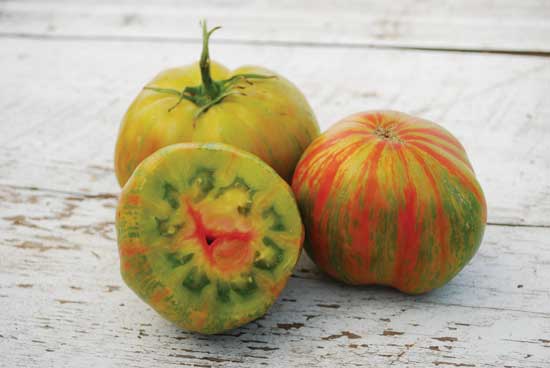
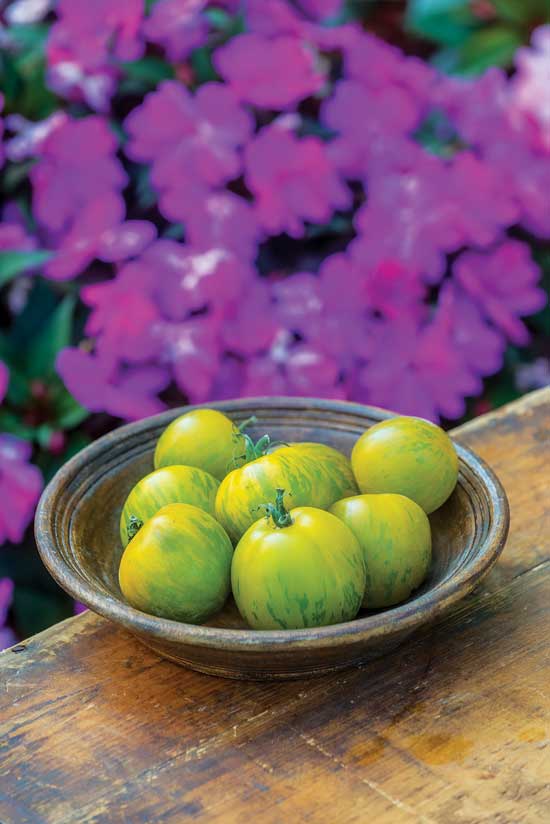
Currently in the tomato world, stripes are in. One of the first “new heirlooms” was Green Zebra, produced by Tom Wagner for his Tater Mater seed catalog in 1983, and is likely the first green-striped tomato produced. This tomato became so popular and widespread that by the 1990s, most people assumed it was an heirloom. Wagner bred Green Grape, a cherry tomato also often mistaken as an heirloom. Since then, varieties such as Isis Candy cherry, Striped (Speckled) Roman, and Pixie Striped are a few modern heirlooms that have been developed by other folks, either from accidental field crosses or intentional breeding.
Wagner continued his breeding efforts, and his company, New World Seeds and Tubers, recently produced a number of interesting new varieties, including “revisions” of Green Zebra and Green Grape. They are respectively known as Abracazebra, a cherry-size Green Zebra reputed to be more cold hardy, and Green Grape Beyond, a very sweet cherry somewhat prone to cracking, like many green tomatoes. Harvesting before fully ripe reduces this issue.
Another particularly good release is Skykomish, an orange bicolor tomato with red blush on its exterior, and yellow flesh with sweet flavor and resistance to both early and late blight. Plants tend to produce right up to frost.
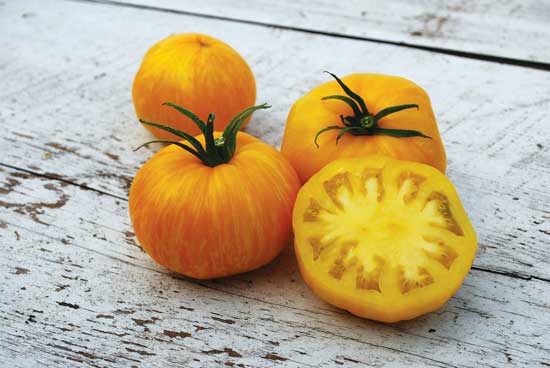
Artisan Seeds is a trademark of the Baia Nicchia Farm in Sunol, California, run by plant breeder Fred Hempel. Along with A.P. Whaley Seed Company, they develop modern heirlooms. Plants are bred and tested in a farm setting, exposed to field diseases and insects, revealing the most resistant varieties. The Bumblebee series is a new group of cherry tomatoes with beautiful stripes, excellent yields, delicious flavor, and resistance to cracking. Fruits are uniform, about 1-1/2 inches in diameter. Sunrise Bumblebee is perhaps the best – orange-yellow with red streaks and an interior blend of red and yellow. Pink Bumblebee has yellow and pink stripes, while Purple Bumblebee is reddish-purple with green stripes. For those desiring a smaller plant more suitable for container gardening, there is the semi-determinate cherry tomato Spike, with unusual deep orange coloration and gold to green stripes. Spike is soft and ripens quickly, making it well-suited for home gardens.
A different take on the classic cherry tomato can be found in the oddly elongated Tiger tomatoes. Reminiscent of paste tomatoes because of their shape, they have distinctly tapered bottoms and are often referred to as julienne tomatoes. The 2-inch-long fruits combine a good balance of sweet and tart flavor. Lucky Tiger is fundamentally a green tomato with green and yellow stripes and a yellow-green interior. Green Tiger has green and yellow striping with a faint marbleized red to yellow-green interior. Pink Tiger is uniformly pink with orange-yellow marbleized stripes. A similar julienne tomato is Blush, a yellow tomato with reddish-pink stripes and a red blush rounded bottom, having a sweet, fruity flavor. These tomatoes ripen well when picked before fully ripe, making them well-suited for market growers.
There are a number of others released by Artisan Seeds, including beefsteak varieties Orange Jazz and Jazz. Both have been field tested for years and are strong growers, fairly resistant to many leaf diseases. These large-fruit types tend to perform better in areas with long, hot summers, such as their home of origin in California.
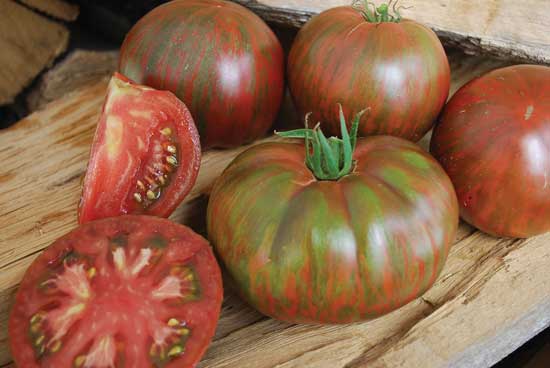
The Wild Boar series is comprised of numerous visually appealing varieties, originating from Brad Gates, a small-scale farmer and breeder from Solano County in California, whose varieties have become very popular in the Bay area. These include appropriately named Green Berkeley Tie Dyed – green with distinctive red striping and faint interior stripes, and a red blush core. Pink Berkeley Tie Dye is dark pink with green striping and pink flesh. Sweet Carneros Pink is well-liked by horticulturist Allen Pyle from Totally Tomatoes. It’s a small rose-colored, gold-striped tomato that is very sweet with excellent yields and is crack-resistant.
Beauty King is a medium-to-large classic bicolor, orange-yellow tomato with beautiful red striping. These and Gates’ larger varieties tend to perform better and have more flavor in warm climates, especially those with hot days and cool nights. They are less suited to northerly regions, but are worth a try if you feel compelled. Others include Pork Chop, a yellow tomato with sweet citrus flavor, early bearing Large Barred Boar, and Janet’s Jacinthe Jewel, a late-bearing variety that produces large orange tomatoes with faint striping.
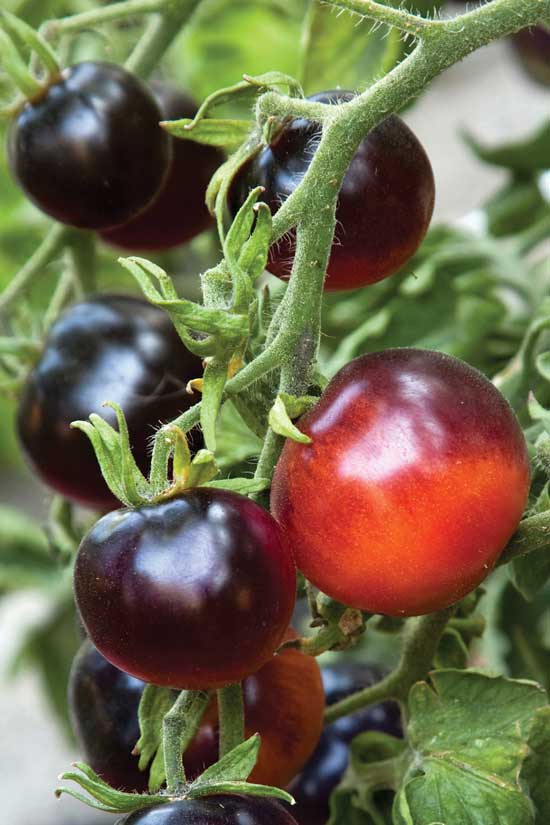
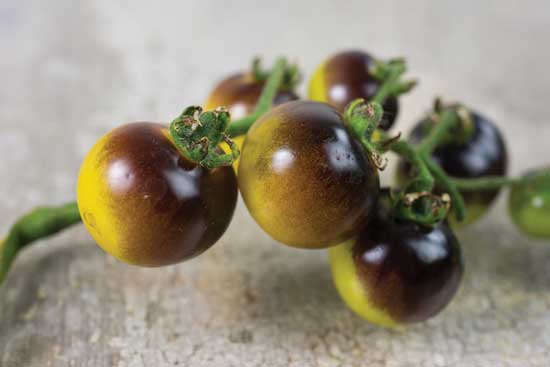
The Indigo series has both hybrid and open-pollinated plants in its portfolio in a range of colors and sizes, and is produced by a number of breeders, including Tom Wagner, Brad Gates and Dr. Jim Myers from the University of Oregon. Bred for high levels of the antioxidant anthocyanin, the few varieties I have tried have been lackluster, although the fruit is nice to look at. Myers’ Indigo Rose is semi-determinate, yielding dark purple to black fruit, while its improved relative, Indigo Cherry Drops, is a more vigorous indeterminate variety with improved flavor. Wagner has bred several Indigo types, including Dancing With Smurfs and Helsing Junction. Gates has created many Indigo varieties, as well, including the cherry varieties Blue Berries and Gold Berries.
There are lots of other small-scale breeders producing an array of these new heirloom tomatoes. It is likely that the field will continue to grow, which means countless varieties and flavors for you to try. Incorporate a few into your garden, along with a few of your standbys, and you might find a new favorite.
Lawrence Davis-Hollander is an ethnobotanist, plantsman, gardener, former director and founder of the Eastern Native Seed Conservancy, and a contributor to Dandelion Gardening Arts in Norfolk, Connecticut.