Grow your farm safety know-how — including your grain bin safety awareness — with these tips on administering first aid and preventing accidents.
You never imagined it could happen to you, but suddenly, your loved one is involved in a serious farm accident and needs your help. What can you do to assist them and provide lifesaving care they may need right away?
Call 911
LaMar Grafft, retired associate director of the North Carolina Agromedicine Institute, says the first key step is to call 911. Be prepared to give the operator the exact address of the accident and a description of where the injured person is located. Use street numbers and specific directions, such as north and south, to describe the accident site, instead of colloquial or local terminology.
If appropriate, contact a neighbor who can meet emergency responders at the farm site address and assist them in reaching the field or extended property where the accident occurred.
“Calling 911 is critical even if it appears the person or people involved in the accident are ambulatory and you believe you can transport them to the hospital yourself,” Grafft says. “What we don’t realize when something like this happens is that the injured person could succumb to a heart attack or become unconscious on the way to the hospital. If you’re driving, you have no way of assisting them or assessing the extent of their injuries.”
Don’t Risk Injuring Yourself
After calling 911, make the scene as secure as possible without putting yourself in harm’s way while waiting for emergency responders.
“This action will vary greatly depending on the nature of the injury,” Grafft says. “It’s important to stop or suppress bleeding before attempting CPR. CPR compression could make any bleeding worse.”
If electricity is involved in an accident, turn off the power source before attempting to approach the victim. Contact with the victim or even the surrounding soil could result in electrocution for the rescuer.
If the injured person is trapped by equipment, don’t attempt to move them as that could injure them further or risk the equipment injuring or falling on you.
Administer Basic First Aid
Having a first-aid kit nearby can greatly help when responding to a minor or major wound. If there’s any doubt about whether the injury is serious enough to contact emergency help, always err on the side of caution and make the call.
“Every adult farm family member should complete a basic first-aid course and be trained to administer CPR,” Grafft says. “Anymore, CPR involves just chest compression. You may also need to give someone a couple of breaths, but knowing the appropriate way to provide chest compression could mean the difference between life and death with a serious accident.”

Fully stocked first-aid kits are available for purchase. However, you can easily assemble your own for use in the home, office, car, or any location on the farm. A complete first-aid kit should include:
- 5-by-9-inch absorbent compress
dressings (2) - 4-by-4-inch sterile gauze pads (5)
- 3-by-3-inch sterile gauze pads (5)
- Triangular bandages (2)
- Adhesive bandages in assorted sizes
- A roll of adhesive cloth tape
(10 yards by 1 inch) - Antibiotic ointment packets (5)
- Antiseptic wipes (5)
- Hydrocortisone ointment
- Roller bandage (4 inches wide)
- Tweezers
- Sterile saline
- Isopropyl alcohol
- Gloves
To ensure farm safety, everyone working on the farm should know where the kit is stored, what it contains, and how and when to use the contents. On an annual basis, examine the contents of all your kits and replace anything that’s deteriorated or expired.
Calling in emergency medical help is necessary when:
- A wound is deep enough to reveal underlying tissue.
- The bleeding of a minor wound can’t be stopped within 10 minutes of firm, steady pressure.
- The injured person demonstrates signs of shock (which can be life-threatening).
- The wound involves the risk of tetanus or rabies.
- The wound involves nerve, ligament, or tendon damage.
- The wound involves penetration to the head, face, torso, or abdomen.
- A limb is broken.
Anytime a wound is gaping and pressure doesn’t allow for closing the wound, medical care is necessary. If the wound is contaminated by a dirty or rusty object or was caused by an animal bite, medical attention will be required. Wearing gloves, pour saline or isopropyl alcohol over the wound to wash away contaminants, and then cover with a clean dressing.
Breathing and Bleeding
Before you manage any minor bleeding, make sure the victim can breathe. Signs that breathing is an issue include:
- Agitation
- Bluish-colored skin
- Confusion
- Alterations in normal breathing pattern or rapid or shallow breathing
- Difficulty breathing or no breathing
- Gasping for air
- Panic
- High-pitched breathing noise
- Decreased breathing sounds in lungs
- Unconsciousness
If the victim is having difficulty breathing or not breathing, be prepared to perform CPR. If the victim is bleeding heavily and requires CPR, quickly apply a compression dressing and then start CPR.
To address bleeding while waiting for medical help to arrive, elevate the wound above the victim’s heart, if possible, to help slow bleeding. Maintain pressure on the wound at the same time.
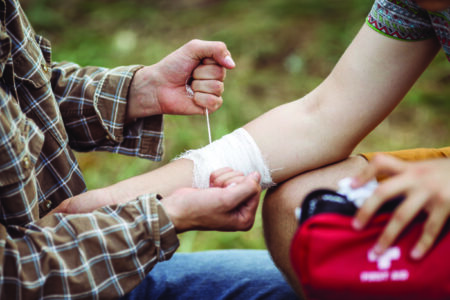
Tourniquets to stop or slow bleeding are almost never advised because they may severely restrict blood flow to an arm or leg, resulting in greater damage to the limb. Use firm pressure at first.
“If a tourniquet is necessary for a major injury, don’t use things like baling twine or some type of cord to help stop bleeding,” Grafft says. “Those types of items can do further damage to tissue. If necessary, a belt or some type of strapping that’s at least 1 inch wide is a better option. An ace bandage or gauze wrapped tightly around the injured limb can also help slow or stop bleeding.”
Further Farm Safety by Understanding Animal Behavior
If livestock injure someone, knowledge of animal behavior will help avoid injury to anyone else attempting to assist the injured person.
“Bulls and bison are commonly involved in injury incidents,” Grafft says. “When cows are calving, cow behavior is affected. That mama cow may suddenly be fearful for her baby and take exception to the fact that you’re in her space.”
Charging is one defensive behavior of cows. Their way of removing a threat in their space is to charge and knock down whatever they perceive to be the cause.
“Typically, the way a cow injures or kills someone is to knock them down and use their head as a battering ram,” Grafft says. “They will try again and again to push you into the ground, causing broken ribs, broken arms or legs, [or] inflicting massive chest trauma.”
Always distract the cow and chase her away from the victim before attempting a rescue. Never assume the quiet cow you’ve been accustomed to won’t display defensive behavior. The best way to prevent this type of incident is to place a sturdy barrier between yourself and the cow before administering care.
“Horses respond differently to a threat,” Grafft says. “A horse will rear up, kick you, or knock you to the ground and stomp you. The safest way to work with any livestock is to set up corrals or other equipment that will keep you safe when you’re handling animals.”
When an emergency involves livestock, designate someone to watch the animals and make sure none of them comes back to the injury site or interferes with rescue efforts.
“It’s comparable to someone keeping an eye on traffic when an injury occurs on the highway,” Grafft says. “Someone must watch to make sure traffic isn’t swerving toward the accident scene.”
Grain Bin Safety
Unfortunately, grain bin accidents are all too common on the farm. Avoid grain bin entry as much as possible, using grain bin entry safety equipment (such as a harness or a lifeline) if entry is necessary, and thoroughly understand the way grain moves when someone walks on top of it to avoid becoming entrapped in grain.
“When someone walks on top of grain inside a bin, the grain is pulled out from underneath the person, and the body is pulled down into that void,” Grafft says. “The more the body moves, the farther it sinks down into the grain.”

A common response for someone becoming entrapped in grain is to tip their head back and yell for help as loud as they can. This instinctive response can be deadly when grain surrounding the person falls into their mouth, blocking their airway.
“If you’re entrapped or you’re on scene when someone is entrapped, keeping the mouth and nose covered will help avoid this kind of tragedy,” Grafft says. “If you must enter a grain bin, always use all the industry-recommended safety equipment, and always have someone outside who can contact help if necessary. If a person is entrapped in grain, it will take a team of rescuers to free them.”
Prevention: The Most Effective Farm Safety Approach
The most effective response to injury or accidents on the farm is taking precautions to prevent serious accidents. Whatever the task, understand the hazards and risks involved. Review and implement farm safety practices recommended by the Occupational Safety and Health Administration’s “Agricultural Safety Fact Sheet“, Purdue University’s “Preventing Accidents on the Farm“, and other online farm safety resources.
Being prepared for an initial response to an accident increases the likelihood of an injured person’s survival and may reduce the severity of the accident’s consequences. “Online and localized CPR courses are available through the Red Cross,” Grafft says. “The American Heart Association also offers CPR classes.” At https://CPR.Heart.org, the American Heart Association helps in locating local CPR training options, offers a course information download, and provides information for hands-only CPR, school training programs, and workplace training options. Learning options include virtual resources and trainings. Additional resources at this site include CPR facts and statistics, “Out-of-Hospital Chain of Survival” (how to improve chances of survival and recovery for victims of cardiac arrest), and extensive CPR education resources.
“Most farm sites are within a reasonable distance of a hospital where the injured can receive full care,” Grafft says. “However, initial first aid can help preserve life, prevent further harm, and promote recovery. Understanding the key points of safely responding to an emergency and being as prepared as possible for that response is a valuable asset for everyone who works on the farm.”
Loretta Sorensen writes from her home in southeast South Dakota, where she regularly develops agricultural safety and health articles for the Central States Center for Agricultural Safety and Health (CS-CASH) at the University of Nebraska Medical Center.
Originally published as “Responding to On-Farm Accidents” in the July/August 2023 issue of Grit magazine and regularly vetted for accuracy.