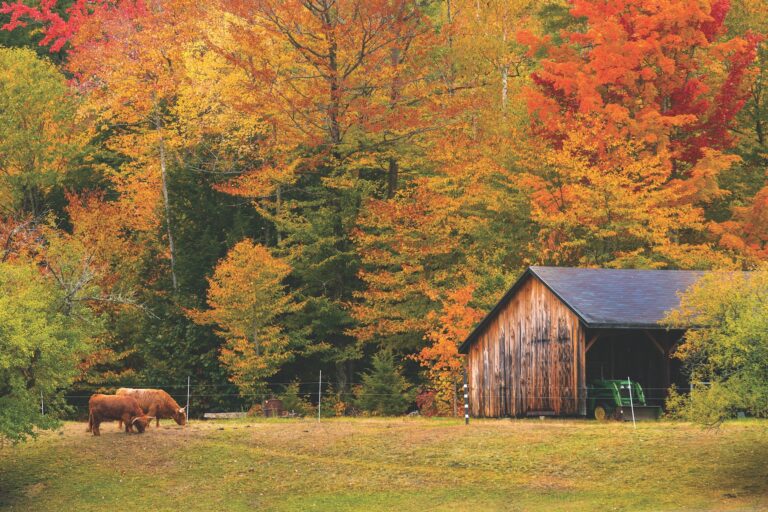
Have you ever wondered why leaves change color in the fall? Learn how the life cycles of deciduous trees contain the key to brilliant autumn colors.
Each year, the lush green of summer turns into the drabness of winter as trees lose their leaves. But the transition in fall typically offers a spectacular panorama of color. For some New England states, it’s a major economic factor. “Leaf peeping,” where tourists gather to see the fall colors, is a multibillion dollar industry. The shift from summer green to warm autumn hues is purely biological, so the beauty is serendipitous.
Although there’s variation from one autumn to the next, an overall pattern repeats itself every year because the display is part of a tree’s annual life cycle. Deciduous trees, primarily the hardwoods, are only active during the warm, freeze-free growing season. Leaf buds will expand in spring, and new leaves will emerge as the air warms. The “job” of the leaves is to gather the abundant sunlight of summer and use this energy to produce food: sugar. The leaves have a large surface area, better for collecting more light, and are typically thin to reduce weight. But these leaves can’t withstand the freezing temperatures of winter. Internal water would freeze, rupturing the vascular transport system. With the shorter days and cooler temperatures of fall, these trees “know” it’s time to shed their leaves and shut down for winter.
Chlorophyll and Other Color-Changing Chemicals
The pigment chlorophyll is an organic compound that has the ability to absorb energy from sunlight, which a plant can then use to produce sugar from carbon dioxide and water through photosynthesis. Chlorophyll primarily absorbs from the blue and red wavelengths of the spectrum while reflecting green — hence the greenish color of deciduous leaves. Once the leaves emerge in spring, they begin to produce more and more chlorophyll, and they turn from light green to a darker, richer hue. As fall sets in, less chlorophyll is produced, and the leaves begin to lose their green color.
There are other plant chemicals in leaves that have distinctive colors. Carotenoids, which produce yellow, orange, and brown hues, are found in leaves throughout the growing season, but are masked by the chlorophyll green. Anthocyanins, which are associated with reds and purples, are produced mainly in fall, and aren’t present in all trees. When chlorophyll production ceases in a leaf, the green color fades, and the other two pigments become dominant. The actual fall leaf color depends on the species of tree.
A Tapestry of Reds, Browns, and Yellows
Fortunately, nature provides us with a full color palette in fall. Aspen and birch are known for their brilliant yellow leaves, which can stand in stark contrast to the surrounding evergreens of more northern latitudes. Oak leaves are typically brown, red, or russet. Sourwood and black tupelo, found mainly in the Southeast, are known for their brilliant crimson leaves. The flowering dogwoods of the Eastern states have purplish-red leaves. Also in the Eastern states, yellow leaves befit the yellow poplar. Hickories go golden bronze; beech become light tan. Some trees, such as elms, don’t take on bright colors; their leaves just turn brown and fall off.

When most people think of fall colors, they think of maple trees, which produce some of the most spectacular color displays. The black maples of the Midwest turn bright yellow. The red maples of the Eastern United States become a brilliant scarlet. From the Midwest to the Northeast, the sugar maple is a fall color highlight, with leaves ranging from gold to orange to scarlet.
Longer Nights and Latitude
This happens every fall, because trees are genetically programmed to behave in this fashion. They respond to day length, or, more precisely, the length of night. Longer nights herald the arrival of colder temperatures. As this is a constant every year, it’s a great mechanism for plant life cycle events. Although all deciduous trees will lose their leaves in fall, they do it at different times, varying by species. Sourwood trees in the South can turn in late summer. Oaks are among the last to turn in fall, and may even keep some leaves until the next spring.
Cooling temperatures are also a cue for the approach of the first freeze, but temperature patterns aren’t as reliable as changes in day length, so this is a secondary cue. Abnormally warm weather can delay the onset of leaf changes, but they’ll still occur due to the lengthening nights. Conversely, colder-than-normal temperatures in early fall can hasten the process.
With the significance of night length and temperature on fall color, it’s easy to see why latitude plays a major role in when colors develop. The farther north you travel, the sooner fall days become shorter. Typically, temperatures cool faster too. In northern Alaska, fall colors start in August. The northern tier of American states can start to see fall color in September (although warmer coastal areas will be later). The southernmost areas where leaves still change can see peak color in November.

The importance of temperature is also shown by the effects of elevation. With temperatures typically cooling as you go up, fall colors at higher elevations can arrive weeks before foliage turns at lower levels. The general rule (officially Hopkins Bioclimatic Law) is that for each 100-foot gain in elevation, fall colors will arrive a day earlier than below. Higher elevations can show the contrast between colorful deciduous trees and evergreen conifers. In addition to earlier color, mountain roads also frequently offer sweeping vistas and less development. In fact, many roads were designed with tree viewing in mind.
Since this whole leaf process generally takes place before temperatures reach 32 degrees Fahrenheit, knowledge of when this typically occurs will give you a general idea of when fall colors will peak. With freezing temperatures being critical for agriculture, there are extensive climatological records on them. A database with this information exists at The National Centers for Environmental Information. The details include the average date of the first 32-degree temperature for thousands of stations in the U.S.
How Weather Affects Leaf Color
But as we all know, some years fall colors are brilliant, and other years they’re dull. This is where weather conditions come into play, most importantly temperature and soil moisture (which is a function of rainfall and evaporation). Anthocyanins seem to be the key. Carotenoids are always present in leaves in roughly the same amounts, so their effect on color shouldn’t vary much. However anthocyanins, produced mainly in the fall, do vary. Warm, sunny days with cool but above-freezing nights are best for anthocyanin pigments. The sunlight spurs the production of sugars, but the gradual collapse of the leaf veins keeps it in the leaves. This extra sugar aids in anthocyanin production.
Soil moisture directly affects the overall well-being of the tree. Drought conditions will slow all processes and result in a diminution of fall color. Some water-sensitive species, such as yellow poplar, may even drop their leaves early, with little color to be seen. Excessive rain in fall is also bad for color. It doesn’t dilute the pigments, as is widely believed, but rather is associated with cloudy, sunless conditions that limit sugar production. Sufficient rainfall is essential for good fall color.
Temperature also plays a role in color vividness. Cold springs will delay the start of the growing season, and may have a ripple effect, delaying and lessening fall color. Excessive heat in summer can take a toll on sugar production. Abnormally warm weather in fall will also throw things off, typically resulting in less-than-optimal colors. In addition, strong winds can physically remove the leaves from trees, ending any fall color. Put these factors together, and you’ll understand how fall colors can vary from year to year.
Climate and the Changing Onset of Fall
Warming global temperatures have recently delayed the onset of the autumn transition in most regions. One study indicated that this delay has approached two weeks over the past 40 years. One problem is that the fall cue of cooling temperatures is being separated from the cue of lengthening nights, which has remained the same. This likely produces stress for trees. In spring, we’ve seen a problem with an early start to the growing season because of overall warming temperatures, making plants more susceptible to killing freeze events, which still occur. A similar effect could occur in fall: If leaf change is delayed by warmth, a freeze event could negatively impact the process.

Another concern would be the increase in severe weather events. Droughts, heavy rains, hurricanes, and wildfires can do immense damage to tree populations. In time, we may even see tree species change. Already we’ve seen some species migrating poleward. This could certainly affect fall colors.
If you want to know about fall leaf conditions in your area, call the United States Forest Service Fall Color hotline (1-800-354-4595), or check its website. The Foliage Network keeps track of leaf colors in the Midwestern and Eastern portions of the country. The National Phenology Network keeps track of fall leaf changes, as well as other seasonal vegetation changes. There’s even a fall foliage prediction map produced by the folks at SmokyMountains.com. They use historical data on weather and past foliage peaks, in conjunction with more current observations, to generate a nationwide forecast. They do add a proviso that predictions can be thrown off by extreme weather events, such as heavy rainfall.
If you live where leaves change with the seasons, consider yourself lucky. The complex hues of fall are some of the most brilliant wonders nature offers.
For 30-plus years, Ed Brotak taught thousands of college students about weather, and helped many of them pursue careers in meteorology. He lives in Asheville, North Carolina, with his wife and daughters.