
Before the dowsing rods come out, the truck rolls up to a small farm where the well has stopped doing its one and only job. The kids are out living their best lives, either mucking around on all-terrain vehicles (ATVs) or doing some ATV-related chores, hard to tell which. The driver of the truck – we’ll call him Dave – and I meet the landowner, and she explains the problem and her research on the history of the on-site well and the neighbor’s well, from which she’s now running a long garden hose to keep her family in water. She’s pulled the publicly accessible well logs filed with the water resources department from when the wells were drilled. Dave is impressed. Not only has she done her homework, but she’s also articulate about where her information came from and has smart questions about what it all means.
Mystery Awaits
One thing is obvious to me after researching dowsing: there is an equal distribution in both camps – the believers and the skeptics – of people who are full to the brim with rubbish. There are believers who make outrageous claims that can’t be substantiated, and skeptics who make cursory attempts in sloppily executed experiments and then claim successful debunking. Someone might “demonstrate” that dowsing is irrefutable by walking over a garden hose and having their hand-held rods bend or cross, while a disbeliever might put a bowl of water under some rods, get no reaction, and decisively declare witching a hoax.
It seems that the gray area we used to attribute to wizards and corpuscles and vapors have all given way to a misguided and vehement certainty. The healthy dose of skepticism that was so important to our survival just a few generations ago seems to have atrophied as well and only gets airtime when someone starts executing too much confidence. There was a point where metallurgy, radiation, and flying were impossible or unexplained, so I suggest we approach dowsing with an open mind.
Do Dowsing Rods Work?
I should rewind back to the beginning. Twenty years ago, behind mirrored glass, I was trying to concentrate on some unimportant spreadsheet for my job at a big-name aerospace facility, while a burly man in a blaze-orange vest and boots hatched from a work truck and ambled across the parking lot. We were about to undergo a big construction project, and I was sure he was there as part of it. Nobody else was outside. He walked casually with two rods in his hands and his arms in L-shapes that mimicked the rods. The rods crossed, and he stopped, took a can of spray paint from the pocket of his vest, and drew something on the blacktop. If I could turn back the clock, I’d have closed my spreadsheet and rocketed out the door to talk to that man. He didn’t know anybody was watching; he had a job to do and was doing it as nonchalantly and as confidently as he’d take out the trash. In the two decades since, I haven’t been able to shake the desire to learn more.
After conveying my sighting of the utility guy with dowsing rods, I asked a distant relative, a retired civil engineer with groundwater experience, if he’d ever worked with anyone who’d used dowsing as a means of doing anything. He told me that the secret to being a good dowser is to study the geological surveys and then only dowse in areas where you’re likely to find water.
A few months later, after some mild online stalking, I made contact with Dave, who’d spent his career locating and drilling wells, and he makes no denial about my relative’s statement. In fact, he reinforces it, saying that to do it right, you’ll have to study the geology – and for the past 40-plus years, he’s put his money where his mouth is. After drilling for more than a decade, he found he could improve the accuracy of his location, depth, and flow rate by putting into practice the skills he’d learned from an old-timer dowsing mentor. Dave was an experienced well driller before he began dowsing, and it was the data in his well logs that proved to him that dowsing has more than a coincidental effect on his results. So much more of a coincidental effect that he took the time to do it when he located wells for the span of his career, and he continues to do it today.
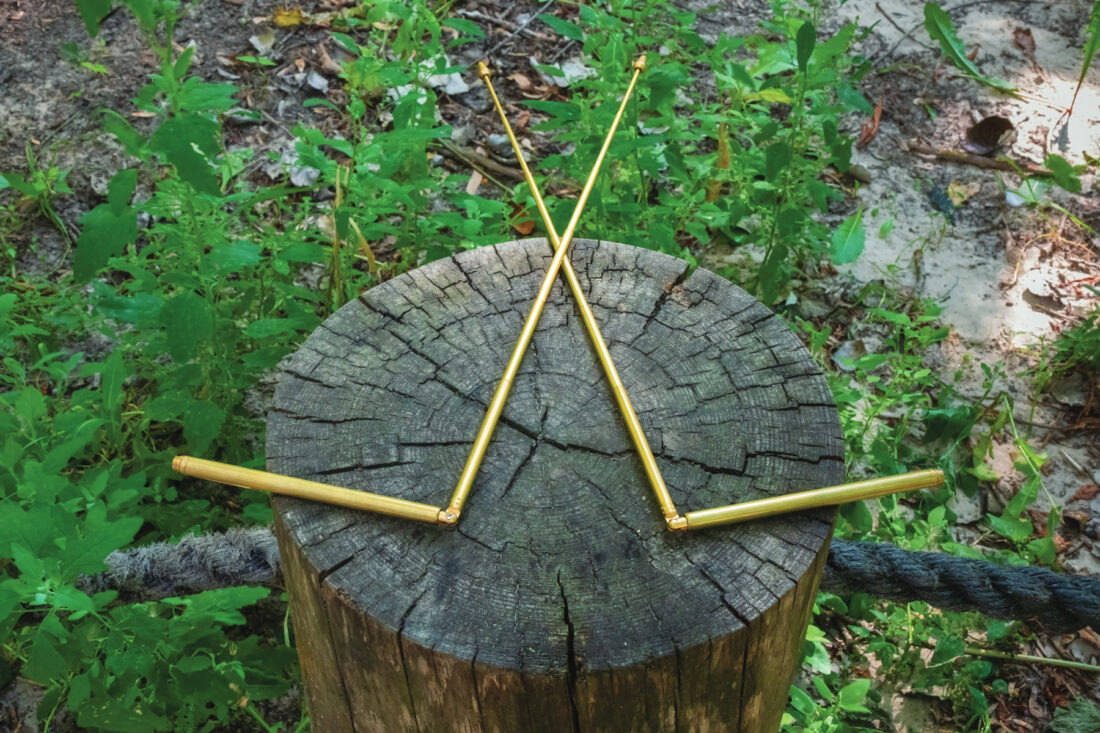
While claim-makers for one side or the other are ubiquitous, people who say they know how it works are as rare as leprechauns. While I’m fiddling with trying to make this work, it occurs to me that the geometry of the rods and forks are probably not coincidental. It’s also noteworthy that for a forked stick to work, it needs to be made of green (wet, therefore conductive) wood. A little research yields the nugget that impure moving water does, in fact, generate a weak magnetic field, just as electrons moving in a wire would do.
This rekindles a memory of my conversation with Dave; he sometimes plays a game with his grandkids wherein he stands by a hose but is unaware of the spigot and the nozzle of the hose. The kids turn the hose water on and off, and he tells them whether it’s running. He says the water has to be moving to detect it. He also plays the same game with an extension cord, but something must be drawing power on one end for it to work. Suddenly, the orange-vested parking-lot guy makes sense, and induced electromagnetic fields make rod dowsing seem at least plausible.
How Do Dowsing Rods Work?
That begs an important question: Are rods the instrument or are you? Is there symbiosis? Do the rods not work without you or you without them? I’ve been using coat hangers as rods. I sand the paint off and try them out. Then, I spent $15 to buy 1/8-inch brass ones like the pro uses, and they work just as well as the coat hangers, which is to say that I’m still unable to detect flowing water or electrical current consistently. I’m disappointed but not surprised when I design my own experiment with a wooden jig to hold the rods over a hose that I turn on and off and nothing happens. The rods do seem to take on a life of their own in my hands. They definitely want to move deliberately, if not predictably, and I suspect that my inability to clear my mind and set intentions may have something to do with it.
One thing is for certain – this process is exclusionary. It doesn’t work for everyone. Just like someone who knows they don’t like fried spam before they’ve tried it, it’s clear that for someone who’s sure dowsing doesn’t work, it isn’t going to work. I suppose the same is true for people who don’t try it. This is why I decide to break out the rods on a family campout and see who can tell if an extension cord meant for RV hookups is carrying current to a work light positioned behind a tree. Of course, I fail miserably, and so does most of my family, but my dad can predict it with uncanny repeatability.
Who can make it work is anyone’s guess, but “experts” lean toward it favoring pure hearts, noble intentions, and clear minds. Dave’s rods were 3-inch brass rods, 1/8 inch in diameter, with a roughly 6-inch bend for a handle. In locating, it’s commonplace to use two rods and see where they cross, but one can be used to determine direction or depth, which Dave does by counting oscillations of the rod as he tries to hold it steady. Others read distances or depths by looking for dips at spoken distances, sometimes in imperial units, sometimes metric. Dave would ground his rods by touching them to the Earth frequently to prevent charge from building up. Some dowsers use plastic tubes to hold the rods, maybe for friction, maybe for charge isolation. I guess I could’ve saved the sanding step on my last rods. Fences and possible buried lines don’t seem to concern him, but Dave warns me that underground sprinkler systems can really interfere with the process.
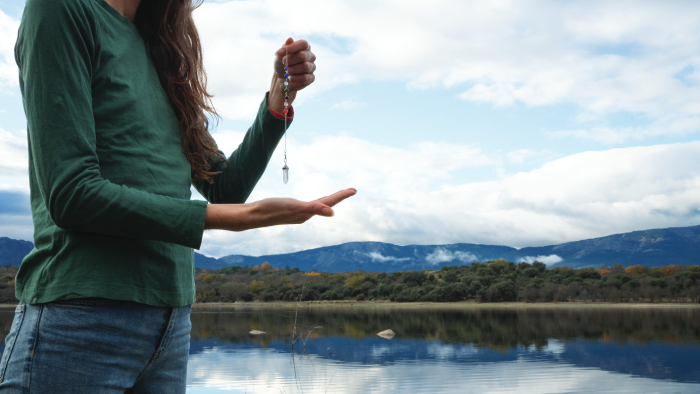
This is where things get even stranger. If you stumbled upon this article in an effort to make your kids think you’re even weirder than they already think you are, you’re in the right place. Strap in and break out your orgone cloudbusters and Ouija boards, because the kind of locating Dave does, on-site with brass rods, isn’t the only dowsing out there.
Pendulum dowsing is so different from rod dowsing that I’m surprised the two live under the same moniker. In this practice, the dowser can ask specific questions and get them answered through the swinging pattern of the pendulum. The questions must be specific, like the ones you’d ask if you were interfacing with computer code. Many dowsing enthusiasts will point to an easy-to-read, how-to pamphlet titled “Letter to Robin” for more practical instruction on this method. Just to drive the weirdness stake a little deeper, the pendulum dowser doesn’t even have to be on-site. For “map dowsing,” the dowser asks questions over a map, which could be a thousand miles away from the actual site. If we assume this works, it again raises the question about whether the person or the hand-held device is the instrument.
This is also starting to look uncannily familiar to the Stargate Project, which the U.S. government ran from 1977 until its termination and declassification in 1995; “remote viewers” would envision and record what was at a set of remote map coordinates. Rod dowsing has also been employed by the military. My original coat-hanger rods were fashioned after the rods used by dowsing expert Louis Matacia and others when they instructed Marines in 1968 on how to dowse for hidden Vietcong materiel at Camp Lejeune.
Really?
It’s easy for all of this to seem like nonsense. Where are all the wealthy dowsers? The ones who map-dowsed the treasure and the veins of silver and pockets of oil? Do they know that exposure of their secret will reveal things that might be better left undiscovered by a general population? Did they die wishing that their grandchildren would’ve shown a modicum of interest in their craft?
On the flip side, it’s rare for people to put so much energy into something that doesn’t work or a lie that doesn’t have a grain of truth. People have been at this for a long time.
If you want to know entirely too much about dowsing history, pick up a copy of The Divining Hand by Christopher Bird. It’s a fascinating tome replete with wood-block art showing dowsers locating ore and water since the before times and more content than you’d think could possibly exist on such a narrow subject.
But if all the anecdotal data is to be trusted, why did dowsing and remote viewing seem to fall off a cliff sometime in the ’70s? Was the whole thing to fool the Soviets, or did it disappear in a National Security Agency psyop to convince us that “there’s nothing to see here, move along please,” so we could actually develop better ways to see into the Soviets’ underwear drawers? In 1977, the U.S. Geological Survey published an informational pamphlet about dowsing that seems aimed at preventing the spread of misinformation and discrediting the practice.
I Want to Believe
If this is all hocus-pocus, what did I see that guy do out in the parking lot with the spray-paint cans? He wasn’t doing it for his YouTube channel or to attract customers to his crystal sales website. It seems like you could rely on the legendary Mythbusters to make the call on this phenomenon, but they chose to sit this one out. That leaves me with one option – to simply open my mind and echo the poster in The X-Files: “I want to believe.”
Josh Lau has a Bachelor of Science in mechanical engineering but isn’t sure that science has all the answers.
Originally published in the May/June 2026 issue of Grit magazine and regularly vetted for accuracy.