


Growing Open-Pollinated Heirloom Corn
“One American farmer feeds 128 folks, plus you,” or so proclaims the adage found on roadside signs across the heartland. Yet ironically, most of those farmers actually produce commodities such as corn that get passed on up the line — and aren’t consumed directly or even indirectly by people. Thanks to steadfast seed savers and a growing interest in saving heirloom seeds, a number of nonhybrid, nonsweet eating corns are still readily available — for growing and for eating. And best of all, you can save seed from this year’s crop to grow next year’s.
Can the sweet corn
While I am not terribly fond of the super sugary sweet corn varieties, I don’t mind an old-fashioned sweet corn now and then, such as Will’s Early June or Golden Bantam. But limiting your corn growing experiments to sweet corn does this marvelous plant and its breathtaking diversity a total disservice. Most corns, even the open-pollinated heirlooms that aren’t sweet corn, are sold as field corn, feed corn or decorative corn. My ancestors and the native folks who farmed this country before them no doubt enjoyed the beauty of multicolored and textured corns, but the notion that they were good for little more than their good looks or feeding to livestock would have never crossed their minds. What about the smoky flavor of fire-roasted ears, or the crunchy delight of parched corn, or good grits made with hominy, or fresh tortillas, cornbread, Indian pudding and polenta? And don’t forget popcorn.
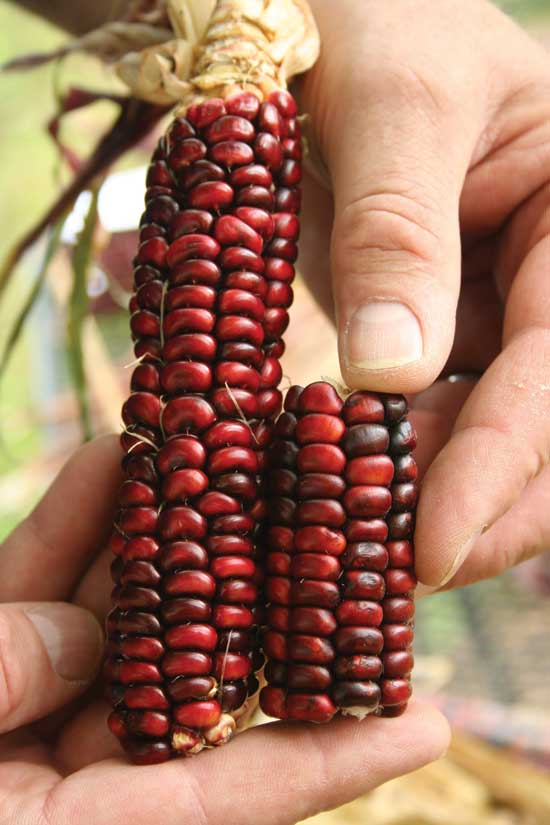
Whether you choose flint, flour, dent or popcorn varieties, some of the oldest and newest selections in open-pollinated corns are indeed utterly beautiful to look at, but more so, they are delicious, versatile and you don’t need to purchase seed more than once. Varieties of open-pollinated heirloom corn are also easy to grow, usually requiring fewer inputs than their high-performing modern counterparts. Adding nitrogen in the form of composted manure at planting and blood meal at the final hoeing or cultivating should be all they need in good soils. The best part is that the variety is virtually endless, and you can create your own by selecting ears with interesting traits and growing out the seed in an isolated bed next year.
Preparing the earth
Your corn patches will benefit from tillage in the fall or the early spring — possibly both. These are the times to work in cover crops and generous amounts of compost or composted manure if you need to get the fertility up a bit. Depending on the size of your patches, you can work the ground with a turning spade or fork, a small or large rotary tiller, or a tractor-mounted field cultivator or disc. If you have a wheel hoe with a tine cultivator attachment and your patch isn’t too large or compacted, use it to loosen the soil and work in the compost or other amendments. Alternatively and especially in mellow, relatively small patches, use a broad fork to loosen and aerate the soil and a hand cultivator (three-prong device attached to a handle) or soil rake to smooth the seedbed.
Once the ground is worked and you’ve left it long enough to become friable and mellow, it’s time to do some leveling and clod or rock removal. The metal “dirt” rake works well for this task. If you are going to plant your crop in ridges so that you can use gravity to help with flood irrigation, now is the time to mark the rows and hoe or use a middle-buster type attachment on the wheel hoe (or tiller or tractor) to cut troughs while forming ridges. If your soil is quite mellow, light and soft, you can accomplish much the same effect with a piece of 2-by-10 or other lumber of a similar dimension pointed at the front like the prow of a ship, adding sides to it and some weight inside, and pulling it through the garden. Likewise, there are attachments for some rear-tine rotary tillers called hiller-furrowers that will also do the trick. If you plan to simply plant the ground without furrowing, so much the easier. If you plan to plant your corn in hills, create soil plateaus about 8 inches high and 18 inches in diameter spaced on a 4- to 6-foot grid, depending on how much moisture you can deliver to them.
Sowing your seed
If you want corn in nice straight rows, stake and line out your rows with string and hoe furrows (drills) about an inch deep. Walk along the furrows dropping seed at 6- to 8-inch intervals. Once the seed is placed, you can use a hoe, your feet or a drag made from a piece of lumber to cover the seed. Walk along the rows or roll the field in some way to press the soil into contact with the seed. If you want corn planted in hills, use a dibble to poke holes in the hills (described above) for planting the seed. Use your hands or the hoe to cover them and to press the soil firmly into contact with the seed. For hill planting, plan to place six to eight kernels and thin to the strongest four to five plants.
Another easy method for placing corn seed in rows or hills is using an old-fashioned stab planter. The stab planter consists of an opener/seed delivery tube and some kind of seed-metering capability — sometimes as simple as the operator dropping the individual seeds into the tube. Closing and pressing are generally taken care of by the operator’s foot. Simple as it sounds, much of corn country was planted with such devices shortly after the sod was broken. Look for functional antiques, or check out the Stand’n Plant seeder. You simply walk down the row or from hill to hill and set seeds where you want them — one at a time.
If you prefer a bit more mechanization and wish to plant in rows, then you may want to upgrade to a walk-behind garden seeder or drill.
Today’s seed planter is a precision machine that places individual seeds at a specific spacing along a row. As the planter moves along the row, it opens the soil to a specific depth, places the seed, covers the seed, and provides some means for pressing the soil into contact with the seed. Walk-behind planters generally have a wheel in front that drives a seed-metering mechanism that delivers a single seed at precise spacing, an often-hollow wedgelike structure called the shoe opens the soil and helps convey the seed to the soil, a closing device pulls the soil back over the seed — chains, discs, etc. — and a press wheel at the rear ensures good seed-soil contact, which is needed for efficient germination. Look for new models in all quality levels and price ranges from companies such as Earthway, Cole Planet Jr. and Hoss Tools.
If new isn’t in your budget, look for one of the nearly thousands of models of antique walk-behind planters that still turn up at farm sales and antique stores around the country. The key to working with these tools is that their seed-metering plates or drums or brushes are intact or easily fabricated. Look for names like Cole, Planet Jr., Atlas and a host of others.
Cultivation
Your corn patch will require cultivation at least twice between the time you plant the seed and when the crop canopies. The first cultivation should be done after the first good flush of weeds has germinated, but before they are really crowding your corn seedlings. In Kansas, we generally cultivate the corn when the seedlings are in the 6- to 8-inch-tall range. The weeds are usually much smaller than that. You can use virtually any tool at your disposal, but the hand hoe, wheel hoe, and even mini-tiller all work well on the smaller scale. If you planted your corn in hills, the wheel hoe and hand hoe make the most sense. One- or two-row tractor-mounted equipment would let you cover more ground more quickly.
Before the corn has canopied and after a good second flush of weeds has sprouted is the best time to cultivate the second time — and you can save labor if you also incorporate hilling into this exercise. Hilling is the process of throwing soil from between the corn rows into them. Hilling helps prop the corn plants up and serves to bury small weed seedlings that sprouted in the row between the plants. We tend to use hoes for hilling and cultivating hill-planted corns, and the wheel hoe with a hiller attachment to accomplish the same end in the row-planted patches.
Effective cultivating leaves weeds uprooted and the soil surface loose so that it can dry and create a mulch of sorts that will reduce weed germination near the surface. Although we’ve used a number of antique wheel hoes — found at various farm sales and junk shops — if you go that route, you definitely want to be sure that the wheel and carriage are functional and that you have at least one set of knives or serviceable tines specific to the individual brand and model. If you are good with metal fabrication, then it goes without saying that you should not hesitate to try and create the attachments you need if you find a wheel hoe sans accessories.
Harvest the bounty
Monitor your patch’s progress, especially as the ears begin to fill. Corn varieties like Hopi Blue can be eaten boiled like sweet corn or roasted in the green husk at the early milk stage. The kernels at this stage are firm enough for you to cut them with a thumbnail, and they will exude a lovely milky juice that is mildly sweet with delicious corny flavor. For most other uses, you can simply let the corn plants mature, turn brown and dry down before harvesting. At that point you can shock the corn stalks — leaving the ears on. Or you can snap the ears off, pull back the husks, and allow them to dry further out of the sun and away from dew and rain. Folks traditionally braided the husks together and hung the braids of ears from barn or shed rafters, but you may simply want to remove the husks entirely, shell the corn by hand or using a hand-cranked box sheller, and store it in paper bags in the freezer or pantry. Be sure to save the nicest, most healthy ears for seed to plant next year. In time, you just might develop a strain that is particularly well adapted to your growing conditions.
Read more: Get Hank’s Wholegrain Cornbread Recipe
Container Corn
Folks often think they can’t grow corn unless they have a huge plot of land. Nothing could be further from the truth, as a few meals’ worth of corn can readily be produced by even a 15-by-15-foot patch, depending on the growing conditions and variety. In fact, you can grow corn in containers on your patio or deck. We experimented with growing corn in 30-gallon plastic containers last summer and achieved good success with about a meal’s worth of grain produced per container. We used a barnyard mixture of composted hay and sheep manure (as scraped from the corral) as the growing medium, and essentially treated each container as a hill. Planting eight to 10 seeds per pot and thinning them to the five strongest plants resulted in average to good yields (number and sizes of ears) for all five varieties that we tested (three popcorns, one flint and one flour). Since the corn’s roots are somewhat restricted, it was particularly important to water the container corn when we didn’t need to water in-ground plantings, and because the “patches” were so small, we spent a little time dusting ear silks with pollen as the pollen shed in the morning. Whether you want to experience the satisfaction of growing one or two batches for your own cornbread or you intend to make spectacularly colorful center pieces, with care a couple containers of corn will have you covered.
Although there are literally hundreds of corn varieties to try, the following are some of my favorites that are typically available. Search the Seed Savers Exchange Yearbook, Sand Hill Preservation Center’s catalog, Southern Exposure Seed Exchange, Native Seeds/Search, Assiniboine Tipis, and all of your favorite seed catalogs for scores more possibilities.
Favorite Flints: Roys Calais, Floriani Red, Maize Caliente
Favorite Flour: Painted Mountain, Mandan Red Clay, Hopi Blue
Favorite Sweet: Maricopa, Will’s Early June, Stowell’s Evergreen
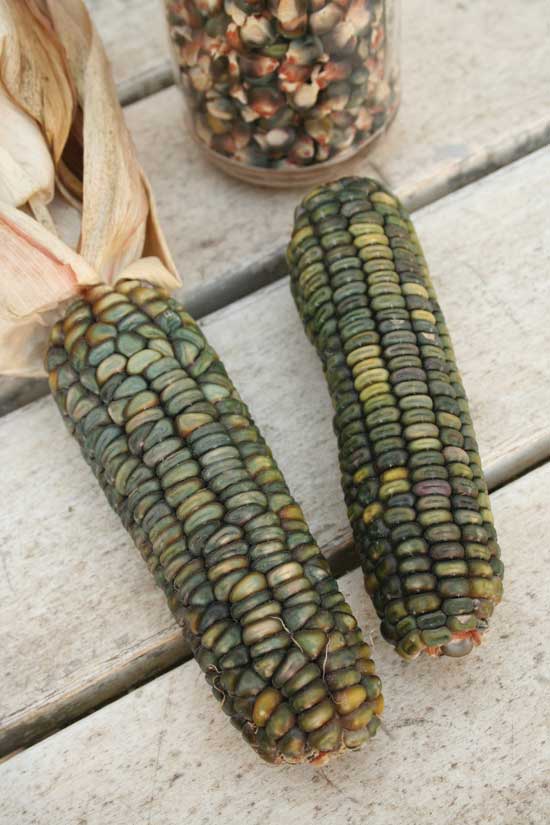
Favorite Dent: Oaxaca Green; Bloody Butcher, Shumway’s Goliath Silo
Favorite Popcorn: Dakota Black, Glass Gem, Chapalote, Strawberry
Corn Culture
Because corn is wind-pollinated and is so diverse in characteristics, whenever you plant corn and wish to produce ears and seed that are true to type and that will breed true, you need to pay some attention to the physical layout of your plots and their relative locations. Most folks know that it is important to keep sweet corn patches away from field corn patches to avoid having ears that contain both sweet kernels and starchy kernels – the reason is all about pollen travel.
If you plant your corn in rows or hills organized in blocks, rather than long thin strips, you will go a long way toward improving pollination percentages within the patch. If you have no choice but to plant in strips or very small blocks, you can help things along during pollen shed by bending tassels down toward the silks and gently shaking to release the pollen. If your blocks are small, you can also avoid all manner of insect pest by constructing light frames covered with window screen and placing them over the patch. Be sure to stake them securely if you live where the wind blows.
Ideally your corn patches will be isolated by at least 660 feet or up to two miles in open windswept country from the nearest source of corn pollen contamination. If you have a tall hedge or shelterbelt between your patch and the foreign pollen source, you can cut the distances down considerably. If you manage several varieties in a season, as I do, you may want to learn how to hand pollinate and of course, you can grow several varieties with different days to maturity and planting dates to ensure that they are not flowering at the same time. Native American farmers understood that corn would travel from one patch to another nearby, and this was not considered to be a bad thing. However, seed was hand selected carefully and patches were separated by rows of other crops.
If you wish to keep your corn perfectly free of proprietary GMO genetics, you may want to time your planting so that your corn is flowering long before the commercial field corn in the surrounding area. With many heirloom open-pollinated varieties, you can plant earlier than grain farmers and if you choose shorter season varieties, you will have your first crop finished about the time the field corn is tasseling. In Kansas, I can plant a second crop of short season varieties in late June and they will tassel long after the local field corn has stopped shedding pollen. There are many ways to keep your corn pure – don’t let the possibility of pollen contamination scare you off.
Editor-in-Chief Hank Will comes from a long line of seed savers. His great-grandfather founded the nursery and seed company, Oscar H. Will & Co. Heirloom corn is just one of Hank’s areas of expertise.
Hank Will raises hair sheep, heritage cattle and many varieties of open-pollinated corn with his wife, Karen, on their rural Osage County, Kansas farm. His home life is a perfect complement to his professional life as editor in chief at GRIT and Capper’s Farmer magazines. Connect with him on Google+.