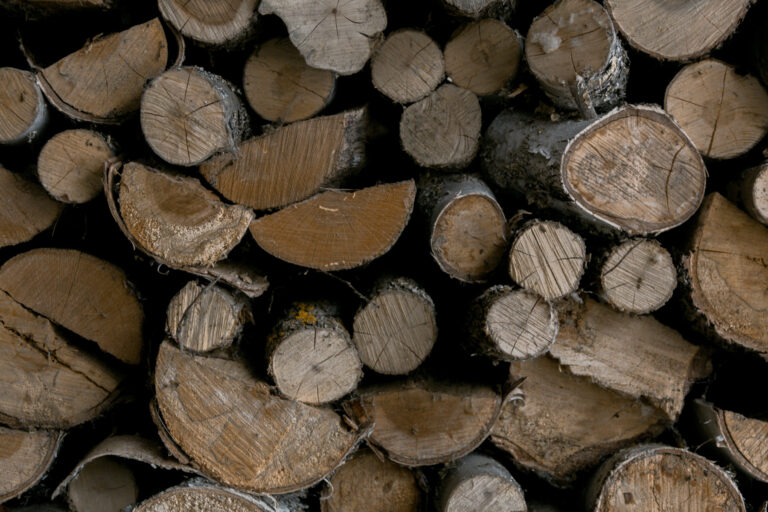
In my part of upper New England, winters are long and cold; one definition of security is a big stack of well-seasoned firewood. The urge to “get the wood in” runs deep, an itch that kicks up when the leaves begin turning in mid-August and won’t stay scratched until the snow season’s fuel supply is ready to hand.
Some folks are satisfied with storing their fuel in haphazard heaps, but students of the stack know that firewood quality will improve with time when billets are well placed in a proper woodpile.
Building a woodpile is an art and a science. Firewood just dumped in a heap won’t dry properly or burn well. But even the toughest ash and beech fire logs will start quickly and burn efficiently if seasoned in the woods for 6 months to a year, sectioned to stove length, split and piled in the woodshed or barn for some months more. The trick to building the pile is to leave room for plenty of air.
Stacked in the woods
Since colonial days, wood cut from trees too small to saw into lumber has been bought, sold and traded by the cord – 128 cubic feet of 4-foot-long logs – and aired in a stack 8 feet long and 4 feet high. Loggers were paid by the cord as piled in the woods – each cord was anchored at one end against a standing tree with the other end ricked against a pair of stout poles sunk in the snow or soft ground. A crafty woodcutter would build in as much air as he could, padding his wages a bit and helping speed the seasoning process.
Left in the woods through at least one season of dry winter air, the logs would lose their live wood moisture content in excess of ambient humidity (about 20 percent) through evaporation in warm weather and, more slowly, via sublimation (direct transformation from ice to water vapor) in freezing temperatures.

Come the wood-selling season the following fall, big-wheeled log wagons pulled by ox teams would haul the 2-ton cords to wood yards in town. There, the 4-foot logs would be sectioned to stove length (a bit less than the width of a parlor stove’s door or length of a range’s firebox), or divided in the middle for 2-foot-log-burning stoves. And it would be stacked in 4-by-4-by-8 cords again for sale.
Exposed to the elements
A woodpile is a public thing – as much of a “statement” as your garden or your mailbox. In some parts of the country, locals judge a person by the trueness of his or her firewood stack. In any case, you will be rewarded with a fine supply of warming wood in the winter if you follow a few basic rules when organizing your own pile of pieces.
If your woodpile is outdoors, give it as much sun as you do your garden, since billets stacked in the moist shade will never dry. Encourage air to move through channels in the stack, by orienting sticks so that the cut ends face the direction of prevailing air movement.
For best results, build your woodpile on a base that will protect the bottom layers of logs from rot. Runners constructed of treated lumber, steel, concrete or other rot resistant materials work well to keep the first layer several inches above the ground, while allowing air to circulate beneath them.

Keep horizontal log layers as even and level as possible as you build the stack. Set logs so they overlap one another for best stability. Stacking round logs one above the other creates long seams that are anything but stable. Build as much air into the stack as you can, using irregularities and odd-shaped logs to create cross-stack channels. Always stack split billets bark side up. Bark will help shed moisture in the woodpile. When possible, use a standing tree, fence post or other stationary object to support the pile. At free ends, build stable, square cribs by stacking logs at right angles to each other in alternating courses.
Fashion a water-shedding weather cap for your woodpile by building a peaked roof from overlapping splits or shingles. Splits of birch, beech or another smooth bark species make the best cap logs. Alternatively, you can cover the stack securely with a sheet of plastic or a tarp. However, be sure you don’t completely seal the woodpile’s sides or the stack won’t dry properly.

The shape and size of the woodpile is your option. Straight stacks along fence lines are traditional, although some wood stackers build a series of cubes and others prefer more whimsical shapes. My favorite woodpile is the Shaker round, which is constructed by first making a circular base of split logs arranged like spokes in a wheel. Adding carefully laid layers results in a shoulder-high, cone-topped, disk-shaped woodpile. Covered with lapped birch splits or thick shingles, it will keep your wood dry and dazzle the neighbors. If you build with a section of perforated plastic pipe in the center and top it with a sheet metal cap painted black, air will be drawn up through the wood and out like a chimney.
Snug and under cover
Storing your firewood in an open-sided woodshed is much like storing it in an outdoor pile except you don’t have to be as careful with the stacking or worry about keeping the rain out. But if you store your fuel inside the house, there are a few things to keep in mind, especially if the house is well insulated and tight.
First, wet wood can store up to a half-ton of water per cord. As the wood cures, the water will evaporate, which can result in moldy ceilings and peeling wallpaper. Second, fresh red oak, cherry and black-birch have a powerful odor, and, finally, legions of tiny, hard-shelled bark beetles and other multi-legged critters will spread from the pile throughout your house.

If the wood is left to season for a year in the woods, water and aromatic oils will dissipate; live tree wildlife will move out; and salamanders, centipedes and other decaying-wood critters won’t move in, so the wood will be easy to live with. When in the house, stack it loosely, away from cellar walls and up off the floor to encourage air circulation.
Uncle Will’s woodpile
My Great-uncle Will made it a point of pride to have the wood in and stacked well before the first hard frost in October. He usually had several cords of 4-foot logs arranged along the roadside fence, while stove-length unsplit sections filled one bay of the barn. Half-splits were piled between barn and house to turn the path from milking parlor to kitchen into a seasonal tunnel. Quarter-splits and kindling were on pallets in the cellar. All the firewood was stacked square and even. Where exposed to public view, only the most perfectly round, freshly cut ends looked out, the vertical face of each stack as flat, plumb and slick as any newly plastered wall. Indeed, the house looked almost walled in by firewood. Neighbors driving by would nod approvingly. Leaf-peeping tourists would stop to snap pictures. And, with all the wood neatly stacked, Uncle Will would glance up from his chores from time to time and comment to anyone within hearing, including the dog, any cat that was handy, or an adoring young grandnephew, “Yep. We’ll stay warm this winter. Now the wood’s in.”
Benefit mind, body and spirit
Uncle Will spent most winter forenoons working up next year’s wood. This meant hauling logs out of the snow-filled woods with Gawd ‘n’ Dammit, the team of geriatric Belgian draft horses he treated like house pets but worked hard enough that all three of them stayed trim and hard-muscled into a robust old age.
He was more than content to leave the family snug in a house heated with fuel he’d felled, bucked, split and stacked with his own hands.
Few of us moderns have so tangible a reason to feel good about ourselves as Uncle Will did. This is why I self-medicate with a bucksaw, maul and set of splitting wedges along with a really big woodpile; it’s therapy for the twitches, gout, flabby midsection, jangled nerves or any number of modern maladies that seem so prevalent today. A heap of fresh cordwood begging to be sawed, split and stacked is all it takes to burn those blues away.
A version of this article originally appeared in Mother Earth News.