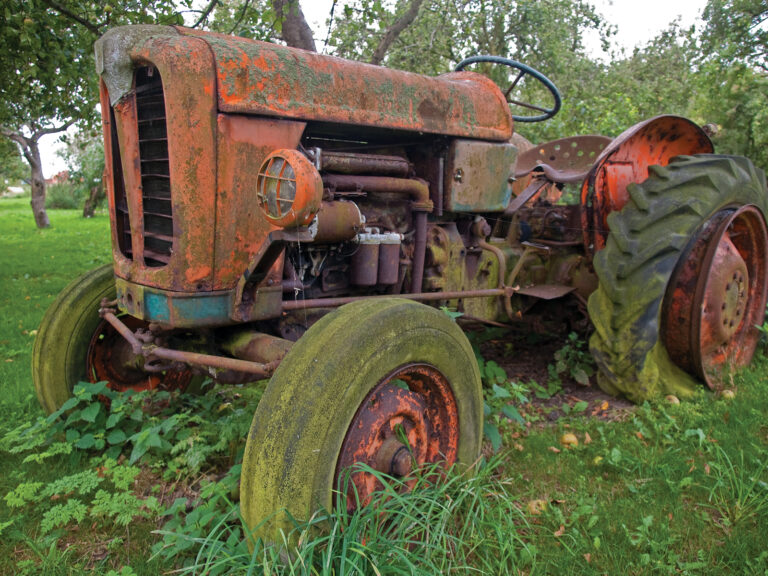
How do you safely restart an old engine that hasn’t run in years? In a word, slowly. No, make that very slowly. Why is this, you might ask? Because in all the time your antique tractor, high-school hot rod or retro garden tiller has sat there gathering dust and rust, gravity and other elements have been working against you.
Every drop of motor oil that was on pistons, rings, cylinder walls, cams, bearings and the crankshaft when the ignition was last shut off — who knows how long ago — is now way down in the oil pan. Your engine’s lifeblood has turned to filthy, mucky sludge. Rust and corrosion now coat many of your engine’s most important moving parts.
That’s why all engine experts agree: You don’t just slap a new battery under the hood, turn the key and crank away. To do so invites mechanical suicide. Your engine will eat itself up from the inside.
“The Society of Automotive Engineers says 90 percent of engine wear and damage occurs during start-up, not while driving,” warns the Classic Car Club of America. “Starting your engine after long-term storage is equivalent to a 500-mile trip.
“When a car’s engine has not been run in months, it may take as long as 10 seconds for oil to reach all parts that need it. Metal-to-metal contact can cause serious wear or damage before there is normal oil pressure.”
Imagine what the internal destruction might be for an engine that wasn’t put into storage properly — and hasn’t run in years or even decades.
Look before you leap
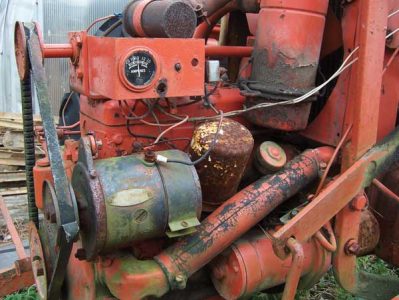
As Yogi Berra put it, “You can observe a lot by watching.” A close visual inspection of the exterior of the engine will give you some idea of what you’re likely to find inside. Cracked radiator hoses or a leaking radiator may mean your cooling system is not too hot. A shredded fan belt or wobbling fan hints that the water pump is shot. Missing filler caps, dipsticks or rubber boots around gearshifts and other levers mean lots of water and rust inside the engine.
Repair or replace all missing or broken parts that could harm your engine when it’s finally time to restart it, advise my neighborhood master mechanics, Phil Casey and Jim Kellar, who have some 75 years of experience in the field between them. Like all engine work, this should be done under shelter in warm weather or in a heated work space.
Before you lay hands on the engine, though, play it safe: Disconnect the battery (if there is one) to avoid an accidental start with your fingers in the way, and set the brakes or block the wheels, so whatever you’re working on doesn’t roll. Lastly, but maybe most importantly, make sure the transmission is in neutral.
A farmer friend in Virginia didn’t take his tractor out of gear a few years ago. He started it while standing on the ground (a BIG safety no-no). The rear wheel ran right over top of him. The tractor crashed through the barn wall, and kept on going.
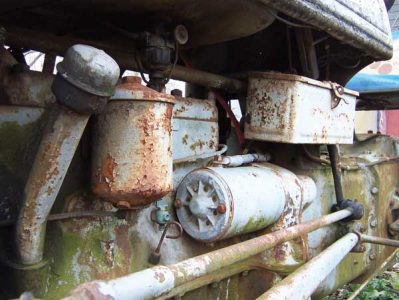
Are there grass or twigs sticking out of the exhaust pipe, carburetor barrels or air filter housing? Is the top of the engine littered with mouse droppings and chewed nut hulls? Chances are good that field mice have been nesting in your engine.
“Check to see if critters have been chewing on any of the wiring,” says Kellar, who has found mud wasp (mud dauber) nests and spiders inside engines, but the worst was a mouse that actually nested inside a cylinder. Don’t ask what that did to the rings.
Is there hope?
Before spending money or time on an old engine, the first question you want to answer is this: Is the engine seized?
If the crankshaft doesn’t turn, no amount of mechanical CPR will restore it to life, easily or economically. You may be facing a total rebuild or even an engine transplant. The best way to find out is to — with the battery and coil wire disconnected — grab the crankshaft belt wheel with both hands and gently try to rock it back and forth. A hand-starting crank also works on older engines, providing you can find the crank handle. If the crankshaft moves even a little, you know there is still hope.
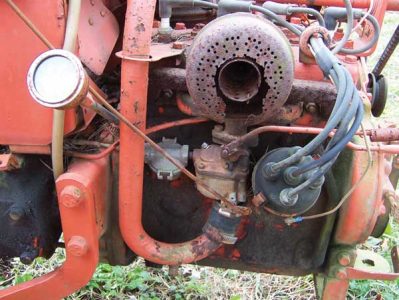
“If it’s really hard to turn the crank, pull the plugs and squirt a little penetrating oil in the cylinders. Mist it in, don’t soak it,” Kellar says. A teaspoonful is more than enough. Some popular brands include Wynn’s, PB Blaster, Seafoam, Deep Creep, Marvel Mystery Oil, Kroil, and everyone’s old standby, WD-40. Transmission fluid even works. Then, let the engine sit, at least overnight, so whatever penetrating oil you use has a chance to work its magic.
But before you go exposing the engine’s internal organs by removing spark plugs, it’s a good idea to remove rust, caked-on grease, mouse droppings, flaking paint and other things you don’t want inside the engine. A wire brush and compressed air work wonders, as do commercial engine degreasers such as Gunk Engine-Brite. Also, carefully use your air compressor to blow chaff, weed seeds, corrosion and dead bugs out of your radiator or clean out the gaps between cooling fins on an air-cooled engine.
Deep cleaning
The next step in reviving a neglected engine is to drain the old oil. “Look for water or coolant in the oil,” says Casey, who super-tuned my 1948 Farmall Cub tractor so it purrs like a contented kitten. “The liquid will come out first. Finding water from condensation is fairly normal after years of weather fluctuations. But coolant in the oil is a clue to look for something more serious, maybe a crack in the block or a blown head gasket.”
Engines that have been stored under a tarp or other cover with poor ventilation and high humidity will have more moisture problems. “An engine that has sat out in the weather with just the hood to keep rain off will actually be in much better shape,” Kellar says.
If the old oil is really awful, you might want to remove the oil pan, scoop out all of the goop, and clean the pickup tube and any screens. Reinstall the oil pan with a new gasket. Don’t forget to change the old oil filter, which can contain up to about a quart of funky old oil. For decades, oil filters, which were introduced in 1923, consisted of a bolt-on housing containing a drop-in filter element. Drain and clean the filter housing the same as you would the oil pan. You don’t have that extra fuss with screw-on filters, which became popular about 1954.
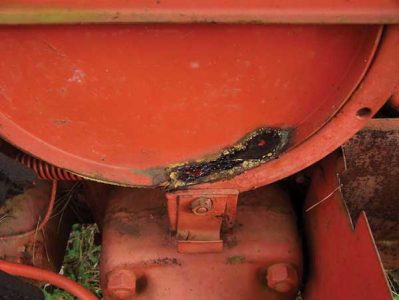
Really old gasoline is another clear and present danger to your engine. Besides water, it can be full of gum, varnish and scales that can break off and clog up the works, just like dangerous blood clots circulating through the human body. It will look, smell and act more like used paint thinner than high-powered motor fuel. To clean rust and scale out of a fuel tank, Casey puts a solution of dishwashing liquid (he likes Dawn) and ball bearings, then shakes the tank like crazy. He patches fuel tank leaks with products such as PC-7 epoxy and J-B Weld.
Drain the fuel tank, carburetor and fuel lines. Clean the sediment bowl and replace the fuel filter. Refill the system with fresh gasoline treated with a fuel stabilizer such as STA-BIL. The stabilizer is especially important now that our gasoline is “gasohol” with 10-percent ethanol. “Ethanol is a real killer. Alcohol sucks in moisture, which breeds corrosion,” Kellar says. Besides soaking up water like a sponge, ethanol breaks down quickly, corrodes and gums up engine parts.
Priming the pump
With new oil in the pan and fresh fuel in the tank, it may seem like you’re good to go, but don’t turn the key just yet. Your rehabilitated engine is still not protected by a drop of that new oil.
So how do you thoroughly lubricate every part of the engine without causing unnecessary damage?
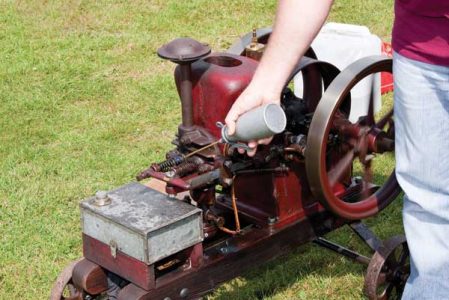
“Disconnect the coil wire, so the engine won’t light off at 600 rpm and chew everything to pieces,” Kellar says. “You want to prime the oil system. Crank the engine for 20 to 30 seconds until the oil pressure gauge moves to circulate oil through the engine.”
An alternate method is to remove the distributor and manually prime the oil pump. You can use an electric drill chucked with an old distributor shaft or a special oil pump-priming shaft that is available at most automotive stores. Just be sure to mark the position of the housing and rotor before you pull the distributor. Double-check with your shop manual and be sure to spin the shaft in the correct direction, cautions Casey. Spin the shaft until oil is circulating freely and you have normal oil pressure. Replacing the distributor may require some jiggling, since the oil pump tang has moved.
Once you have the engine fully lubricated, install a new battery, connect the coil and plug wire, pull the choke, and turn the key. It may take a few tries, but your old engine will soon roar to new life.
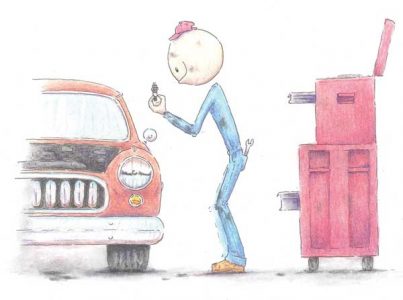
And that’s when the fun really begins, with an endless list of possibilities that includes pressure and compression testing, super tune-ups, searching for original parts, and figuring out if you want to go further and completely restore — or just enjoy — your newly reborn engine.
Read more: For more information on restoring old engines check out Farm Collector, a monthly magazine focusing on antique tractors and all kinds of antique farm equipment.
In his spare time, Pennsylvania farmer George DeVault works to revive two tractors, a 1947 Ford 2N and a 1948 Allis-Chalmers G.