On a cold windswept day, I visited Göttweig Abbey with fellow Viking River Cruises passengers as part of the Danube Christmas Market Cruise. Founded in Austria as a monastery and dedicated in 1072 AD, its presence atop a hill overlooking the river was a dramatic scene as the tour bus approached.
We gathered with our guide, and he began his narrative as soon as we exited the bus. Named a UNESCO World Heritage Site in 2001, Göttweig became a famous seat of learning with strict monastic observances almost immediately. A school, library, and nunnery were established. The nunnery continued until 1557.
As we walked our guide — a young man with excellent English and an enthusiastic way of communicating the abbey’s storied past — explained that today 42 monks live and work here as well as in nearby parishes. He told us that during the 15th and 16th centuries the abbey declined, and that in 1564 not a single monk was left. Michael Herrlich was appointed abbot and restored the monastery spiritually and financially; he rebuilt it after it had been almost entirely destroyed by fire in 1580. In 1718, the monastery again fell victim to fire and was rebuilt on an even grander scale.
The abbey is certainly a survivor.
The wind whipped around us as we stood in the center of a grand courtyard surrounded by buildings modestly yet beautifully decorated with carvings and other architectural accents as we learned more about the abbey’s history.
We were invited into the abbey’s amazing chapel before being led into the Imperial Wing. Its center point is a grand fresco decorating the staircase that is considered a masterpiece of Baroque architecture in Austria. Executed by Paul Troger in 1739, it represents the Roman Empire.
We climbed the staircase for a closer look at the fresco, as well as to tour four imperial apartments decorated with paintings by artists Martin Johann Schmidt and Andreas Altomonte.
Our guide explained that during World War II, the Germans did not harm the abbey’s interior but stole many of its valuable artworks. When the Russians stayed here, however, they destroyed much of the interior by using whatever they could find to build fires inside the buildings, causing great damage to the floors. Fortunately, many of the art pieces have been returned to the abbey, and the interior fully restored.
The abbey has a library of 130,000 books and manuscripts and a particularly important collection of religious engravings, besides valuable collections of coins, antiquities, musical manuscripts, and natural history, all of which survived World War II.
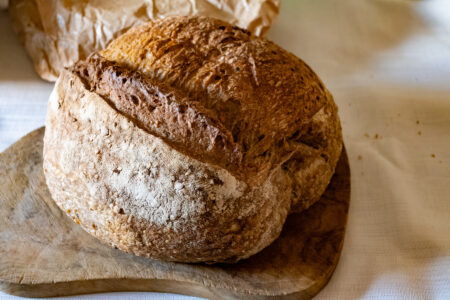
Here our tour ended, and we were invited to enjoy the Christmas Market setup inside public rooms near the official gift shop. Local crafts and baked goods were for sale in the labyrinth of rooms. Friendly men and women chatted about their wares, making the experience even more festive.
The abbey, the guide, the Christmas market — it was another fantastic day with Viking River Cruises exploring the history and beauty of Austria.