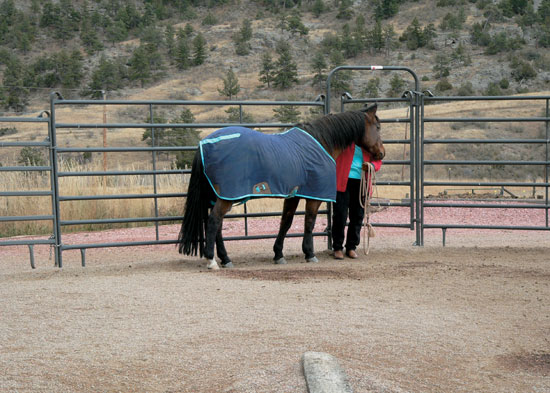
Every horse should receive a basic education that prepares him to live safely and confidently in the company of humans, and it begins with easing common equine fears. In What Every Horse Should Know (Storey Publishing, 2011), horsewoman Cherry Hill explains the finer points of horse training, including how to help a horse overcome wariness of human touch and restraint. Hill covers every detail from their blind spots and how to catch a horse to lateral work and ranch work. The following excerpt is from chapter 1, “No Fear of People.”
Fear of Someone in Blind Spots
Horses are acutely aware of their surroundings, and because of the location of their eyes and their wide range of vision, they are able to pick up the subtle movements of things all around them. They do have blind spots, however — areas where they can’t see what’s going on — and that can make them nervous. It’s similar to when you are driving your car or truck: sometimes you can’t quite see the vehicle (or even if there is a vehicle) in that spot between your rearview mirror and your sideview mirror. In some situations, you might be tempted to turn quickly and look at that spot or slow down so that if there is a vehicle, it will pass you.
In a similar way, a horse is uneasy if he senses something to his side or rear that he can’t see. He is more comfortable if he can see a thing clearly and head on. If there is a perceived threat off to the side or the rear of a horse, he will most likely try to turn and face it.
You’ve been taught from day one that when you are behind a horse or approaching him from the rear, you should let him know of your presence by putting your hand on his hindquarters. Well, this needs to be expanded to allow you to be able to touch your horse when he is in any position, any time, anywhere. As always, these suggestions need to be implemented with common sense for safety’s sake.
A horse needs to be comfortable with you:
• Next to his head on the near side.
• Next to his head on the off side.
• At his girth on the near side.
• At his girth on the off side.
• In front of his head.
• At his hindquarters on the near side.
• At his hindquarters on the off side.
• Behind him.
• Standing above him in all positions.
• Squatting below him in all positions.
• Farther away, doing all of the above.
• Mounting, and moving around on his back while mounted.
Eventually, a horse needs to be comfortable with all sizes and shapes of humans: very tall or short; toddlers and infants in arms; elderly or injured people walking oddly or with crutches, walkers, or wheelchairs; kids running and leaping.
How to Catch a Horse
Your training relationship with your horse really takes on a formal tone when you go to catch him, so it is a perfect time to start things out on the right foot. In an ideal situation, a trained horse should know that when you stand at his gate with a halter in hand, you want him. He should respond by coming to you, with or without a signal or cue. But it would also be satisfactory if he just turned and faced you when you entered his stall, pen, or pasture, and stood still while you approached him. It would be unacceptable if a horse turned or moved away from you when you went to catch him.
Here is where you might be thinking, “My horse avoids being caught. How do I change that?” The best way to develop and maintain a horse’s good attitude about coming when called, or at least facing and standing when you approach, is to have a pleasant attitude yourself and to do something pleasurable to him when you first catch him. It can be a simple rub on the forehead, brushing flies off his chest, giving him a scratch where you know he likes it, making a certain sound, or even using a treat the proper way. All of these reward a horse for being caught and make him look forward to being caught in the future.
If you want to teach a horse to fear or dislike being caught, give him a slap on the neck when he finally does let you approach, halter him roughly, give a jerk on the lead rope when you finally get him haltered, and generally be in an ill temper yourself. That should do the trick!
As with so many other interactions with your horse, during the catching and haltering procedure, he is learning, so take your time as you catch him and develop a good association. When I’m with a horse who has learned to dislike catching and haltering, I might carry a halter and lead rope with me, approach him, give him a rub, but not halter him; instead, I just walk away. Or I might catch, halter, rub, remove halter, turn loose, and walk away. Or I might just hang out with the horse for a bit with no agenda.
Excerpted from What Every Horse Should Know: Respect, Patience, and Partnership, No Fear of People or Things, No Fear of Restricting or Restraint by © Cherry Hill, photography by © Richard Klimesh and Cherry Hill, used with permission from Storey Publishing, 2011.