How much does a calf weigh at birth? Learn about raising a bottle calf after saving it from winter weather and heifers abandoning them.
Over the years, our kitchen has doubled as an intensive care unit for many calves. Some needed warming in subzero weather or emergency treatment during acute illness, while others (premature babies too fragile to be outdoors) spent weeks in the house. Some became family pets. Here are the stories of two special babies.
Saving Bandit Eyes from Winter Weather
The first calf arrived on a cold December night in 1969. Our son Michael, a year old, watched from his playpen, fascinated by the creature his daddy carried.
The mother was our smallest Angus heifer, Annie. The birth wasn’t planned. Our Hereford bull, Big John, had jumped a fence nine months earlier and bred Annie and a Holstein heifer. Annie was very small and young; we’d never have put her with a bull that soon.
Annie calved on a frigid night. At that time, our only livestock shelter was an old falling-down milk barn. A strong wind blew through cracks between the old logs.
When my husband, Lynn, and I checked Annie at 2 a.m., she was still in early labor. By 4 a.m., she’d calved unassisted, but instead of licking her new baby, she bunted it around and shoved it into a drafty corner. The little heifer’s ears and tail were frozen, and the inside of her mouth was cold.
There wasn’t time to argue with Annie about motherhood; my husband carried the calf to the house.
We gave the calf a warm shower to thaw her out, since we didn’t have a bathtub, and young Michael thought it hilarious that we were showering a calf! We toweled her dry by the woodstove, but her ear tips and the end of her tail were so badly frozen that even warmth and massage couldn’t restore circulation; she eventually lost them.
I thawed some frozen colostrum that we’d saved when our milk cow calved earlier that year, poured it into a pop bottle, and then tried to feed the calf with a lamb nipple. But Bandit Eyes (so named because of the black spot over each eye) was too weak and cold to suck. This was before we learned how to use a nasogastric stomach tube. Finally, we injected some dextrose under the loose hide over her shoulder, where she could absorb it rapidly into her bloodstream. This gave her energy, and within 20 minutes, she was trying to stand up. After that, she nursed from my bottle. It was several hours, however, before she stopped shivering. She spent the rest of the morning on towels in front of the stove.

By midday, warm and dry, she seemed strong enough to go outside. When we carried the calf back to the barn, Annie aggressively started butting her. Lynn haltered and tied up the snorty young cow, and we tried to guide the calf to the udder. If we could get the calf to suckle, it might stimulate maternal hormones and help Annie accept her baby. But she fought and kicked at us and the calf. We decided it would be safer and easier to raise Bandit Eyes on the young Holstein heifer, which was due to calve soon – the other heifer bred when Big John jumped the fence. She’d have plenty of milk for two babies.
We brought Bandit Eyes to our bathroom, since we didn’t want her making messes all over the house. She slept on an old rug, and we fed her a bottle every six hours. By evening, she jumped up to greet whoever came to feed her, prowling around the bathroom afterward for something else to suck on.
When she wandered out of the bathroom and into the kitchen, butting cupboards and bumping into the table and chairs (much to Michael’s delight), we barricaded the door with chairs. The bathroom door in our old log house didn’t shut properly and had no latch. We hoped the calf wouldn’t get out during the night!
The next morning, we considered taking her to the barn to live with our milk cow’s calf until the young Holstein calved, but the weather was still frigid, so Bandit Eyes stayed in the house a little longer. Young Michael enjoyed petting her like a big dog.

As the day progressed, Bandit Eyes became livelier, bucking around and crashing into everything. A bunting, slobbering calf immediately attacked anyone going into the bathroom. In self-defense, I started taking her bottle with me whenever I had to go in, to let her suck and bunt the empty nipple instead of me. This calf needed a binky! When Lynn tried to shave, she sucked on his pant legs, and he nicked himself with the razor each time she jostled him. That was the last straw. She had to go outside.
During her last night in the house, she banged around in the bathroom, and we feared she might get through the barricade. We didn’t dare look, since the sight of anyone made her more energetic. When we went to the kitchen that morning, she saw us and crawled through the stack of chairs.
That day, the weather warmed up, and our young Holstein calved. It was the perfect time to move Bandit Eyes out to the barn. The Holstein heifer – named Seven because of the white patch on her face that looked like a seven – was motherly. We smeared birth fluid on Bandit Eyes, and Seven licked both calves. We supervised to ensure her own calf could get up and suckle enough colostrum before we guided Bandit Eyes to the udder.
With Bandit Eyes situated with her new mother and brother, I began cleanup in the bathroom, thankful we’d saved her from freezing to death. The animals we raise are more than just dollars to pay the bills. They’re individuals, each precious for its own sake.
Bandit Eyes eventually had calves of her own. She looked funny with her short ears and stubby tail and was also a little spoiled as a pet. But she was special – the first of many calves that lived for a while in our house.

Rudolph the Bottle Baby
The first “preemie” to spend time in our house was born five weeks early.
In early December 1976, a snowstorm prompted us to bring the cows down from the mountain the next day. Our cows grazed on a mountain pasture until late November or early December, when we’d bring them down to the hayfield until they got closer to calving. About Christmastime, we’d put them in closer fields near the “maternity ward” pens and barns. This specific year, Lynn drove our Jeep up to call the cows. They came when called, knowing they’d be fed. I rode my horse up another canyon to gather the cows that couldn’t hear him and found a small group clustered in the far corner. A big coyote watched them. I rode closer and saw a tiny calf, his mother standing guard over him.
How Much Does a Calf Weigh at Birth?
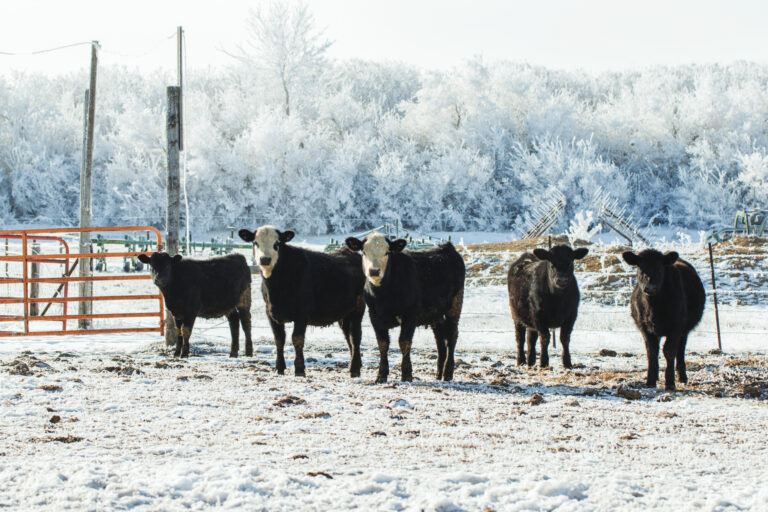
She’d calved too early; the calf weighed about 20 pounds, only one-fourth the size he should’ve been, and his hair was like velvet. He was lucky to be alive in weather at only 6 degrees F.
I thought about putting the calf on my saddle and carrying him over the hill to the Jeep, but I rode a young, skittish gelding, and I wasn’t sure he’d tolerate it. Instead, I chased the coyote away, then galloped over the mountain to find Lynn. He drove the Jeep over the mountain and up the canyon until it got too steep and rocky. He hiked the rest of the way through the snow. Lynn carried the calf down to the Jeep, with mama at his heels, and I herded the other cows along behind them. The calf rode on the Jeep seat the rest of the way home.
The baby was too frail to live with his mama in the barn; he already showed signs of pneumonia. When we got the cattle home, we brought the little fellow into the house to warm up and gave him antibiotics. When our two young children, Michael and Andrea, came home from school, they named the calf Rudolph because of his red, frostbitten nose.
We kept Rudolph in the kitchen in Andrea’s old baby crib. The calf was so small that he couldn’t jump out. Andrea fed him a bottle of colostrum. For several days, we fed and treated him with medication every few hours. He struggled to suck his bottle because he used all his energy just fighting to breathe.
By Christmastime, he’d won his battle against pneumonia. Michael and Andrea were happy to be home for Christmas vacation and help take care of Rudolph. The calf tried to jump around in the small crib, but there wasn’t much room, so we let him out for a few minutes to play and buck. He enjoyed that so much that we started letting him out for a few minutes every day.
The living room was a perfect place for his frolics, as the rug gave his little hooves much better traction than the slippery kitchen floor. We usually let him out of the crib in the evenings, when we were done with chores and the whole family could watch. We kept a jar handy, in case Rudolph needed to take a leak.

Lynn would lift Rudolph out of the crib and carry him into the living room, and the calf’s little legs churned in anticipation. As soon as his feet touched the carpet, he bucked and charged around the room. It took all four of us to guard the things we didn’t want him to crash into, such as the record player and the Christmas tree. One of us kept him away from the hot woodstove, and Andrea would head him off if he dashed for the dining room. If we couldn’t catch him in time, he careened out on the linoleum floor, like little Bambi on the ice pond: sliding out of control or doing the splits with his hind legs.
Rudolph galloped up onto the couch a few times. He also attacked anyone who tried to play games with him, knocking heads with Andrea and Michael, showing us how tough he was. We’d laugh so hard we practically rolled on the floor with him. The Christmas tree fascinated him, and if we didn’t guard it closely, he’d try to eat the branches or knock off the ornaments. Sometimes we had to limit his playtime so he wouldn’t get too tired and out of breath.
After three weeks, he outgrew the crib and tried to climb out. He still wasn’t full-term in size or time, but he was closing the gap. In early January, Michael and Andrea helped us create a warm corner for Rudolph out in the barn. He had a lot more room to run and play in his new room. Andrea still fed him a bottle several times a day, except when she was at school, when we’d feed him.
When the weather got warmer, we made a pen for Rudolph outside. He grew large and strong, and soon the kids had to be careful playing games with him. Playfully butting heads with a 20-pound calf had been fun, but at 500 pounds, that was something else.
Though he started as the smallest calf, he was one of the larger steers in our herd that fall. It was difficult for the kids when it came time to sell him. We wondered if he remembered his early weeks as a house calf, chasing us around while he played king of the living room. Maybe. But no way would he ever fit into that crib again.
Heather Smith Thomas ranches with her husband near Salmon, Idaho, raising cattle and a few horses. She has a bachelor’s degree in English and history. She has raised and trained horses since 1959 and has been writing freelance articles and books nearly that long, publishing 25 books and more than 14,000 articles for horse and livestock publications.
Originally published in the November/December 2026 issue of Grit magazine and regularly vetted for accuracy.