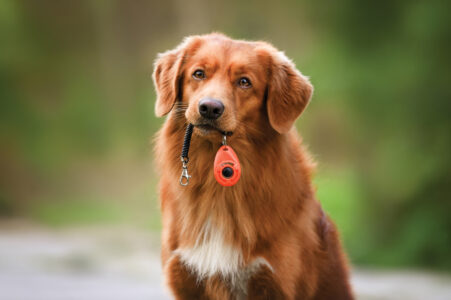
Learn how positive reinforcement and clicker training basics can be on-the-job training for your favorite furry friends.
About 15 years ago, I was introduced to clicker training by a co-worker at an animal shelter who was studying to become an accredited professional dog trainer. The staff learned how we could use this method to positively enrich the lives of the animals within the shelter. I was astonished to see how, within a short time, the chaotic morning breakfast for adult shelter dogs became a training opportunity that resulted in almost every one of them sitting patiently before receiving their bowl – a beneficial behavioral difference that could help attract potential adopters. While working in the cat room, I adapted the methods to teach kittens and adult cats alike how to perform requests to sit, high-five, relax in place, and spin in a way that did no harm to the animals.
Eight years later, my husband and I were faced with an abandoned chick that required human intervention and socialization to grow and thrive within our small flock. As she got older, I sought ways to enrich her days and form a closer bond. I recalled learning about Sophia Yin, a veterinarian and animal behaviorist who produced many educational resources about working with animals of all types, including a video about clicker training chickens. I’d long been under the impression only dogs could be trained, but after many successful sessions with felines, and helpful input from Yin’s videos and website (see “Clicker-Training Resources,”), I decided to try training my hen. This eventually inspired me to work with all the poultry and livestock my husband and I raise at Wolf Branch Homestead.
Clicker Training Basics with Positive Reinforcement
Clicker training an animal typically involves using a small handheld tool called a “clicker” that makes a loud clicking sound when a button is pressed. This creates a sound marker. In this positive-reinforcement training system, you’re working to have an animal perform a certain task by using a reward-based method that doesn’t harm them. Clicker training notes the correct action to let the animal know they did something right, and then rewards them for it. Some people instead note the correct action with a different verbal cue, such as saying the word “good” or by making a simple clucking sound with their tongues.
The word “trick” is sometimes associated with a negative or violent training approach with animals, so in this article, I use the more positive word “skill.” The skills your animals learn can serve many purposes, such as calling them back to their pen, or simply building a relationship with them. A well-socialized animal that knows a helpful skill or two may even attract the attention of prospective new owners when you’re looking to re-home the animal. Poultry and livestock are capable of learning different actions with the right approach and a dedicated handler.
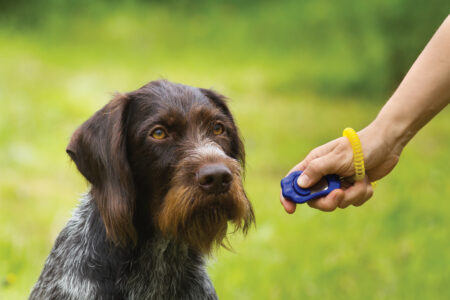
Clicker Training Without Treats
Because clicker training is a reward-based method, the animal associates the sound of the clicker with the reward being given. You begin by teaching the animal to associate the sound of the click with an immediate treat, meaning a click equals a reward. Hand-feeding treats may sometimes lead an animal to seek food from people who aren’t their trainers – for example, a clicker-trained horse may reach out to hands in search of a snack – so handlers may choose to use a tool to deliver the reward, or they may use a gentle pet instead. Many trainers reward from the hand without any problem. Understanding your animal and its body language is critical. What are its favorite healthy treats? Learn to recognize the signs of discomfort and agitation so you and your animal will remain safe during training.
Learning the Ropes
First, you’ll need to practice with the animal over multiple sessions of a clicker sound followed by a treat – no skill involved. Then, you’ll move on to working on a skill, so the animal associates the clicker sound with a request to complete a task.
Decide whether you want to use verbal cues or visual cues with your animal. If verbal cues, avoid using words for separate tasks that sound the same; for instance, “spin” and “in” may confuse the animal. The same applies to visual cues. If the animal associates a pointed finger with stepping back, it may be confused if you point your finger to direct it to move to a certain place. You can try using distinct whistles for certain tasks as well.
Timing is key. When the animal delivers the correct action, reward it immediately to let it know it has successfully completed the desired task. If the animal doesn’t perform the correct action, don’t reward it at all because this can cause it to associate the wrong action with reward. Don’t treat the animal negatively if it performs the wrong action. Instead, continue to repeat the task until the right action is achieved. This will require dedication and patience on your part as you practice frequently with your animal, but it’s quite satisfying when you’ve successfully taught your animal its first skill.
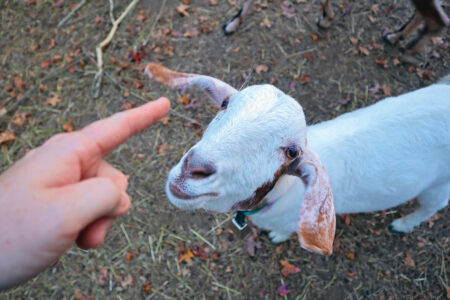
Both young and adult animals are trainable. Younger, hand-raised animals will catch on quickly, but an adult animal that’s comfortable with you as its caretaker can also learn skills under your patient tutelage. You can work with a bottle-fed kid by using the last portion of its bottle as the reward, while an adult goat is capable of learning with a solid food treat. We’ve had the privilege of working with animals in different age ranges in this exact scenario, teaching a bottle goat to spin at 1 month of age. He practiced and retained what he learned, and he will now give the same response as an adult for a solid reward. His mother came to our farm at nearly a year old, and she caught on just as quickly when learning the skill of “back” to prevent crowding at feeding time.
A useful example of clicker training poultry is to recall your free-range chickens to their coop with a special sharp whistle followed by a reward of mealworms or black soldier fly larvae when the flock reaches its destination. If you’d like your duck friends to learn something for fun, teach them to ring a bell and reward them with a vegetable snack after they’ve made the sound. You can apply clicker training to asking your horse to back up for a variety of helpful scenarios. My personal goal is to one day clicker train a working steer to haul small logs for firewood out of tricky paths in the woods. (Some people debate the effectiveness of clicker training oxen, though.)
A lack of time may prevent large-scale farm operators from clicker training animals. We find it most helpful when you have a simple homestead, backyard flock, or small breeding program. Creating relationships with your animals can assist you with practical purposes or simply produce fun experiences. Socializing and handling your animal may help lead to a well-mannered partner in the long run, making possible such daily tasks as leading a milk goat to her station or calling your ducks in before a bad storm. Equip yourself with a clicker and your animal’s favorite treats, learn more about this positive training method, and think about all the ways you can benefit yourself and your animals through clicker training!
Click Training Resources
Before you attempt clicker training, it’s important to understand positive reinforcement and reward-based training. The following resources will help you learn how to properly use a clicker tool.
- Cattle Dog Publishing Sophia Yin’s website; also check out the YouTube channel @CattleDogPublishing.
- Find clickers in the online store. Clicker Training
- Humane Society
Fala Burnette is an Alabama homesteader who’s working with her husband to build a cabin by hand. She enjoys creating and selling art made from scrap lumber and other recycled materials. Together, the couple practices clicker training on a variety of animals on their property.