Pick up fishing for bass tips to boost your catch while learning the best bass river fishing spots, and the best bass lures of all time that you need to catch bass.
Mason Creek isn’t a particularly remarkable stream as it flows through the backyards of suburbs in Salem and Roanoke, Virginia, before merging with the Roanoke River. But this little creek is where I caught my first smallmouth bass and is also the waterway that created and nurtured my lifelong love of bass, moving water, and nature itself.
As a grade schooler, I constantly risked the wrath of my parents by sneaking away and biking the mile from our house to Mason Creek. My parents believed that nothing good could ever come from those rapscallions who wasted their time wetting a line. It was better, they lectured me, to spend time preparing for the workaday world by doing my schoolwork instead of risking being bitten by snakes, stung by bees, and developing poison ivy while at that godforsaken creek. After all, my grades weren’t satisfactory, and I’d never make any money fishing.

But their warnings had the opposite effect. If a place flaunted all kinds of dangerous creatures, as well as bass, then it must be a paradise worth exploring. And so I did, quickly learning how to catch sunfish and chubs, but struggling to convince those mysterious brown bass to hit my worms dangling beneath a bobber.
One day, Rick, older by two years and incomparably wiser, showed me a miraculous lure: an in-line spinner. He patiently lectured that it was a “bass slayer” if one kept the blades revolving at a steady pace. Armed with this forbidden knowledge, one wondrous day, I convinced a 9-inch smallmouth to slam the spinner, and so my moving-water bass career began. Here’s how you, too, can relish this experience.
Bass Around the U.S.
There are nine black bass species in the U.S.: Alabama, Florida, Guadalupe, largemouth, redeye, shoal, smallmouth, spotted, and Suwannee; though some fishers say there are up to 14. Indeed, every state in the United States, except Alaska, harbors one or more black bass species, and many states host multiple species in their upland rivers, tidal waterways, creeks, and small streams. Your home state fishery department’s website can supply information on those places, as can local tackle shops, fishing clubs, and fly fishing organizations.
The Experience

Britt Stoudenmire, who operates the New River Outdoor Company in Pearisburg, Virginia, explains the appeal of river bassing.
“When I first started fishing rivers, I spent a lot of time looking downward and trying to figure out where the bass were holding,” he says. “That’s still important, of course, but now I also spend a lot of time looking up and around me, just enjoying the experience of being on moving water.
“Every day of every season is different. In fall, the reds, browns, and oranges decorate the landscape, and the hawks are migrating. In the spring, the mountains and forests go through all these shades of green as the trees leaf out; plus, new songbirds are migrating back every day. In the summer, the landscape seems to be just bursting with life. And every day, in every season, the river is constantly moving, and something new is just around the bend.”
Fishing for Bass Tips: Basic Gear
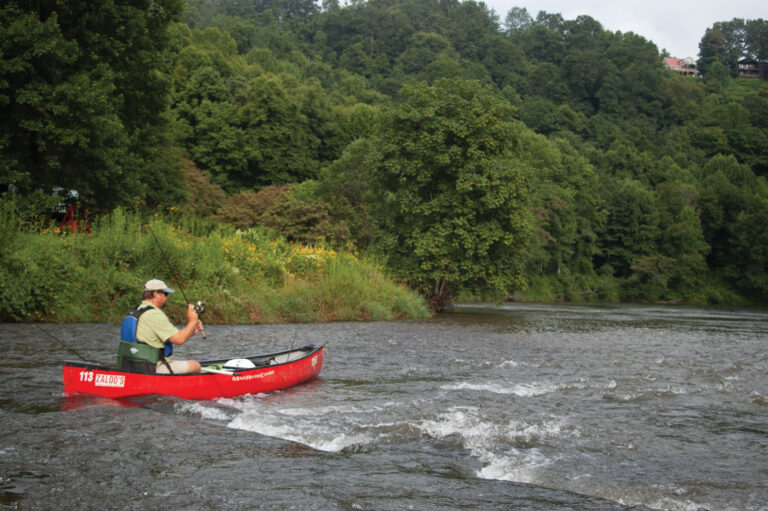
Just about every pastime requires gear of some sort, and river bassing is no different. Stoudenmire says someone who enjoys river fishing from a canoe or kayak will appreciate having two different spinning rods and reels that can handle different lures and situations.
For example, a 6-1/2-foot medium-action spinning rod has a certain amount of flex in it, which is ideal for working surface baits and crankbaits. And a 6-1/2-foot medium-heavy-action spinning rod offers more strength, which is needed to set the hook through soft plastic baits, especially. Numerous line options exist, but a good starting point is to spool 8- or 10-pound test monofilament on both of these spinning rod and reel outfits.
Later in folks’ river angling careers, continues Stoudenmire, they may want to add a 6-1/2 foot medium-heavy baitcasting rod, spooled with 12-pound test line, to their arsenal. This outfit is a superb choice for working tubes, swim baits, and plastic worms across the substrate and muscling the fish out of deep water. Eventually, some anglers graduate to a fly rod to toss topwater flies, such as poppers or damselfly and dragonfly imitations, to surface-cruising bass.
Fishing for Bass Tips: Best Bass Lures of All Time
Anglers often hotly debate their lure choices, whether they ply lakes, rivers, or streams. “River rats,” as they sometimes call themselves, are no different, but Stoudenmire maintains that a few basic categories of baits will suffice.
Crankbaits are among the easiest lures to master, as they can simply be reeled in with the angler occasionally speeding up, slowing down, or imparting seductive little jerks in the retrieve (reeling in the line) to cause a reflex strike. Popular crankbaits include the Cordell Big O, the Bomber Model 2A, and the Bandit 200.
Many river enthusiasts claim that convincing a bass to strike on the surface is the biggest thrill in this avocation. Stoudenmire agrees, as a big smallmouth “blowing up” on a topwater artificial bait is always a thrill. Perhaps the most exciting surface lure to deploy, he says, is a 1/4-ounce buzzbait, which is retrieved rapidly across the surface. Anglers often speculate whether a buzzer imitates a duck whirling across the surface prior to takeoff, a minnow fleeing from a predator, or a small fish being chased by a bass.
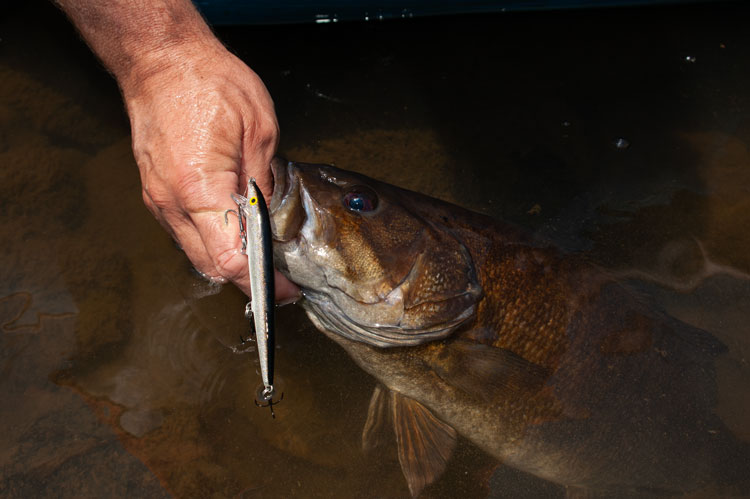
The reality, though, is that a buzzbait is nothing more than a chunk of metal with a line eye and a churning blade on its front, and a hook and a few strands of rubber on its rear. A buzzbait looks like nothing else, and no creature exists that moves like one, either. Bass don’t seem to care, however, as they maul this lure out of reflex.
Other topwater baits are propeller-adorned baits, such as the Heddon Tiny Torpedo and Phillips Crippled Killer; poppers, such as the Rebel Pop-R and River2Sea Whopper Plopper; and baitfish imitations, such as the Rapala Original Floating Minnow and Rapala Shad Rap.
Soft plastics are a third category. Stoudenmire relates that 4-inch tubes, which imitate crayfish as they’re hopped across the bottom, are often considered “big bass baits.” Curly tail worms are effective deep-water soft plastic choices, as are lizards and ringworms. These lures can be rigged with size 2/0 or 3/0 offset hooks with a 1/8- or 1/4-ounce sliding bullet sinker. The hook is buried in the bait (which is called the Texas Rig) to make it weedless and less prone to snags.

Stoudenmire’s final soft plastic choice is the easiest for beginners to master: a 3-inch curly tail grub impaled on a 1/4-ounce jighead. Merely retrieve this lure at a moderate pace under the surface, and bass will slam it.
If you want to give fly fishing a try, arm yourself with Sneaky Pete Poppers, Clouser Minnows, and a few crayfish imitations, and you should do just fine.
Where to Fish: Bass River Fishing Spots
Stoudenmire emphasizes that certain areas of a river or stream stand out as bassing hot spots.
“Rocks or wood that form current breaks are often superb places to fish,” he says. “So are eddies – places where the current sort of reverses itself. Outside bends with rock, wood, or aquatic vegetation along the shoreline often hold bass, as do rocky pools with drop-offs. Basically, moving-water bass relate to cover or structure that gives them the opportunity to ambush minnows, crayfish, and other creatures.”
Fishing for Bass Tips: Safety Precautions
Stoudenmire maintains that two of the most important things to do are check the weather forecast and water levels. Heavy rains can ruin even the most promising trips, and launching a boat or going wade fishing when water levels are too high is unwise. The guide suggests anglers check the U.S. Geological Survey’s Current Water Data for the state they’re fishing in. Then, note what the water level gauges register and whether that level is within the norm for that particular section of a river. Anglers should also contact local canoe and kayak liveries and tackle shops to gain additional insight on safe paddling conditions.

Obviously, float and wade fishermen should always wear personal floatation devices (PFDs). I believe so strongly in this safety precaution that I won’t allow people in my canoe unless they wear a PFD. Once, while a friend and I were floating the New River, we encountered two elderly anglers who were both drinking and not wearing PFDs. I warned the gentlemen that a Class III rapid was approaching and that the drop was quite severe. The duo replied with some expletives. The next day, in the local newspaper, I read that two elderly, intoxicated anglers – without life jackets – had drowned while running that rapid.
And while on the subject of rapids, beginning float fishermen should avoid trips with Class III and above drops. The rapids rating system states that Class I rapids are generally safe to run, as they contain small waves, few riffles, and inconsequential obstructions. Class II rapids can host rocks, drops in the stream bottom, and larger waves. If you have doubts about running a certain rapid, debark from your craft and portage around the rapid, either by going ashore or by walking your boat through the area.
Take a Kid Fishing
Stoudenmire enthuses that some of his most wonderful days on the water involve taking his 10-year-old daughter, Sadie, or the youngsters of clients, float fishing.
“I love going fishing with Sadie and, really, with any kid,” he says. “Sadie squeals with joy when we go through a rapid, and she gets so excited when she catches a fish of any size. It’s important to understand when you’re fishing with youngsters that you’re there to make them happy, not for you to catch fish.
“If Sadie or another child wants to stop fishing and go wading in the water or skip rocks, then that’s what we do. I also recommend that you keep fishing trips short; four hours is about right. Also, bring plenty of snacks and sunscreen. A picnic-type lunch along the shore or an island is another good idea.”
My parents were right about a lot of things; my skipping school “a time or two” to go fishing definitely didn’t help my grades. But, probably to the shock of my teachers and parents, I grew up to become a high school English teacher and a freelance writer who has written five books on river fishing and hundreds of magazine stories on fishing. And I’m still drawn to bass.
Bruce and Elaine Ingram live in Troutville, Virginia. They’re the authors of Living the Locavore Lifestyle. For more information on this book and others they’ve written, email them at BruceIngramOutdoors@Gmail.com.